

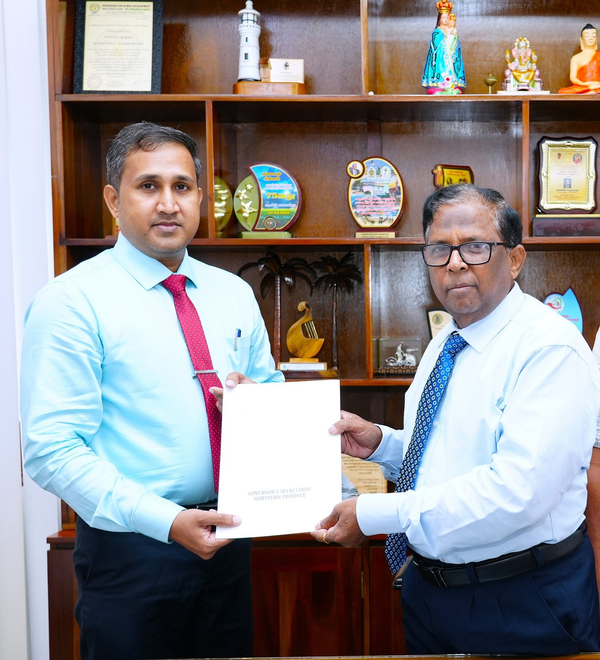
JAFFNA — D.C. Aravintharaj, a senior Sri Lanka Administrative Service officer, was appointed Commissioner of the Jaffna Municipal Council on Tuesday during an official appointment event held at the Governor’s Secretariat here.
Northern Province Governor N. Vethanayahan handed the official letter of appointment to Mr. Aravintharaj during the event, which was also attended by the Governor's Secretary, S. Sathiyaseelan, and other senior officials.
Mr. Aravintharaj entered the Sri Lanka Administrative Service in 2012. He began his administrative career in the elections administration stream, serving successively as Assistant Commissioner of Elections in Vavuniya and then in Mannar.
He subsequently served as Assistant Government Agent for Manthai West in Mannar District.
A product of Jaffna Hindu College, where he was part of the 2005 Advanced Level batch, Mr. Aravintharaj went on to read for a Bachelor of Science in Agriculture Technology and Management at the University of Peradeniya. He later received an Australian Government scholarship to pursue a Master of Science in Organizational Management, a distinction that has marked him as one of the more academically credentialed officers in the Northern Province administrative cadre. He is also known as an avid reader and a regular presence at book launches and literary review gatherings in the region.
The Jaffna Municipal Council is one of the most important local government bodies in the Northern Province. As the principal local authority for Sri Lanka’s fourth-largest city, it is responsible for urban infrastructure, road maintenance, public health and sanitation, waste management, market operations, building regulation, land use, and the delivery of essential municipal services.
Though often described in public discourse as one of Sri Lanka’s wealthier municipal councils outside Colombo because of its tax base, commercial importance, and revenue generated during the month-long Nallur festival season, the council has also frequently faced criticism from residents over inefficiency, delays in public works, poor maintenance, bureaucratic lethargy, weak accountability, indifferent public service, poor responsiveness to complaints, and an entrenched culture of administrative complacency. The council also administers the Jaffna Public Library, one of the most symbolically important public institutions in the Tamil north.
The Municipal Commissioner additionally holds ex officio responsibilities in relation to the Jaffna Cultural Centre — a facility that, despite its importance to the region's cultural life, has in recent years operated well below its intended capacity. Whether the new commissioner will move to revitalise programming and administration at the centre is likely to be an early test of his tenure.
Mr. Aravintharaj’s appointment comes at a time when civic administration in Jaffna faces sustained pressure over infrastructure deficits, inadequate public services, longstanding disputes over land use in the urban core, and growing public concern over alleged political interference and influence by the National People’s Power in local administrative affairs across the Northern Province.
Yet several officials and residents familiar with his previous work said they believed he had both the administrative capacity and temperament to push for long-awaited reforms in a municipal system widely seen as stagnant and resistant to change.