
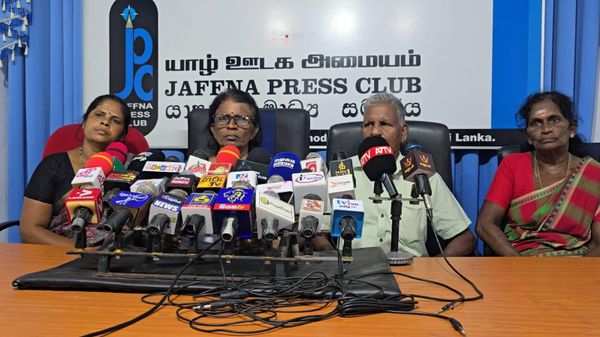
JAFFNA, Sri Lanka — Families of Sri Lankan Tamils who vanished during decades of political violence said they would convene an international conference in Jaffna on Aug. 30, renewing their demand for international accountability and rejecting the government's efforts to address the issue through domestic mechanisms.
The gathering will mark the International Day of the Victims of Enforced Disappearances. Organized by associations of relatives from the Northern and Eastern Provinces, it is expected to draw victims’ families, civil society groups, university students, political representatives, and members of the public, the organizers said at a news conference at the Jaffna Media Centre.
The conference, the organizers said, would press the case for international justice, contending that successive Sri Lankan governments had failed to investigate enforced disappearances credibly despite decades of promises.
Tamil men and women, they said, had been abducted, detained, and disappeared by state security forces and allied paramilitary groups in the country’s north and east, and elsewhere on the island.
“The government has remained silent for decades about what happened to the disappeared and who should be held accountable,” the associations’ representatives said, accusing a succession of administrations of mounting inquiries that produced no meaningful justice.
The families were especially critical of the governing National People’s Power, which they said had recast enforced disappearances as a shared national tragedy afflicting Sinhalese families in the south as much as Tamil families in the north and east.
The issue, they said, could not be settled through compensation, government jobs, or the issuance of death certificates. Their demand was unchanged: to learn what had become of their relatives, and to hold those responsible to account.
They also accused the government of using discoveries such as the mass graves at Chemmani, where investigators have resumed excavations in recent months to identify remains believed to date from the war, to nudge families toward accepting compensation.
More than 400 parents who took part in years of roadside protests have died without learning the fate of their children, the associations said, warning that the campaign was losing its elderly leaders with each passing year. The organizers urged political parties, civil society groups, students, and the public to attend, regardless of political affiliation.
Enforced disappearances remain among the most contentious legacies of Sri Lanka’s ethnic conflict and its southern insurrections. Human rights groups estimate that tens of thousands of people vanished across different periods of violence, including the civil war between government forces and the Liberation Tigers of Tamil Eelam and the two uprisings led by the Janatha Vimukthi Peramuna. Successive governments have appointed commissions of inquiry and created bodies such as the Office on Missing Persons, but many families say those mechanisms have failed to establish the truth or deliver accountability.