

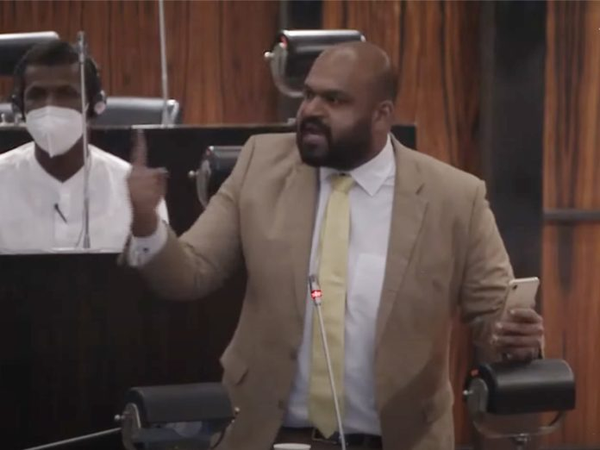
COLOMBO — The minister responsible for Sri Lanka’s mining sector conceded in Parliament that mineral-extraction projects had gone ahead without any environmental assessment, that companies had profited by trading and transferring their licenses, and that the country had no plan to add value to the raw minerals it exports — admissions a Tamil opposition leader said should force the cancellation of every permit issued under those conditions.
The concessions by Sunil Handunnetti, the Minister of Industry and Entrepreneurship Development, whose portfolio includes the Geological Survey and Mines Bureau (GSMB), came in response to sustained questioning from Shanakiyan Rasamanickam, the Batticaloa lawmaker who leads the Ilankai Tamil Arasu Katchi (ITAK) in the House.
The exchange followed a recent conference on mineral resources and gemstone mining that the Ceylon Chamber of Commerce organised in Colombo and that Mr. Handunnetti attended.
Mr. Rasamanickam anchored his argument in the Supreme Court’s ruling in SCFR Application No. 137/2017, which held that the bureau’s treatment of license applicants must conform to the guarantee of equal treatment under Article 12 of the Constitution. The court found the GSMB’s unsolicited, “first-come, first-served” system for granting exploration licences to be unconstitutional, and the permits issued under it remain suspended pending review. Licences, Mr. Rasamanickam noted, had been granted for terms of 15 to 20 years.
Responding on the floor, Mr. Handunnetti acknowledged that no Initial Environmental Examinations (IEE) or Environmental Impact Assessments (EIA) had been carried out for the projects at issue, calling the omission a serious shortcoming. He said a list of the companies involved was available and would be tabled in the House. He confirmed that firms had earned substantial profits by trading and transferring their permits — validating long-standing concerns about how the licences have been used — and agreed that Sri Lanka had no comprehensive policy to add value to its mineral wealth, leaving the country exposed to exporting raw minerals while absorbing the irreversible costs of extraction.
If the government accepted those admissions, Mr. Rasamanickam argued, every mining permit issued without proper environmental approval should be cancelled and put through a fresh, lawful approval process. He called for the entire licensing framework to be reviewed against the court’s ruling, for IEE and EIA procedures to be made mandatory before any extraction is approved, and for a national policy on value addition. Indiscriminate mining, he warned, depletes mineral deposits and groundwater alike — resources that cannot be replenished once exhausted.
The bureau, Mr. Rasamanickam said, was now preparing to issue extraction permits on the basis of mineral surveys conducted earlier across the Northern, Eastern, and Southern Provinces. He singled out the eastern coastal areas of Thirukkovil, in Ampara District, and Vakarai, in Batticaloa District, where he said such activity posed a serious threat. Both lie on a Tamil-majority stretch of coast rich in mineral sands; Vakarai has seen repeated community protests in recent years against ilmenite mining and the acquisition of land.
The lawmaker also levelled a series of allegations specific to Batticaloa. He said that during a presidential visit to the district, complaints had been made that a district engineer collected 50,000 rupees from each permit holder, purportedly to raise funds for diabetes patients. Permits in Batticaloa, he alleged, could not be obtained directly from the GSMB engineer but only through intermediaries or brokers. He added that requests submitted by the Valaichenai and Aaraiyampathy Pradeshiya Sabhas remained pending while similar applications from private companies had already been approved.
He urged the government not to post to Batticaloa a GSMB official previously rejected by the Hambantota District Coordinating Committee, and to appoint an impartial engineer instead.
Citing the minister’s own remarks, Mr. Rasamanickam said Mr. Handunnetti had described all 25 engineers attached to the bureau as touched by corruption. Transferring engineers between districts, the MP argued, would merely relocate the problem; what was required was structural and institutional reform of the GSMB itself.
In reply, Mr. Handunnetti said he agreed with the concerns raised. He told the House that all permits issued to date were under review by a special committee and that action would follow its recommendations.
The GSMB, which regulates mining under the Mines and Minerals Act of 1992, was moved from the Ministry of Environment to the industries portfolio — a shift welcomed by mining investors and criticised by conservationists who saw the bureau’s environmental brief diluted. Over roughly three decades it has issued hundreds of exploration licences — 471 by one recent tally — without a single one resulting in a working mine, according to environmental campaigners who have opposed the sector’s expansion along the eastern and southern coasts.
Concluding, Mr. Rasamanickam pressed the government to cancel all permits issued without environmental scrutiny, overhaul the licensing framework in line with the Supreme Court judgment, make IEE and EIA assessments mandatory, adopt a national value-addition policy, and reform the bureau to restore public confidence.