BATTICALOA, Sri Lanka — The Criminal Investigation Department told a magistrate’s court in eastern Sri Lanka on Monday that Sivanesathurai Chandrakanthan, the former Eastern Province chief minister widely known as Pillayan, is one of three suspects in a string of shootings that left five people dead in Batticaloa District in 2008.
According to details presented before Batticaloa Magistrate Annathurai Darshini, investigators are examining a series of fatal shootings carried out in 2008, several of them allegedly involving T-56 assault rifles. The killings span multiple locations across the district: two people, one of them a former police officer, were shot near Kallady on Jan. 9, 2008; two more were killed on the main road in Kattankudy on May 22; and a fifth man, identified as Alagathurai Dharmalingam of the Vavunatheevu area, was shot dead by an armed group at Koththiyapulai on Aug. 20.
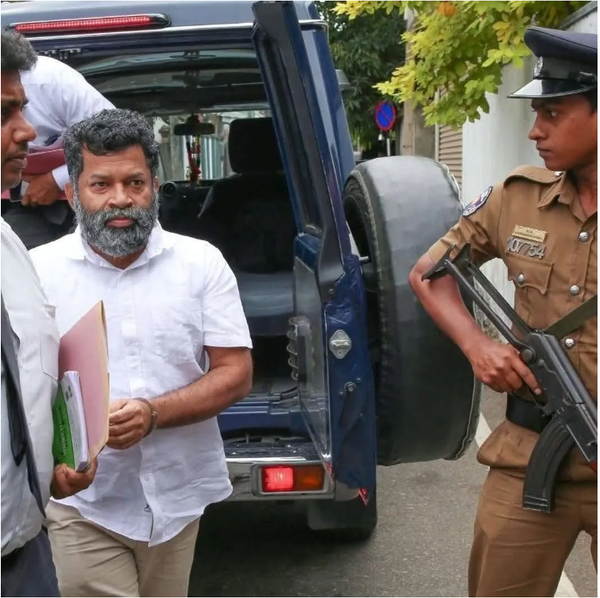
The C.I.D. named Mr. Chandrakanthan, the leader of the Tamil Makkal Viduthalai Pulikal (TMVP) party, alongside two co-suspects identified as former military intelligence informants, Rasik Mohamed Faiz and Hameed Lebbe Mohat. The suspects were produced before court under heavy security and ordered held until June 30. Investigators told the court that another suspect is believed to be living abroad.
Mr. Chandrakanthan is already in remand custody in a separate case involving the 2006 abduction and killing of Professor Sivasubramaniam Raveendranath, the vice chancellor of Eastern University, who disappeared in Colombo during the civil war and whose remains have never been recovered.
Neither case, however, involves the Easter Sunday bombings of April 21, 2019, in which more than 260 people were killed in coordinated suicide attacks targeting three churches and three luxury hotels. As of this week, no Easter Sunday-related charges have been presented against Mr. Chandrakanthan in court.
A Year of Easter Allegations
When the C.I.D. arrested Mr. Chandrakanthan at his party headquarters in Batticaloa on April 8, 2025, government officials publicly linked the arrest to the Easter Sunday attacks.
Within days, Public Security Minister Ananda Wijepala told Parliament that investigators had obtained substantial information connecting Mr. Chandrakanthan to the bombings. President Anura Kumara Dissanayake, who campaigned on a pledge to deliver accountability for the attacks, also referred to the arrest at political rallies ahead of the 2025 local government elections.
In July 2025, Mr. Wijepala told Parliament that the government possessed evidence suggesting that Mr. Chandrakanthan had prior knowledge of the attacks, had met the National Thowheeth Jamaath leader Zahran Hashim, and had provided a confidential statement to a magistrate regarding the bombings.
But when Mr. Chandrakanthan was produced before the Mount Lavinia Magistrate’s Court on April 2, 2026, after nearly a year in detention under the Prevention of Terrorism Act, prosecutors did not file Easter Sunday-related charges. Instead, the case presented concerned the 2006 disappearance and killing of Professor Raveendranath.
Monday’s allegations concerning the 2008 killings add another historical case to the proceedings against him. As of this week, no Easter Sunday-related charges have been filed against Mr. Chandrakanthan.
Government officials have maintained that investigations into the Easter attacks remain ongoing. Authorities have not publicly explained why the allegations discussed in Parliament have not yet resulted in charges against him.
Justice Welcomed, Motive Questioned
Rights lawyers and opposition figures say the crimes now before the courts are serious allegations that warrant investigation. The disappearance of a university vice chancellor and a series of unresolved killings have left families seeking answers for years.
But some critics question why the government publicly emphasized alleged Easter Sunday links while the cases now being pursued concern different crimes from earlier years.
Udaya Gammanpila, Mr. Chandrakanthan’s lawyer and leader of the Pivithuru Hela Urumaya party, has argued that despite repeated public claims linking his client to the Easter attacks, no Easter-related charges have been filed. He has also noted that many of the allegations were made in Parliament, where lawmakers are protected by parliamentary privilege.
Critics have drawn parallels with the case of retired Maj. Gen. Suresh Sallay, the former intelligence chief who was arrested under the Prevention of Terrorism Act amid allegations relating to the Easter attacks. In both cases, they argue, some of the most serious public allegations have yet to be tested before a court.
Whether the Easter Sunday investigation ultimately results in charges remains unclear. For now, prosecutors are pursuing cases linked to a disappearance in 2006 and killings in 2008, while questions about the government’s earlier public assertions continue to fuel political debate.