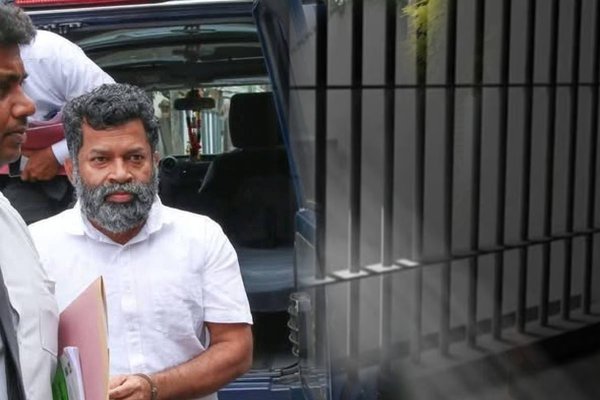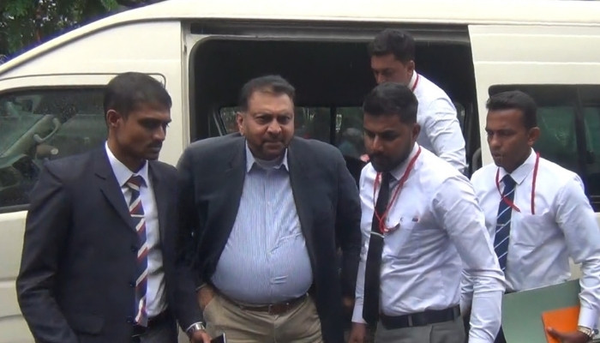
COLOMBO — The arrest on Friday of Admiral of the Fleet Wasantha Karannagoda on corruption allegations, followed by his release on bail later the same day, has renewed questions among many Sri Lankan Tamils, human rights advocates and families of the disappeared, not over the decision to arrest him in the corruption case, but over why he has never been taken into custody in connection with the long-running investigation into the disappearance of eleven civilians during the final stages of Sri Lanka's civil war.
Karannagoda, 73, was arrested by investigators from the Commission to Investigate Allegations of Bribery or Corruption after appearing before the commission in Colombo. He was later released on bail after being produced before the Colombo Chief Magistrate's Court.
The case concerns the alleged recruitment in 2006 of Yoshitha Rajapaksa, son of former President Mahinda Rajapaksa, as a cadet executive officer despite not meeting required qualifications, and his subsequent training at Britain's Britannia Royal Naval College using public funds outside established procedures, according to investigators.
The allegations are unrelated to the long-running "Navy 11" investigation, one of Sri Lanka's most controversial wartime criminal cases, in which Karannagoda was once named as a suspect before prosecutors withdrew the case against him.
That contrast has become the focus of public debate, particularly in Sri Lanka's Tamil-majority North and East, where enforced disappearances remain among the most painful legacies of the civil war.
"If the state can arrest him over a recruitment file, why has it never arrested him over the disappearance of eleven young men?" is a question increasingly being asked by relatives of the missing, civil society activists, and many Tamil social media users following Friday's arrest.
The "Navy 11" case concerns eleven civilians who disappeared after allegedly being abducted in Colombo between August 2008 and February 2009.
According to Criminal Investigation Department findings presented in court, the victims — most of them Tamils, along with several Muslims and one Sinhalese man — were allegedly abducted by naval intelligence personnel, held at naval facilities in Colombo, transferred to secret detention sites inside the Trincomalee naval base, and never seen again.
Investigators said relatives later received ransom demands amounting to millions of rupees. Some families paid, believing their sons would be released. None returned home.
Court proceedings have heard that one victim, Rajiv Naganathan, telephoned his mother and told her he was being held by the Navy before all communication stopped.
Nearly seventeen years later, none of the eleven has been found.
Ironically, the investigation itself originated from a complaint lodged by Karannagoda.
In May 2009, after a dispute with his personal security officer, Lieutenant Commander Sampath Munasinghe, Karannagoda reported him to police. During a search of the officer's quarters, investigators recovered identity cards belonging to several of the missing men, leading the inquiry to expand into one of Sri Lanka's largest wartime disappearance investigations.
Following renewed investigations after the change of government in 2015, the Criminal Investigation Department named Karannagoda as the fourteenth suspect in 2019.
Prosecutors alleged that naval personnel operating under his command carried out the abductions and that he bore command responsibility because he was informed of the operation but failed to prevent or investigate it.
Karannagoda has consistently denied all wrongdoing and has never been convicted of any offence related to the case.
In August 2021, however, the Attorney General's Department informed the court that it would not proceed against him, citing a confidential report. He was formally discharged from the case two months later.
The decision drew criticism from the United Nations High Commissioner for Human Rights and Amnesty International, both of which said it dealt a significant blow to accountability for one of Sri Lanka's most prominent enforced disappearance cases.
International scrutiny has continued. The United States imposed visa restrictions on Karannagoda in 2023, while the United Kingdom sanctioned him in 2025 with an asset freeze and travel ban over alleged gross human rights violations.
Domestically, however, petitions seeking to overturn the Attorney General's decision remain pending before the Supreme Court.
For many families of the disappeared, Friday's arrest therefore represented a paradox.
The first time Karannagoda was taken into custody, it was not over the allegations connected to one of Sri Lanka's most notorious wartime disappearance cases, but over an alleged abuse of recruitment procedures.
For many relatives of the missing and human rights advocates, Friday's arrest was therefore met with mixed reactions. They acknowledged it as a sign that President Anura Kumara Dissanayake's government is prepared to pursue corruption allegations involving politically influential figures. But they also questioned whether the administration would show the same resolve in reviving one of the country's most consequential unresolved criminal investigations.
Nearly two decades after the eleven young men disappeared, the central question for those families remains unchanged: whether this government will move to restore accountability in the Navy 11 case, or, like successive administrations before it, leave one of Sri Lanka's most enduring disappearance investigations unresolved.