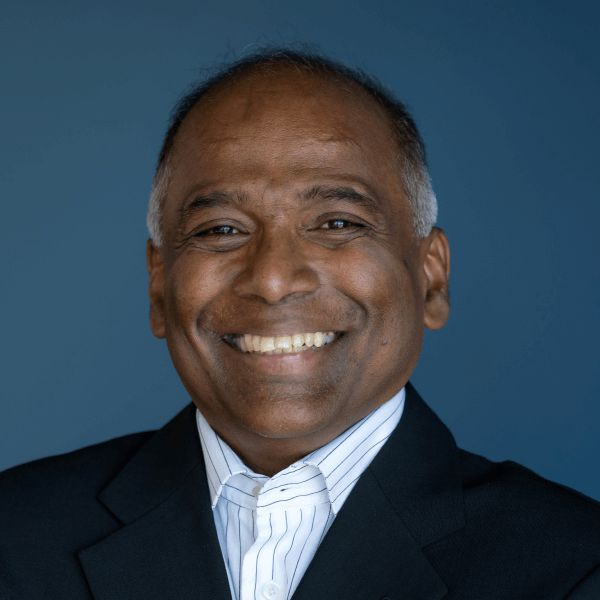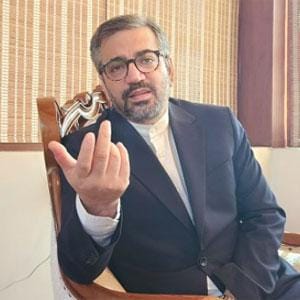
On India’s 77th Republic Day, Jaffna Monitor sat down with Indian High Commissioner to Sri Lanka, Santosh Jha, for a wide-ranging conversation on constitutional devolution, cyclone relief, fishermen’s disputes, stalled port projects, and other key issues.
Jha is no stranger to Sri Lanka's complex political terrain. He first served in Colombo from 2007 to 2010 as Counsellor at the High Commission, handling commercial and economic affairs during the critical post-conflict transition. It was during those years that he helped architect the framework for India-Sri Lanka development cooperation—a foundation that has since grown into billions of dollars in assistance and what India describes as a "non-transactional" and "civilisational" relationship.
Now serving as High Commissioner, Jha oversees what may be India’s most significant engagement with Sri Lanka in decades. From the USD 4.5 billion assistance package during the 2022 economic crisis to the rapid launch of Operation Sagar Bandhu after Cyclone Ditwa, India’s contribution has been prominent and substantial, often outstripping that of other international partners.
In this interview, Jha addresses some of the most persistent questions about India's engagement: Has New Delhi softened its stance on the 13th Amendment? Why does the Kankesanthurai Port project face delays despite India's unprecedented USD 61 million grant? Is India serious about building a land bridge to Rameswaram? And how does New Delhi respond to recent protests in Jaffna—including calls to close the Indian Consulate—over the fishermen's issue?
This is an exclusive conversation on friendship, infrastructure, history, and the sometimes uncomfortable realities of being each other’s “closest maritime neighbour.”
In recent engagements with the Sri Lankan Government, there has been speculation that India may have softened its long-standing position on the 13th Amendment, alongside reports that New Delhi encourages greater unity among Sri Lankan Tamil political parties. How does India currently view the 13th Amendment as part of its engagement with Sri Lanka, and why does it see political unity among Tamil parties as important in this context, particularly given differing views on devolution?
I do not understand on what basis it is being suggested—or why the question is being raised—that India has softened its position on the 13th Amendment. India has not softened its position. India’s stand remains unchanged. We have been raising this issue in every high-level meeting, during interactions at the level of leaders, and whenever joint statements are issued, and we have consistently reiterated that it continues to be an important matter for us.
As for unity among Tamil political parties, I do not prescribe what Tamil political parties should or should not do. It is for them to decide what is good for them.
As this interview is being published on India’s Republic Day. How do you view India’s broader civilisational contribution to the region and the world? In particular, how does India seek to translate its ancient traditions of pluralism, dialogue, spirituality, and coexistence into its contemporary engagement with neighbours such as Sri Lanka?
At the outset, let me convey my greetings on the occasion of the 77th Republic Day of India. This marks the day on which the Constitution of India came into effect on January 26, 1950, signalling India’s emergence as a Republic. Since then, India has come a long way.
Today, India is the world’s fourth-largest economy, and with a GDP growth rate of 8.2 per cent, it is poised to become the third-largest economy within this decade. We have set for ourselves the goal of becoming a developed nation—Viksit Bharat—by 2047. India is also the world’s most vibrant democracy. The fact that an elected government has been returned to office democratically for a third consecutive term reflects the confidence of the Indian people in the country’s direction and governance.
India’s engagement with the region and the world is deeply rooted in its civilisational values. We believe in the principle of Vasudhaiva Kutumbakam, which means “the world is one family.” Guided by this philosophy, India sees itself as Viswamitra—a friend to the world. This outlook informs our Neighbourhood First policy, reflecting our commitment to our immediate neighbourhood.
We are also guided by the MAHASAGAR approach—Mutual and Holistic Advancement for Security and Growth Across Regions—which underscores our priority for shared prosperity with our maritime neighbours. Sri Lanka occupies a special place in this approach. We are each other’s closest maritime neighbours—Sri Lanka is India’s closest maritime neighbour, and India is Sri Lanka’s only immediate neighbour. Our destinies in the Indian Ocean are therefore deeply interconnected.
The combined effect of these policies is a cooperative approach grounded in shared civilisational heritage. This approach is generous, non-reciprocal, and seeks to build friendship and trust with our neighbours.
At the centre of all these policies are people. With Sri Lanka, India shares deep bonds of language, culture, religion, dance, music, cuisine, and art. In many ways, we are civilisational twins. We therefore prioritise positive and constructive cooperation with Sri Lanka, guided by the belief that working together is not merely a choice, but a natural and essential thing.
India extended assistance to Sri Lanka amounting to approximately USD 4.5 billion during the height of the economic crisis—by far the largest support package provided by any single country at a moment of unprecedented economic collapse. More recently, India also announced an additional USD 450 million in assistance following Cyclone Ditwa. Many Sri Lankans view India, in moments such as these, as a true friend and an elder brother who stood by them when it mattered most. What were the key considerations behind this sustained engagement, and how does it reflect India’s sense of responsibility toward smaller neighbouring countries?
India’s response in the aftermath of Cyclone Ditwa was spontaneous and natural. Most importantly, it was swift and immediate—we began bringing in essential relief items even before a formal request was made, and this assistance was welcomed by Sri Lanka. As a neighbour, we feel a responsibility to come to the assistance of another neighbour in need, particularly one with whom we share close and friendly relations.
All assistance extended by India is unconditional. We seek friendship and goodwill with the people of Sri Lanka, and our relationship is fundamentally with the people of Sri Lanka. The support we provide is meant for them.
At the same time, we coordinated closely with the Government of Sri Lanka, especially the Disaster Management Centre (DMC), to ensure that assistance matched Sri Lanka’s needs. We worked with relevant ministries to identify urgent requirements and structured our support based on those assessments.
Comparisons with other countries in this regard may not be appropriate. India is Sri Lanka’s closest neighbour and a true friend, and Sri Lanka has no other immediate neighbour apart from India. Our relationship with Sri Lanka has never been transactional; it is civilisational. It flows naturally from our geographical proximity and from the deep, longstanding civilisational ties between our two peoples.
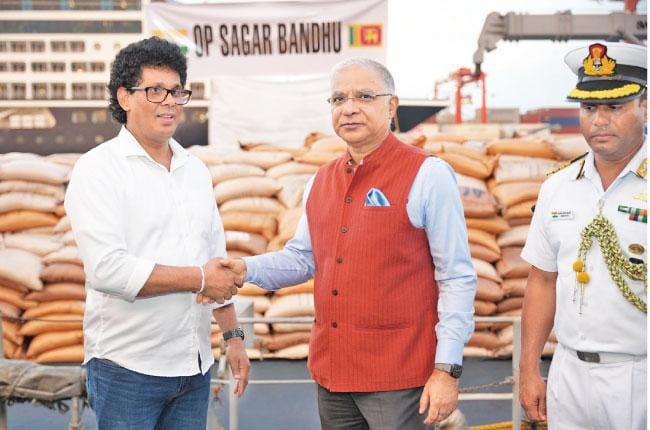
Could you briefly outline India’s response to Cyclone Ditwa—particularly the scale of personnel and assets deployed by the NDRF, Indian Air Force, and Navy, the key missions undertaken, and how coordination with Sri Lankan authorities was ensured?
I was in India on the day Cyclone Ditwa made landfall in Sri Lanka. Immediately thereafter, we reviewed the extent of the damages and launched Operation Sagar Bandhu to address urgent requirements. INS Vikrant and INS Udaygiri, which had arrived in Colombo to participate in the International Fleet Review, were immediately diverted into disaster-response mode. These ships carry Humanitarian Assistance and Disaster Response (HADR) packets, which were off-loaded and handed over to Sri Lanka’s Disaster Management Centre (DMC). Dry rations were also provided from these ships. Chetak helicopters from INS Vikrant joined Sri Lankan forces and carried out urgent rescue operations.
As the cyclone was passing over the region, aircraft carrying relief supplies from India were initially unable to land and were held in Kochi with urgent supplies until weather conditions improved. From the early morning of November 29 onwards, Indian Air Force aircrafts began bringing in relief materials, including dry rations, hygiene kits, water-purification kits, essential medicines, and surgical equipment. Subsequently, larger quantities of relief material were transported by Indian Naval ships—six in total. Altogether, more than 1,100 tonnes of relief items were delivered.
This included BHISHM Cubes, India’s modular medical care units designed for rapid deployment during disasters. These compact, box-like units—roughly the size of a cupboard—can be quickly assembled into fully functional trauma medical facilities with surgical capabilities, capable of treating up to 200 patients per day at the site of a major disaster. The BHISHM Cube units were deployed at several locations, including Ja-Ela and Negombo, to meet urgent medical needs in the affected areas.
In parallel, India deployed 80 personnel from the National Disaster Response Force (NDRF), along with K9 canine units, to assist with rescue and relief operations in inaccessible areas. They were deployed across five provinces and carried out painstaking work, including rescuing people, distributing aid, and searching for missing persons.
At the same time, three Mi-17 heavy-lift helicopters of the Indian Air Force were deployed alongside the Sri Lanka Air Force to assist in rescuing people from cut-off areas and distributing relief supplies. These helicopters also transported Advanced Level examination papers, as examinations were underway at the time, responding to urgent requirements on the ground.
As requirements in Sri Lanka continued to evolve, we airlifted a Field Hospital of the Indian Army, along with doctors and support staff, which was established in Mahiyanganaya and treated approximately 8,000 patients. Indian Army signal personnel from this team also restored disrupted telecommunications by reconnecting optical fibre cables damaged during the cyclone.
With bridges severely damaged or swept away, restoring road connectivity became a priority. At the request of the Sri Lankan Government, India airlifted four sets of Bailey Bridges—totalling approximately 228 tonnes—along with 48 Indian Army engineers. The first double-lane bridge was constructed on the A35 highway at Paranthan near Kilinochchi. Subsequently, two additional damaged bridges were reconstructed on the Kandy–Ragala Road along the B492 highway. As requested by the Government of Sri Lanka, additional Bailey Bridges will be provided.
Following the immediate disaster-response and relief phase, on December 23, India’s External Affairs Minister, Dr S. Jaishankar, visited Sri Lanka and announced an additional assistance package of USD 450 million for post-cyclone reconstruction and rehabilitation. The implementation of this package is currently underway in close coordination with the Government of Sri Lanka. It includes approximately USD 100 million in grants, with the remainder provided as concessional Lines of Credit denominated in Indian National Rupees. Most urgently required reconstruction—such as shelter materials, housing repairs, and the reconstruction of the Northern Railway Line—is being undertaken under grant assistance.
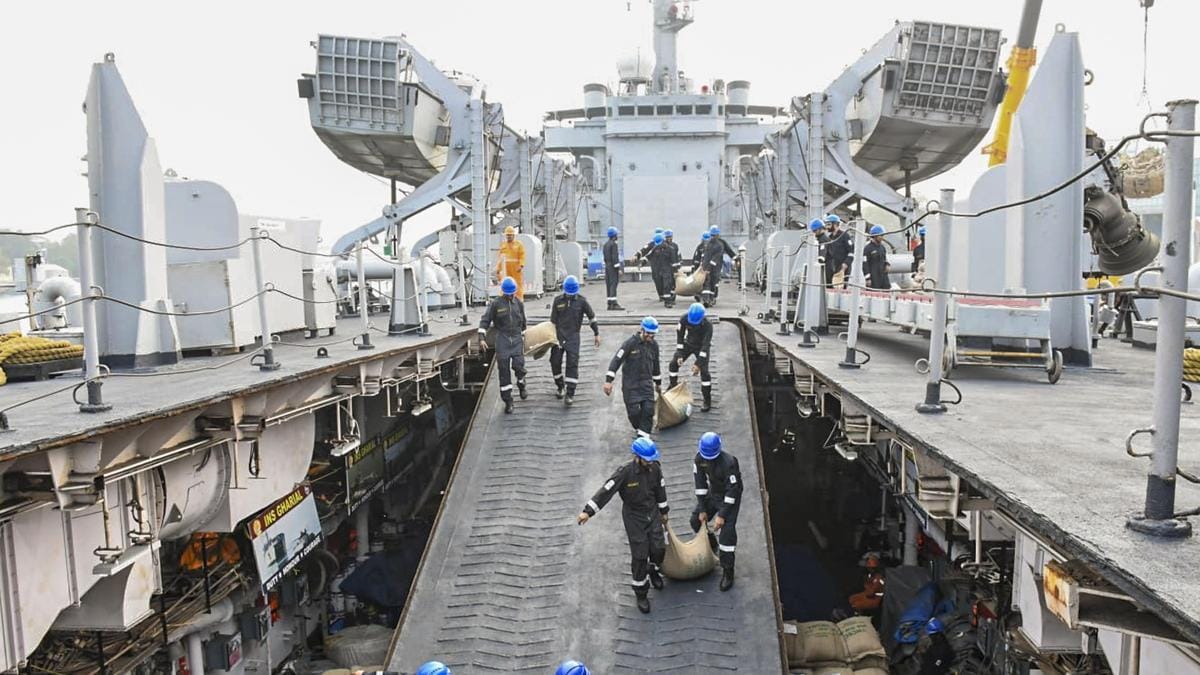
What mechanisms are in place to ensure that this assistance is not misused?
All Government of India assistance is subject to joint supervision through Joint Monitoring Committees established for each specific project. Every project undergoes detailed scrutiny, including joint evaluation and screening of expenditures, to ensure transparency, accountability, and proper utilisation of funds. Both governments are fully committed to ensuring utilization of funds appropriately and for the purpose they have been provided.
You have noted that traditional connectivity links, such as the Mannar–Rameswaram corridor, are under renewed discussion with the new government. How serious is India about pursuing land or bridge connectivity between the two countries, and what factors will determine whether this moves beyond the discussion stage?
Physical connectivity is an important aspect of India–Sri Lanka relations, and India has been consistently working to improve it. India facilitated the launch of the first direct flights from Chennai to Palaly Airport. Similarly, India is extending Viability Gap Funding for the Nagapattinam–Kankesanthurai (KKS) ferry service. We are encouraged by the growing interest in this ferry service and the steady increase in passenger numbers.
The Rameswaram–Talaimannar ferry service has been a long-standing demand. However, its revival requires the development of necessary infrastructure on both the Indian and Sri Lankan sides before operations can resume. These matters were recently discussed with Sri Lanka’s Minister of Ports, Anura Karunathilaka, and we are working closely with the Sri Lankan authorities on this issue.
With regard to the proposed land bridge connecting Talaimannar and Rameswaram, it is important to clarify that this proposal originated from the Sri Lankan side as far back as 1998–99, although it is often mistakenly described as an Indian proposal. The idea was subsequently included in the India–Sri Lanka Vision Statement of July 2023. Following this, the proposal was discussed in detail with the then government in Sri Lanka. We also shared proposals to prepare a Detailed Project Report (DPR) through a globally reputed company selected through competitive process. This would provide a basis for better appraisal of benefits and impacts of the project and also establish its technical and financial viability and feasibility. However, we are yet to receive a response and we are therefore awaiting further communication.
The proposed land bridge would, in fact, be far more beneficial to Sri Lanka than to India. It has the potential to spur tourism and infrastructure development and would significantly transform the Northern and Eastern parts of Sri Lanka by enhancing connectivity. Improved connectivity would be a game-changer, particularly for the people of the North even though significant benefits will accrue to the entire Island.
How does India view Sri Lanka’s role in the Indo-Pacific region, particularly given its strategic location and growing interest from multiple global powers?
For India, Sri Lanka is first and foremost our close maritime neighbour. It may be other countries that view India and Sri Lanka primarily through the lens of the Indo-Pacific, but we view Sri Lanka more as neighbour. Similarly, Sri Lanka does not view India as part of the Indo-Pacific. We see each other as neighbouring littoral states in the Indian Ocean, bound by geography and history.
India’s approach is guided by an Indian Ocean vision—earlier articulated as SAGAR and now broadened as MAHASAGAR. Within this framework, we view Sri Lanka as a brotherly/sisterly country and a civilisational twin.
The term “Indo-Pacific” is often interpreted by others as implying strategic competition or rivalry. That perspective may apply to relations among other countries, but in my view, it does not apply to India and Sri Lanka. We certainly do not see it that way. Our relationship is not defined by rivalry or competing spheres of influence but one of close cooperation and partnership based on our own realities of proximate location, civilization closeness and good neighbourly relations.
Both India and Sri Lanka are Indian Ocean countries and close neighbours, and both enjoy tremendous goodwill among each other’s peoples. It is this mutual trust, shared heritage, and sense of neighbourhood that forms the foundation of how India views Sri Lanka’s role in the region.
How would you characterise India–Sri Lanka relations under the current NPP-led government compared to previous administrations? What areas show continuity, and where do you see new opportunities or challenges?
I would characterise India–Sri Lanka relations as excellent. We have been working very closely with the Government of Sri Lanka. As you would recall, the first overseas visit of the Sri Lankan President after assuming office was to India in December 2024, and the first foreign leader he received in Sri Lanka was the Prime Minister of India in April 2025. These two visits themselves reflect the strength and continuity of our relationship.
If one looks at the outcomes of these engagements, there is considerable continuity, alongside several new elements. Many significant proposals are progressing well. The Sri Lanka Unique Digital Identity Project is moving ahead and is now in the final stages of the tender process. The Sampur Power Project has already been launched, and tenders have been issued for the selection of a contractor to construct the plant. Discussions on power grid interconnection are also progressing steadily; technical consultations have been completed, and we are now working towards finalising the financing modalities.
Beyond these flagship projects, progress has been made across a wide range of sectors. Over the past year, we have conducted capacity-building and training programmes for a large number of Sri Lankans. Officers from the Sri Lankan Administrative Service, auditors, parliamentarians, members of the judiciary, as well as stakeholders from the fisheries and dairy sectors and young politicians, have travelled to India for orientation and training programmes.
During the visit of the Prime Minister of India to Sri Lanka in April 2025, we also announced major cultural projects, including the development of the historic Thirukoneswaram Temple in Trincomalee, the Ramayana-linked Sita Amman Temple in Nuwara Eliya, and projects associated with Anuradhapura. Across areas such as digitisation, energy, infrastructure, and broader development cooperation, the partnership continues to deepen.
In terms of grant assistance, the commitments made and projects currently under implementation in Sri Lanka could be nearing USD 450–500 million. This represents a doubling compared to the previous 13-year period. Overall, India’s financial assistance to the Government of Sri Lanka amounts to approximately USD 7.5 billion.
India offered substantial grants for the development of the Kankesanthurai Port, yet the project has faced significant delays. Can you clarify the current status of this initiative and whether discussions with the NPP government are now progressing?
The Kankesanthurai (KKS) Port project is a complex one and has been under development for a long time. When I was previously posted in Sri Lanka, I personally visited the site and initiated key processes. At that time, a sunken ship that was blocking the navigation channel was cleared. While the port has not yet been developed to the level required, ferry services started to operate from KKS to Nagapattinam in India.
The proposal to modernise the port was initially taken up under a Line of Credit, with an announced allocation of USD 45 million. A consultant was appointed, and the report submitted subsequently indicated that this amount would not be sufficient to complete the project and that additional funding would be required. Around the same time, due to Sri Lanka’s economic crisis, the Line of Credit had to be suspended.
Given the importance of the KKS Port for the people of the Northern Province, the Government of India took a very generous decision to provide USD 61 million as a grant—in addition to the USD 3 million already incurred on consultancy—for this project. Except for housing projects in North in 2010, India has not extended a grant of this magnitude for any single project in Sri Lanka. This therefore represents the largest single grant assistance programme by India in Sri Lanka outside the housing sector.
Once the decision was taken to implement the project through grant assistance, discussions on the modalities of implementation were initiated. After the new Government of Sri Lanka came to office, the project underwent a review process. The Government has now taken a decision to proceed and has publicly announced its intention to move forward with the project.
We are currently in the process of finalising the Memorandum of Understanding (MoU) for implementation, after which the project will be taken up. As you may recall, during President Anura Kumara Dissanayake’s recent visit to Jaffna, he publicly announced that Sri Lanka is accepting India’s grant assistance for the KKS Port and that work on the project will resume soon.
India supported the revival of Palaly Airport to improve connectivity to Northern Sri Lanka, including limited international services. Looking ahead, is India open to supporting a broader international role for Palaly if the Sri Lankan government articulates a clear policy vision and request?
India supported the Palaly Airport project at an early stage. In the early phase, we had also provided subsidies to help with resumption of flight connectivity between Chennai and Jaffna. Now, we have another flight from Trichy also coming to Jaffna. We had also proposed a Memorandum of Understanding on further airport development, but it is yet to be finalized.
We recognise that Palaly Airport remains an important area of engagement, particularly for improving connectivity to Northern Sri Lanka. Whenever the Government of Sri Lanka decides to take forward the development of Palaly Airport and articulates a clear policy direction, India will certainly be happy to extend its support and assistance.
The fishermen's issue has remained unresolved for decades despite repeated bilateral mechanisms. Why has a durable solution proved so elusive, and what practical cooperation does India believe is required?
This is a very important issue for us to resolve. Fishing-related activities and the challenges surrounding them have been ongoing for decades, and therefore solutions are not easy. We have established bilateral mechanisms to discuss these issues, and both sides agree that these issues must be approached in a humanitarian manner.
The people involved are struggling fishing communities on both sides of the Palk Strait, many of whom are economically vulnerable and face serious livelihood challenges. They therefore require understanding and support. Under the Joint Working Group, as well as through our national efforts, we are taking steps to gradually move away from unsustainable practices.
On the Indian side, we are converting trawlers into deep-sea fishing vessels so that fishermen can venture into the deep sea and secure better and more sustainable catches. In addition, several ancillary programmes are being implemented to diversify livelihood options for fishing communities. At its core, this remains a livelihood issue, and we consistently emphasise that it must be addressed with sensitivity.
Dialogue and cooperation remain the best way forward. At the same time, we are also working on projects to support fishermen in Northern Sri Lanka. The Karainagar Boatyard is one such initiative, and the development of the Point Pedro Harbour is another. Over the years, India has also provided nets, boats, and related assistance to Sri Lankan fishermen to enhance their capacity. We remain willing to support further infrastructure development.
Do you believe that this long-running fishermen issue has strained relations between India and the Tamil people of Sri Lanka? There are also concerns that external actors with vested interests may be seeking to exploit the issue. You may have noted that a recent protest in Jaffna even included calls for the closure of the Indian Consulate. How do you view these developments?
People in the North of Sri Lanka are very close to India. We have a very special relationship with the North.
The relationship we share with the people of Jaffna—and with the Tamil people of Sri Lanka more broadly—is not something that can be undermined by anyone. Nor is it a relationship that can be easily misrepresented or manipulated. The Tamil people know India well, and they understand our goodwill.
As I said earlier, our ties are deep, longstanding, and built on trust, shared history, and strong people-to-people connections.
As people-to-people ties between India and Sri Lanka continue to strengthen, what opportunities exist to further expand educational exchanges, scholarships, and university partnerships—particularly for youth—and how realistic is Sri Lanka’s integration into India’s technology ecosystem in areas such as innovation and artificial intelligence? Which forms of collaboration do you see as most promising?
There are several scholarship schemes available for Sri Lankan students to pursue studies in India. More recently, we have introduced dedicated scholarships for students from the University of Jaffna and the Eastern University, particularly for meritorious students, to support their higher education. Under this initiative, 100 scholarships were introduced last year for each of these universities. Earlier, these scholarships were awarded on a year-to-year basis; we have now extended them to cover the entire duration of the course. This means that once a student is selected, they can continue to receive the scholarship throughout their full undergraduate programme.
In addition, there are approximately 700 scholarships available for Sri Lankan students to study in India under various schemes, including the Mahatma Gandhi Scholarship and the ICCR scholarship programmes. We also offer ITEC training slots, under which professionals from Sri Lanka can undertake specialised training courses in India.
Beyond scholarships, there are multiple forms of educational exchange underway. These include collaboration in curriculum development and growing partnerships between universities in both countries. We are increasingly seeing Indian universities and colleges visiting Sri Lanka and engaging with Sri Lankan educational institutions. I am optimistic that joint degree programmes between Indian and Sri Lankan universities will emerge in the near future. Recent education reforms in India now allow for such arrangements, even though Sri Lanka has long had the flexibility to pursue them.
We are also supporting universities in developing innovative programmes in emerging areas such as artificial intelligence, innovation, and start-up ecosystems. These kinds of collaborations naturally take time to mature and cannot happen overnight, but the trajectory is promising.
One of the strongest examples of our educational cooperation is that the current Prime Minister of Sri Lanka, Harini Amarasuriya, studied in India under an ICCR scholarship. Similarly, Sri Lanka’s current High Commissioner in New Delhi, Mahishini Colonne, is also an ICCR alumna. We are proud that our scholarship programmes have helped nurture leaders in Sri Lanka, and we hope to see many more such success stories in the years ahead.