By M.R. Narayan Swamy
Sri Lanka faces the risk of its dominant Marxist ruling party pushing the country toward a one-party state, M.A. Sumanthiran, Acting General Secretary of the Ilankai Tamil Arasu Kachchi (ITAK), said, adding that the government is already setting up a parallel power structure in the Tamil-majority North.
At the same time, lawyer-cum-politician M.A. Sumanthiran underlines that while President Anura Dissanayake is pragmatic, he is surrounded by some who the former Tamil MP dubs “hardliners” opposed to political co-habitation.
“The greatest danger facing the country—not just the Tamils—is that the JVP will move towards a one-party state,” Sumanthiran said in an interview with me during a brief visit to New Delhi. “It is a very serious situation.”
According to Sumanthiran, 62, the government’s anti-poverty programme, called Praja Shakthi, was being used at the lowest level of the development structure, with handpicked representatives to bypass existing institutions and elected political players.
Also, civil society actors, professional groups, lawyers, and community organizers in the Tamil-majority northern province allege that the JVP was not allowing any major civic initiative outside its influence or oversight.
“Sumanthiran added that the government had imposed five MPs from the region to act as shadow ministers, usurping the powers of the Northern Provincial Council, for which elections have not been held for years.
A JVP leader recently declared that while it has formed a government, it craved for “state power” – an expression that critics said was a sign of the party’s hunger for monopolistic political control over the country.
Sumanthiran recalled what legendary Tamil political leader SJV Chelvanayakam, who was compared to Mahatma Gandhi for advocating non-violence, had warned way back in 1971: “We (Tamils) are also for socialism. But we are not for a one-party rule.”
While admitting that the JVP’s wins in parliamentary elections in the Tamil north showed that Tamils had lost faith in traditional Tamil parties, Sumanthiran was sure his Ilankai Tamil Arasu Katchi (ITAK) would come on top if and when the provincial council elections are held in the country’s north and east.
The former MP’s confidence stems from the fact that Tamil voters swung back in a major way towards the Tamil parties in local body elections after giving them a shock defeat in the parliamentary battle. The ITAK, he said, now controls 34 of the 40 local bodies in the north and east.
“We are sure we will form a government in the north and east after the provincial elections,” said Sumanthiran, who has expressed a desire to be his party’s (ITAK’s) chief ministerial candidate. He was quick to add that the ITAK would take power in the east only with the help of Muslim parties.
Sumanthiran has enjoyed a friendship with President Dissanayake, along with a select few in the JVP, for nearly 15 years, but conceded that they are now drifting apart.
He said while Dissanayake was reasonable and willing to come a long way from his established positions, hardliners in his party were against wooing other political forces, more so after winning a two-thirds majority in parliament.
Sumanthiran also sought to clarify reports that claimed Dissanayake had offered him the Justice Ministry after forming the government, and that he had rejected it.
He said the offer was made before Dissanayake became president, but he could not go against the position of his party, which had decided not to support Dissanayake in the presidential contest.
That decision, Sumanithiran said, had angered Dissanayake. He quoted the future president as saying then: “I will win (the presidential election). If I lose, it will be because of you.”
Sumanthiran, one of Sri Lanka’s best-known lawyers, said he continued to talk to Dissanayake and had promised help in the drafting of a new constitution if asked. “But we are drifting apart. He himself has said it.”
One reason was the big gap on the Tamil question between the JVP on the one hand and the ITAK and other Tamil parties on the other. “Because of this, it is difficult to be seen working with them. We (ITAK) are also their primary political foes in the north and east.”
The Tamil politician said that while the armed struggle waged by the Tamil Tigers may have had relevance at one point, he has always been steadfastly opposed to violence and believes in taking the majority Sinhalese community along in whatever political framework the Tamils seek to build.
Sumanthiran said some of the hardline statements made by a section of the Tamil political leadership were jarring and not beneficial to the Tamil community.
“Is a separate state an option now? Why, then, threaten the Sinhalese with rhetoric that points in that direction? It is counterproductive.”
“It is with the consent of the Sinhalese people that we can get somewhere,” he said, echoing an argument that finds many takers in the Tamil community today. “We need to convince them (Sinhalese) and stop giving validity to counter-productive slogans.”
A section of the Tamil leadership, which enjoys the backing of those sections of the Tamil diaspora dominantly in the West who were aligned with the vanquished Liberation Tigers of Tamil Eelam (LTTE), continues to harp on clichés like federalism and self-determination, idioms which are detested by both the Sinhalese and the Tamil-speaking Muslims.
Sumanthiran added that such self-defeating slogans and promises were another reason Tamil voters turned their backs on Tamil parties and opted for the JVP in the 2025 parliamentary elections, giving the largely Sinhalese party a foothold in Jaffna and elsewhere in the North—stunning both friends and foes.
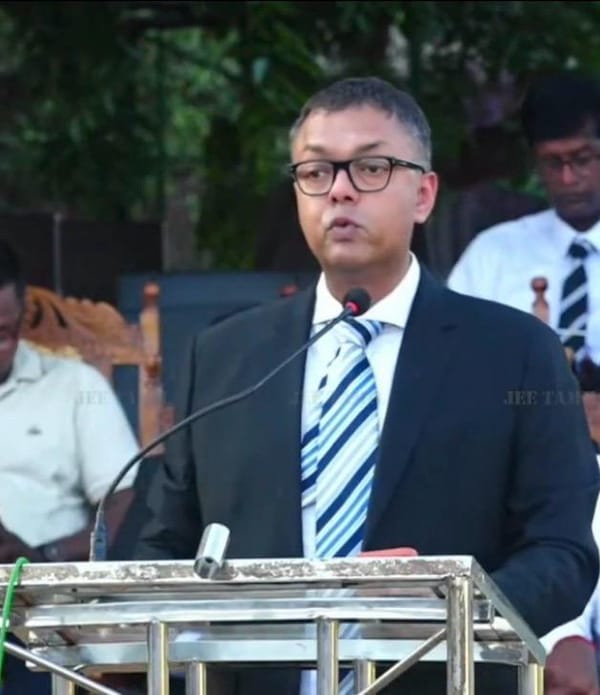
Sumanthiran visited India as part of an official delegation of the Sri Lanka Bar Association at the invitation of the Bar Association of India. In the Supreme Court, India’s Chief Justice welcomed and interacted with the Sri Lankan delegation. He spoke to this writer at his hotel after the official event concluded.