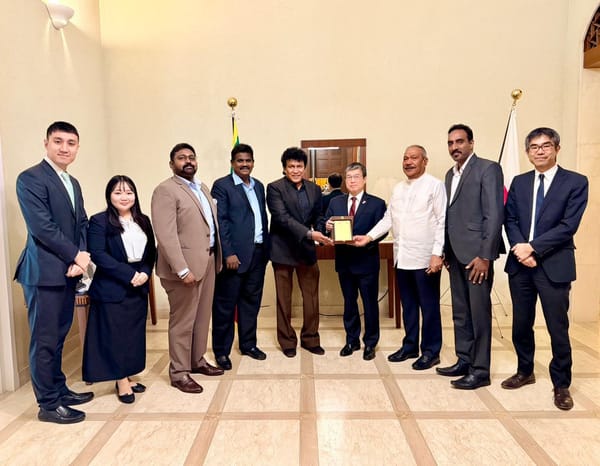
COLOMBO, Sri Lanka — The leader of the Tamil Progressive Alliance, Mano Ganesan, told Japan’s ambassador to Sri Lanka on Tuesday that the country’s Malaiyaha Tamil community — nearly 1.5 million people living across the plantation districts of the central highlands — should no longer be viewed solely as a labour force and must be included more directly in international development efforts.
“We are no longer merely a labour community,” Mr. Ganesan said during a meeting with Japan’s ambassador, Isomata Akio, at the ambassador’s residence in Colombo. “We are a proud ethnic community contributing to the nation and seeking equitable development.”
The delegation included MP Radhakrishnan, deputy leader of the Tamil Progressive Alliance and leader of the Upcountry People’s Front, along with representatives from the Democratic People’s Front and the National Workers Front.
During the meeting, the group raised longstanding concerns affecting plantation communities, including housing shortages, under-resourced schools, limited economic mobility, and a wage structure that has kept many estate workers among the country’s most economically vulnerable.
A Community That Waited Decades for Citizenship
Mano Ganesan briefed Ambassador Isomata on Sri Lanka’s four major ethnic communities: the Sinhalese majority, the Tamil population of the Northern and Eastern Provinces, the Muslim community, and the Malaiyaha Tamils, descendants of labourers brought from South India during British colonial rule to work the island’s tea and rubber plantations.
Soon after Sri Lanka gained independence in 1948, legislation stripped most Malaiyaha Tamils of citizenship, rendering hundreds of thousands stateless. The final segment of the community regained citizenship only in 2003, ending more than five decades of legal exclusion.
Mano Ganesan said the effects of that history remain visible.
“Structural inequalities continue to affect education, housing, health, and livelihood opportunities,” he told the ambassador.
Calls for Development Attention in Plantation Regions
The delegation urged Japan — one of Sri Lanka’s largest bilateral development partners — to ensure that future assistance programs reach plantation regions in the Central and Sabaragamuwa provinces, which they said have received comparatively less international development support.
Barath Arullsamy, the Democratic People’s Front’s vice president for international affairs, said that while Japan had extended significant development assistance to Sri Lanka, plantation communities had not always benefited directly.
He urged that future cooperation projects include initiatives specifically targeting the Upcountry region.
Ambassador Isomata acknowledged Japan’s extensive development engagement in Sri Lanka, particularly in the Northern and Eastern Provinces, and said Tokyo remained open to exploring additional cooperation in plantation areas.
He noted that Japan currently supports skills training programs, including caregiving and technical education, and encouraged the delegation to pursue partnerships through international agencies and Japanese grant assistance programs that support grassroots development initiatives.
Proposals for Economic Reform and Education
The meeting also included discussion of two proposals put forward by the Tamil Progressive Alliance.
Mano Ganesan outlined what he described as a “tea partner model,” which would restructure the relationship between plantation workers and estate management by allowing workers to become stakeholders in tea production rather than remaining dependent on a daily wage system.
MP Radhakrishnan also asked the embassy to revisit a proposal submitted during his tenure as Sri Lanka’s state minister of education in 2018 to establish a model school and nursing training facility in Talawakelle, a plantation town in the Nuwara Eliya district.
He said such an institution could help address persistent education and healthcare gaps in plantation communities.
Ambassador Isomata did not make any formal commitments but indicated that the proposals could be explored through existing development cooperation frameworks.