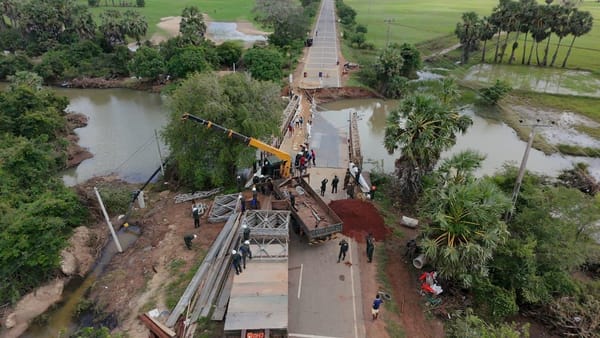
MULLAITIVU, Sri Lanka — Sri Lanka’s Road Development Authority (RDA) has confirmed that the temporary Bailey bridge installed on the Paranthan–Karaichchi–Mullaitivu (A035) road after Cyclone Ditwa was never intended to serve as a long-term solution, as pressure grows for the construction of a permanent structure along one of the district’s most vital transport corridors.
In an interview with Jaffna Monitor, a senior engineer attached to the RDA’s Northern Province office, speaking on condition of anonymity because he was not authorized to comment publicly, said the bridge was conceived strictly as an emergency intervention.
“This is a temporary structure by design,” the engineer said. “It cannot function as a long-term substitute on a road that serves as a primary connection between Mullaitivu and neighboring districts.”
The A035 links villages, markets, schools, and medical facilities across the district.
Recent restrictions imposed by the RDA — including prohibiting heavy vehicles and requiring buses to unload passengers before crossing — stem from the inherent load constraints of Bailey bridge construction.
RDA officials have communicated the need for a permanent replacement to relevant authorities, including the Transport Ministry. “We have conveyed the urgency,” the engineer said, while acknowledging that no formal approval has yet been granted to commence a permanent project.
India Signals Openness, Awaits Formal Request
As public appeals intensify for India to assist in building a permanent bridge, Jaffna Monitor sought clarification from sources familiar with India’s post-cyclone assistance framework.
Individuals with knowledge of the matter said New Delhi allocated approximately $450 million in support to Sri Lanka following Cyclone Ditwa. Project selection and prioritization, they emphasized, rest with the Government of Sri Lanka.
India’s assistance operates on request and in full respect of Sri Lanka’s sovereignty, the sources said. The Bailey bridge itself was constructed at Colombo’s request during the emergency phase.
Should the Sri Lankan government formally propose a permanent bridge under the existing assistance framework, the sources indicated the request would be viewed positively.
The procedural next step, therefore, lies in Colombo.
Delays and Political Undercurrents
Sources familiar with the installation said the process was slowed by coordination gaps between certain Sri Lankan agencies and the Indian engineering team. Individuals briefed on the matter said the delays did not stem from technical constraints on the Indian side but from procedural and administrative obstacles within Sri Lankan institutions.
Individuals briefed on the matter said what was initially projected as a two-day installation extended to nearly two weeks due to logistical and administrative hurdles on the Sri Lankan side. Some sources alleged that elements of the delay appeared deliberate.
A separate RDA source said the temporary bridge has increasingly become intertwined with domestic political narratives. The official, who requested anonymity due to the sensitivity of the matter, alleged that certain political actors had framed the bridge’s structural limitations as indicative of shortcomings in Indian assistance. No formal public statements directly attributing fault to India have been recorded.
According to the source, segments of the online media ecosystem have circulated commentary portraying the bridge as emblematic of inadequate Indian support — a narrative the official said overlooks the emergency context in which the structure was built. The source further alleged that some senior figures within the NPP had implicitly encouraged such framing.
The Decision Ahead
Technical assessments underscore that the Bailey bridge fulfilled its purpose during crisis recovery. But its load capacity and operational restrictions make clear that it was never designed for permanent service.
Mullaitivu falls within the Vanni electoral district, represented in Parliament by members of the National People’s Power (NPP). Community leaders say sustained advocacy at the national level will be necessary to secure prioritization of a permanent bridge.
Emergency relief restored connectivity in a moment of disaster. Converting that emergency span into durable infrastructure now depends on formal initiative within Sri Lanka’s own institutions.
According to multiple sources, India is prepared to consider a permanent bridge if Colombo submits a proposal.