A May Day speech in which President Dissanayake told supporters they would be able to applaud a pending court ruling has triggered a formal international complaint — and exposed a constitutional provision that criminalises executive interference in judicial proceedings.
COLOMBO — Twenty-four Sri Lankan opposition members of parliament have filed a formal complaint with the United Nations Human Rights Council's Special Rapporteur on the Independence of Judges and Lawyers, alleging that President Anura Kumara Dissanayake's remarks at a May Day rally constitute a threat to judicial independence — and invoking a provision of Sri Lanka's own Constitution that criminalises improper influence over judicial actors.
The complaint, submitted using the OHCHR Special Procedures Communication Format, was filed in the name of MP Dayasiri Jayasekara on behalf of Parliament of Sri Lanka, and carries the signatures of 24 lawmakers, including Opposition Leader Sajith Premadasa, Mano Ganesan, V. Radhakrishnan, Jeevan Thondaman, Chamindrani Kiriella, Sujeewa Senasinghe, and others drawn from across the principal opposition formations.
The filing is notable not only for the breadth of its signatories but for its legal architecture: it is the first time opposition parliamentarians have placed Sri Lanka's judicial independence concerns before a U.N. mandate-holder using the formal Special Procedures mechanism.
What the President Said
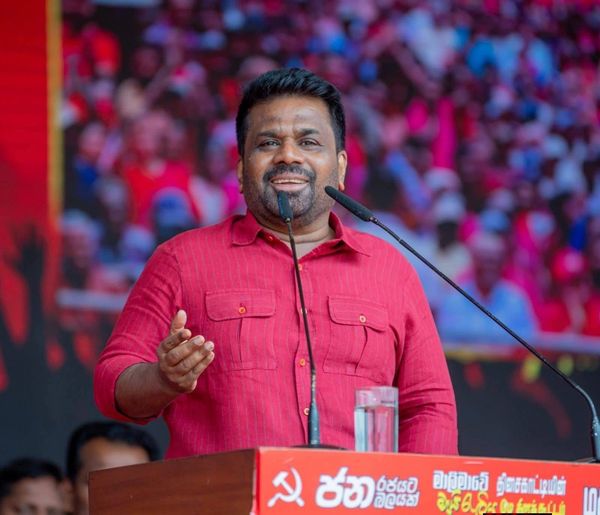
Addressing the National People's Power May Day rally in Maharagama on May 1, President Dissanayake stated, with regard to a pending case, that the hearing had taken place the previous day and that the judgment would be delivered on May 25. He urged his audience to be prepared to greet the verdict with warm applause.
The President also declared that 2026 would go down in Sri Lanka's history as the year when "the corrupt, the crooks, and the thieves were sent to prison," telling supporters there were ten cases before the courts that month alone. He said the government was strengthening key investigative and legal institutions, including the Criminal Investigation Department and the Bribery Commission, and warned that a significant number of individuals accused of fraud and corruption would face imprisonment in 2026.
The case at issue, which the president did not name publicly, involves Udayanga Weeratunga, Sri Lanka's former Ambassador to Russia, who faces corruption charges related to alleged irregularities in the acquisition of MiG-27 aircraft from Ukraine and an Airbus procurement deal during former President Mahinda Rajapaksa's tenure. The U.S. State Department imposed travel bans on Weeratunga and a co-accused over what Washington described as significant corruption.
The Constitutional Dimension
The submission cites Article 111C(1) of Sri Lanka's Constitution, which guarantees freedom from interference in judicial functions, alongside Article 111C(2), which goes further: it criminalises acts that improperly influence judicial actors. By placing this provision at the centre of their complaint, the MPs are not merely arguing that the president's remarks were inappropriate — they are signalling that they may constitute a criminal offence under Sri Lankan law.
The complaint also invokes Article 14 of the International Covenant on Civil and Political Rights, which guarantees the right to a fair hearing by an independent and impartial tribunal, and the UN Basic Principles on the Independence of the Judiciary (1985), which require that public officials refrain from actions that undermine judicial independence.
The submission’s legal analysis argues that three doctrines are violated simultaneously: the objective test of perception, under which judicial independence must not only exist but also be seen to exist; the chilling effect on judges, who may feel indirect pressure when senior executive officials publicly anticipate outcomes; and the separation of powers, which requires the executive to refrain from commentary that may affect pending judicial proceedings.
What the MPs Are Asking the U.N. to Do
The complaint makes five specific requests of the Special Rapporteur: transmit an urgent communication to the Government of Sri Lanka; seek clarification regarding the president's statement; remind the State of its obligations under international law; recommend safeguards to prevent executive interference in judicial matters; and monitor ongoing developments, including the referenced May 25 verdict. The MPs have also consented to the communication being shared with the Sri Lankan government — a procedural step that puts Colombo formally on notice that the complaint exists.
The urgency section of the document warns of "irreparable damage to institutional credibility" and cautions that failure to address such conduct may "normalise executive encroachment" over the judiciary.
The Legal and Institutional Response
The Bar Association of Sri Lanka expressed grave concern over the president's remarks on May 5, warning that the tenor of the statement is open to the suggestion of interference with the judicial process and that such comments may erode public confidence in the independence of the judiciary. The BASL cited constitutional provisions prohibiting external influence over judges and pledged to take all necessary steps to safeguard the Constitution.
The Free Lawyers Association separately urged the Chief Justice to investigate, alleging that the president's statement went beyond a general comment on judicial processes and included specific references to timelines.
A separate petition submitted directly to Chief Justice Preethi Padman Surasena — signed by former President Ranil Wickremesinghe, Prof. G. L. Peiris and M. A. Sumanthiran, P.C., among others — described the president's statement as having "the most significant implications for the integrity of the judiciary and the separation of powers." The petitioners characterised the statement as "a contempt of court" and "a despicable attempt to bring pressure to bear on a judge in relation to a case being heard before him."
Chief Opposition Whip Gayantha Karunatileka separately submitted a special resolution to Speaker Jagath Wickramaratne calling for an urgent adjournment debate in Parliament to "strongly condemn the influence and interference of the executive on the independence of the judiciary."
SLPP National Organiser Namal Rajapaksa alleged that it had become evident during the May Day proceedings that key judicial decisions were being communicated from the JVP platform.
The Government's Defence
The government has pushed back hard. Justice and National Integration Minister Harshana Nanayakkara said the opposition was attempting to misinterpret the president's remarks, declaring that the president had never interfered with the judiciary under any circumstances and that there was no need for the NPP to do so. The minister characterised opposition media briefings as evidence that they were "struggling to cope with the developing situation" — and suggested those who had done nothing wrong had nothing to fear from the courts.
A Contested Backdrop
The opposition and civil society critics have also noted that Transport Minister and House Leader Bimal Rathnayake used the same May Day occasion to name nearly ten politicians, both sitting and former lawmakers, who were to be summoned to courts beginning in May. Legal observers said the combined effect of the president's remarks and those of his minister created the impression of coordinated political messaging around pending judicial proceedings.
The Free Lawyers Association argued that the NPP appeared to have used May Day to counter growing accusations over a series of domestic controversies — including the Colombo port container controversy, a coal procurement irregularity, a Rs. 13.2 billion NDB fraud, and the reported theft of USD 2.5 million from the Treasury.
The episode threatens to complicate President Dissanayake's carefully constructed image as a break from the corruption of his predecessors. His NPP government swept to power in 2024 on a sweeping anti-corruption mandate and has built much of its political identity around prosecuting previous administrations. Critics now argue that the government’s prosecutorial zeal has created the appearance that it is prejudging the outcomes it seeks to secure, crossing a line that, under both Sri Lanka’s Constitution and international human rights law, the executive is not permitted to cross.
The verdict in the case cited by the president is due on May 25.