
By M.R. Narayan Swamy
One day, dozens of children from a convent school flocked to the Kamakoti Peetam at Kanchipuram in Tamil Nadu to take the blessings of the now late Sri Chandrasekharendra Saraswati, undoubtedly one of modern India’s greatest and most revered Hindu saints.
The Mahaperiyava, as he was addressed, gave each student, boy or girl, a banana as prasadam or holy offering. He later told his aides that many of the students were Christians, and it would not have been correct to offer them vibuthi (sacred ash) as he would normally do to devotees.
Chandrasekharendra Saraswati presided over the ancient Math for 87 long years from the age of 13 until he passed away in 1994. During this period, the saint acquired a spiritual halo few Indians have attained in modern times, and came to be widely known as Nadamadum Kadavul or Walking God.
One reason for his immense popularity was that, despite being a pontiff and immersed in the Vedas, he never imposed his views on others, always gently guiding the millions who thronged to him to lead a good life based on values such as honesty, simplicity, and sincere, even if brief devotion to God.
He did not want Hindus to shed their religion, and he was equally opposed to Muslims or Christians giving up their religion to embrace Hinduism. “Be honest to the religion you are born in,” he always maintained. Secular to the core, he respected everyone irrespective of the religious divide.
This is why, when A.P.J. Abdul Kalam, an eminent scientist from Tamil Nadu’s Rameswaram and a Muslim by birth, was to become the President of India, he spent the night at the Kanchipuram Math before flying the next day to New Delhi to take the oath of office. This was after the Mahaperiyava had shed his mortal coil.
Amid such secular ethos, it is sad to hear some sceptics point out, at times in hushed tones, that Tamil film superstar Vijay, who on Sunday became the chief minister of Tamil Nadu, is a Christian – as if it is a crime to be one.
It was in 2019 or 2020 when H. Raja, a leader of Prime Minister Narendra Modi’s Bharatiya Janata Party (BJP) in Tamil Nadu, began referring to the actor by his full name, Joseph Vijay, in a bid to highlight his Christian identity.
Until then, most people, including those who knew which religion the actor was born into, simply knew him as and called him Vijay – a screen name he has had for decades.
Raja, like many who share his political beliefs, seemed to think that the people of Tamil Nadu, where the overwhelming majority are Hindu, would have a problem if they knew that Vijay was a Christian. This was far from the truth.
Soon after Raja got into the act, Vijay – born to a Christian father and a Hindu mother- issued a statement on a letterhead bearing the name Joseph Vijay. From then onward, he carried that name openly, almost like a personal defiance.
By the time Vijay gave birth to the Tamilaga Vettri Kazhagam (TVK) just two years ago, there was hardly anyone in Tamil Nadu (or admirers beyond) who did not know that he was a Christian.
As the Tamil Nadu election results clearly showed, the masses are not bothered by his faith. For most people, his religion is a personal matter — one between him and God.
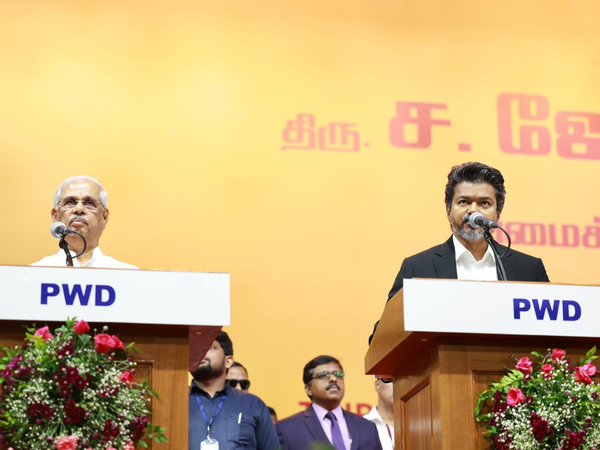
On Sunday, his full name — C. Joseph Vijay — was written in bold letters in both Tamil and English at Jawaharlal Nehru Stadium, where the oath-taking ceremony took place.
Those close to the actor admit that Vijay is aware of the growing politico-religious fissures in India, more so in areas where the BJP is on the ascendency. He knows he needs to tread carefully on matters related to religion.
Unlike some in Tamil Nadu politics who called themselves secular but constantly made fun of Sanatan Dharma, the actor has told aides that his belief in secular values is total and he won’t attack any religion.
Can Vijay govern a state as large and complex as Tamil Nadu without any administrative experience and with only two years in active politics?
These are valid questions. But this line of thinking presupposes that people with long political careers are unlikely to make mistakes.
Nothing could be farther from reality.
Muthuvel Karunanidhi was, without doubt, one of India’s most experienced politicians. He was also widely seen as a good administrator, including by officials who did not embrace his political ideology.
But during the fag end of his career, he made one mistake after another as the Tamil Nadu chief minister, including by allowing the Tamil Tigers from Sri Lanka a free run in the sprawling Indian state.
This led to his government’s dismissal in January 1991 by New Delhi. By then, however, the LTTE had prepared a fertile terrain in the state, which it could exploit to grotesquely assassinate former Indian Prime Minister Rajiv Gandhi.
“He is only an actor,” a disgruntled AIADMK leader remarked the other day about Vijay.
True, indeed. But so was M.G. Ramachandran, or MGR. He may have been involved with the DMK for a long time and may have founded the AIADMK, but his popularity primarily stemmed from his screen image — the hero who always fought the villains and ensured justice for the masses, especially the poor.
Wasn’t Jayalalithaa an actor too? If MGR ruled Tamil Nadu for a decade until his death in December 1987, Jayalalithaa’s reign lasted 14 years over six terms. During this period, the DMK could only huff and puff, although it was led by supposedly more “experienced” leaders.
We don’t know if Vijay will emerge as a good administrator in Tamil Nadu. He may or may not succeed. Governance is no joke, more so if you uphold values that other powers that be may not be comfortable with.
Whatever happens, Vijay should be judged by the governance he provides to a state of 85 million people, by the promises he keeps, and by what he ultimately delivers. What should not be targeted is his religion — or even his troubled personal life.