By M.R. Narayan Swamy
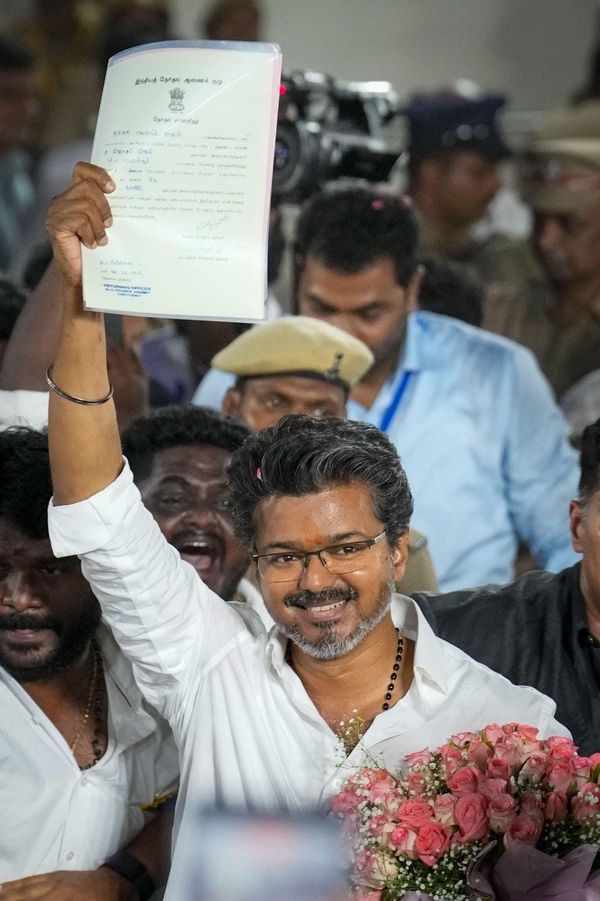
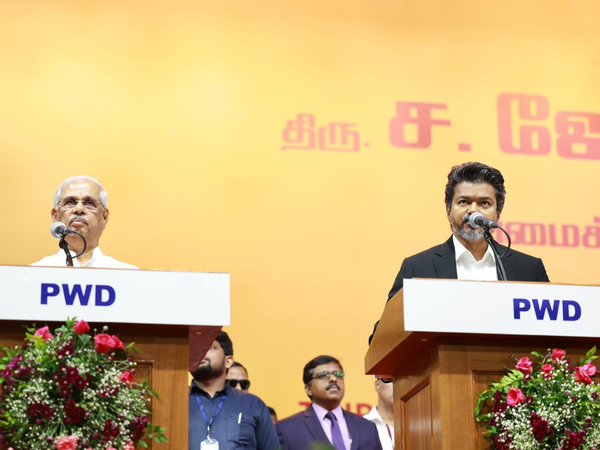
Just 824 days after he took to politics, Tamil superstar Vijay, nee C. Joseph Vijay, on Sunday, took oath as Tamil Nadu’s new chief minister amid cheers and wild whistling by thousands of supporters, and immediately vowed to provide “a new era” to one of India’s biggest states now saddled with a huge debt.
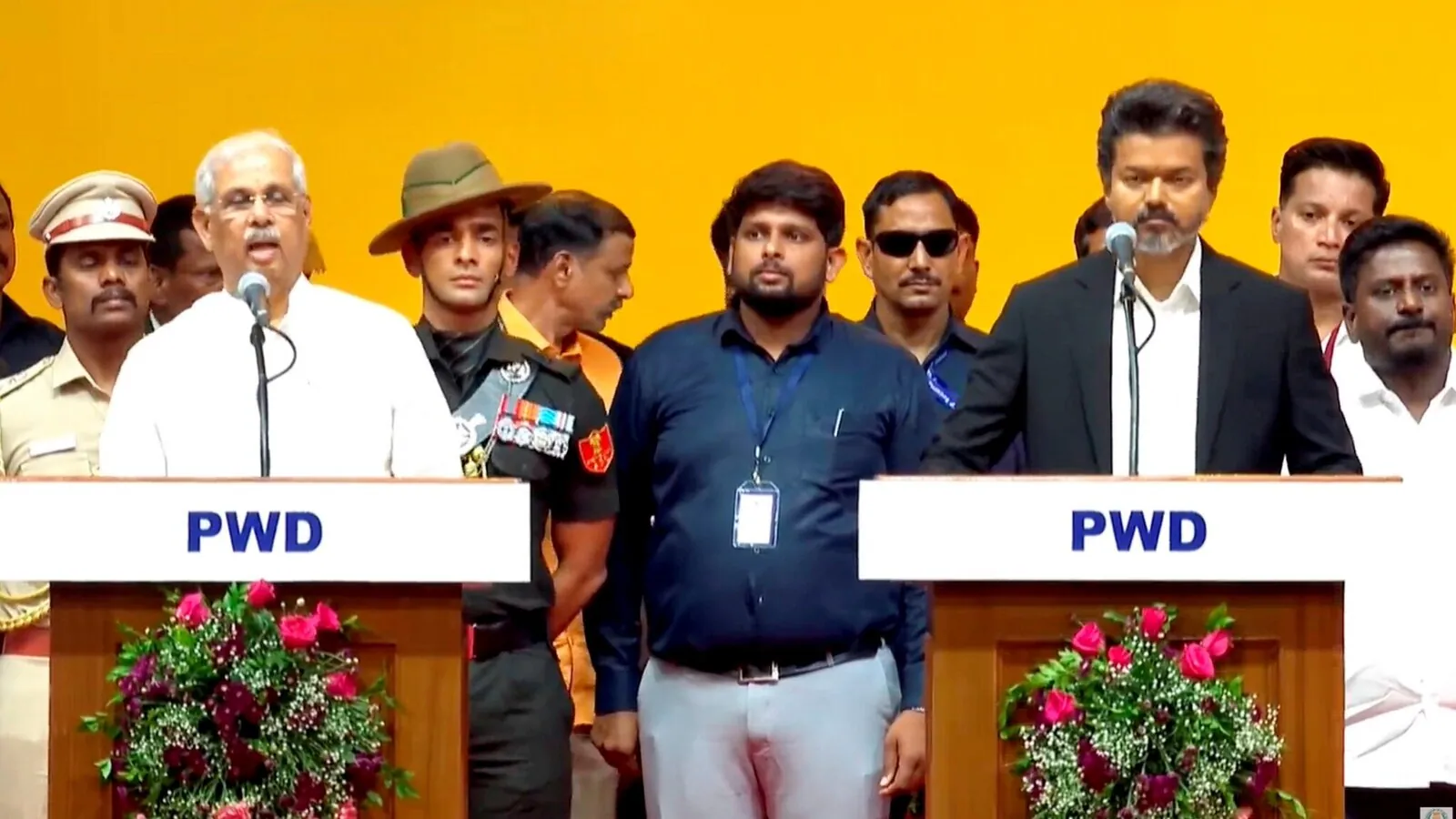
As a packed Jawaharlal Nehru stadium roared in approval, Vijay, 51, was administered the oath of office and secrecy by Governor Rajendra Vishwanath Arlekar, who, until Saturday evening, refused to let him be the chief minister until he furnished proof that he enjoyed a legislative majority.
Vijay, who had founded the Tamilga Vettri Kazhagam (TVK) only in 2024, and the nine ministers – the youngest being the sole woman in the ministry – took the oath in Tamil. Barring one, all did so in the name of God.
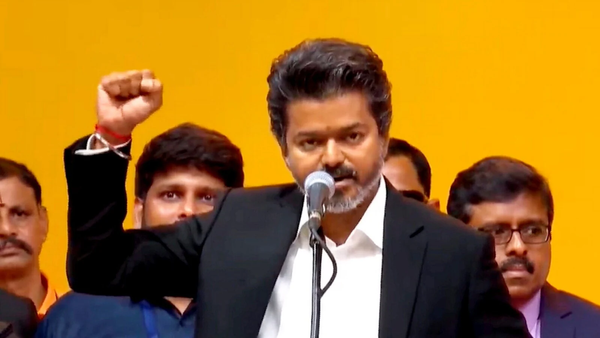
“This is a new era,” the TVK leader later told the jubilant supporters in a brief speech in Tamil laced with English.
And to show that he was a man who keeps his word, the first three files he signed as chief minister included one to provide 200 units of free electricity a month to every household consuming under 500 units per month, and two others to establish a Women Protection Force and an Anti-Drug Squad in every district across the sprawling state.
In his speech, he accused – without naming anyone – the outgoing DMK government of leaving behind a whopping debt of Rs 10 lakh crore and said his first priority would be to release a White Paper on the state of the economy. “This is the first thing I want to do.”
Speaking at times in movie style, with his right hand clenched in the air, Vijay told admirers and detractors alike that he would be no pushover despite his limited political experience and lack of administrative skills.
“There will be only one power centre — and that will be me,” he said, as the swaying crowds lapped it up. He made it clear that he would not allow anyone in the party to indulge in corruption, whoever they may be.
“I promise the people of Tamil Nadu that I will never misuse even a single rupee of public money. I have not entered politics for wealth… I will never allow corruption.”
Knowing he had made some promises during the election campaign that won’t be easy to implement, Vijay urged the people to have patience and give him time to settle down so that he can keep those pledges.
The actor-turned-politician, born to a Christian father and a Hindu mother, vowed to uphold secular values and work for social justice.
“Be confident,” he said towards the end of his speech. “Only good things will happen. Victory is ours!”
Sunday’s event was also attended by Congress leader Rahul Gandhi, as well as Tamil Nadu heavyweights from Prime Minister Narendra Modi’s Bharatiya Janata Party (BJP), including Nainar Nagendran and Dr. Tamilisai Soundararajan.
Notably absent, however, were outgoing Chief Minister and DMK veteran M.K. Stalin, AIADMK leader Edappadi K. Palaniswami, and Viduthalai Chiruthaigal Katchi leader Thol. Thirumavalavan, whose party also extended legislative support to TVK.
The ceremony brought to light the faultiness running through Vijay’s family.
While his parents were seated prominently in the front row and became teary-eyed during the oath-taking, Vijay’s son and daughter kept away. Vijay is estranged from their mother, Sangeetha, a Jaffna Tamil now in the UK. He is now in a relationship with the well-known Tamil actor, Trisha Krishnan, who attended the event dressed in a bright blue sari and looking overjoyed.
Those who took the oath as ministers were N. Anand, Aadhav Arjuna, K.G. Arunraj, K.A. Sengottaiyan, P. Venkatramanan, R. Nirmalkumar, Rajmohan, T.K. Prabhu, and S. Keerthana.
After Vijay, the loudest cheering and boisterous clapping were for Sengottaiyan, a veteran politician who was formerly in the AIADMK. It was only for him that Vijay stood up from his chair and clapped lustily.
Five of the ministers, including Vijay, were elected from Chennai, the state capital, which tilted heavily in favour of TVK in the April elections. Venkataramanan, also from Chennai, is the first Brahmin to serve in a Tamil Nadu cabinet since the late Chief Minister J. Jayalalithaa.
The portfolios of the chief minister and the ministers will be announced during the day.
Vijay may be just one of India’s 28 chief ministers, but no one else in Indian state politics has received more congratulatory messages from neighbouring Sri Lanka, which is separated from India by a narrow strip of sea.
“Sri Lanka and Tamil Nadu are connected through history, culture, enterprise, and enduring people-to-people ties across generations,” President Anura Dissanayake said in a message to Vijay on X.
“Our future holds immense economic promise and opportunity as Sri Lanka and India continue to build ever closer ties and a stronger partnership,” he added. “I look forward to working together …towards great prosperity and progress.”
Tamil Nadu is still home to thousands of Sri Lankan Tamils who fled the island to escape the ethnic conflict. While many of them would like to return to their country one day, many others want to remain in India as Indian citizens.
It is also bottom trawlers sailing from the Tamil Nadu, which are the heart of a dragging fishermen row involving Sri Lanka and India.
Prime Minister Modi also congratulated Vijay, offering him best wishes “for a successful tenure”. He promised to work with the Tamil Nadu government for the sake of the people.
At the same time, speaking in Bengaluru, Modi took a swipe at Rahul Gandhi, accusing him of unceremoniously dumping long-time ally DMK after the latter was routed in the Tamil Nadu battle and embracing the TVK.
“Time and again, the alliance with the DMK pulled the Congress out of crises,” Modi pointed out. “Yet, the very DMK that consistently worked for the betterment of the Congress was betrayed the moment the political winds shifted,” said Modi, speaking in his characteristic style.
Vijay’s elevation as chief minister marks the formal end of decades of Dravidian party rule in Tamil Nadu, where no non-Dravidian outfit had been able to seize power since the DMK ended Congress’s monopoly in 1967, riding the emotive winds of anti-Hindi sentiment and regional identity.