
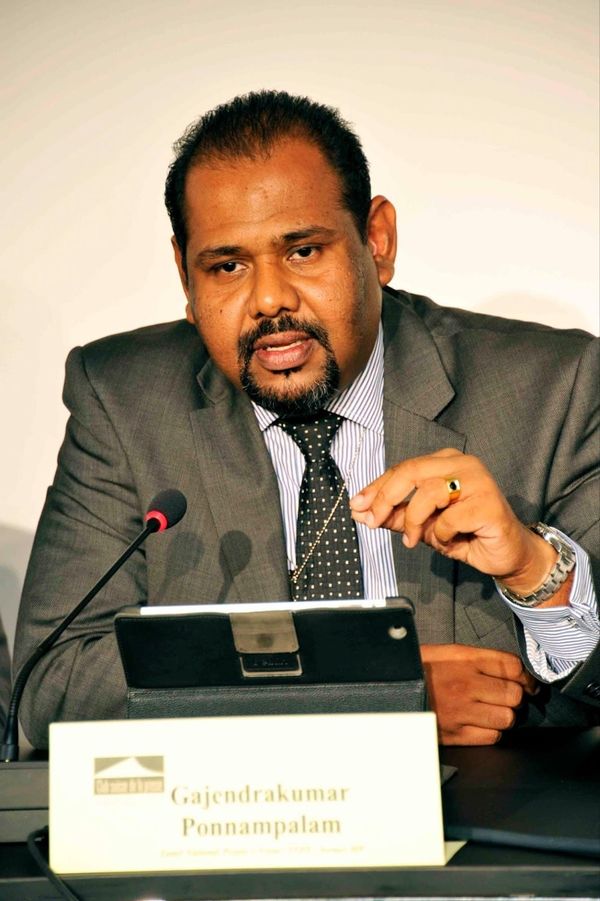
Tamil National People’s Front (TNPF) leader and Jaffna District MP Gajendrakumar Ponnambalam has made explosive revelations about the final days of Sri Lanka’s civil war, alleging that the Liberation Tigers of Tamil Eelam (LTTE) sought a humanitarian ceasefire to evacuate trapped civilians — but that the government instead intensified its military operations.
Mediator Between the LTTE and the Government
In a recent address, Gajendrakumar revealed that he personally acted as a mediator between the LTTE leadership and the Sri Lankan government during a critical 72-hour period between May 16 and 18, 2009, when an estimated 150,000 civilians were trapped in Mullivaikkal.
Political observers note that the MP had long remained silent about any such mediatory role. His revelation now appears to confirm long-standing speculation that he had been in contact with both parties during the war’s final phase.
White Flag Controversy
Several Tamil leaders, including fellow Tamil nationalist MP Sritharan, have previously accused Gajendrakumar of involvement in the controversial “white flag” incident, in which several LTTE leaders were killed while reportedly attempting to surrender.
Sritharan alleged that Gajendrakumar’s role as a mediator with the government may have facilitated the surrender and questioned his long silence on the matter. He also challenged Gajendrakumar to disclose his communications with British journalist Marie Colvin, who was reportedly involved in efforts to arrange the surrender, arguing that the public “deserves transparency” about his actions during those critical days.
Ceasefire Proposal
Detailing his version of events, Gajendrakumar said LTTE Political Wing Head S. Nadesan and Peace Secretariat Chief S. Pulithevan personally contacted him to convey their willingness to agree to a temporary ceasefire that would allow civilians to leave the war zone safely.
“The LTTE leadership told me they were ready for a ceasefire to ensure civilians could move to safety,” he said. “They asked me to convey this to Basil Rajapaksa, and I did. I am a witness to this.”
At the time, then–Economic Development Minister Basil Rajapaksa was handling government communications while President Mahinda Rajapaksa was overseas.
Government Response and Breakdown
According to Gajendrakumar, Basil Rajapaksa acknowledged the LTTE’s proposal, and the matter was later discussed at the National Security Council meeting following President Rajapaksa’s return on May 17.
“There was an understanding to allow a delegation, including the late Bishop of Mannar Rayappu Joseph, to enter LTTE-held areas and facilitate the safe evacuation of civilians,” he recalled. “These discussions were held around 8 p.m. on May 16.”
However, Gajendrakumar alleges that instead of facilitating civilian evacuation, the Sri Lankan military launched heavy artillery attacks on LTTE-controlled areas.
“Rather than enabling civilian evacuation, what took place was a mass killing of civilians within LTTE-controlled territory,” he claimed. “I personally witnessed these events. What happened was a massacre of Tamil civilians.”
Conflicting Accounts from Former LTTE Members
A few credible sources who spoke with Jaffna Monitor, including former LTTE leaders, confirmed that the LTTE did indeed seek a ceasefire — not only to evacuate civilians, but also as part of a broader arrangement that included the safe surrender of several top LTTE figures such as S. Nadesan, S. Pulithevan, Pulikalin Kural radio head Jawan (also known as Tamil Anban), LTTE police chief Ramesh (also known as Ilango), and others.
However, several parents whose children were brutally abducted by the LTTE’s abduction wing have accused Jawan and Ramesh of masterminding large-scale child conscription during the height of the war. Yet, they stress that nothing can justify the killing of children, women, or the leaders themselves, all of whom had surrendered to the army.
According to these sources, the negotiations involved Gajendrakumar and a few others. Under the deal, the government had allegedly agreed to accept the surrender of the LTTE leaders who would approach carrying white flags — but they were ultimately executed instead.
Fonseka’s Explosive Allegation
In a recent press conference, former Army Commander Field Marshal Sarath Fonseka stated that he has credible evidence proving that Gotabaya Rajapaksa, who was then Secretary to the Ministry of Defence and brother of President Mahinda Rajapaksa, had ordered Major General Shavendra Silva, then commander of the 58 Division, to eliminate those who came forward carrying white flags to surrender.
Endgame and Accountability
The final phase of Sri Lanka’s 26-year civil war ended on May 18, 2009, with the defeat of the LTTE. The closing weeks of the war remain highly contentious, with multiple reports — including those by the United Nations — documenting violations of international humanitarian law by both the Sri Lankan military and the LTTE.
The UN estimates that up to 40,000 Tamil civilians may have been killed in the war’s final months, though exact figures remain disputed.
Successive Sri Lankan administrations — including Mahinda Rajapaksa’s and those that followed — have consistently denied allegations of war crimes, maintaining that all military operations were conducted in compliance with international humanitarian law. However, international human rights bodies and independent observers continue to present evidence that contradicts those official claims.