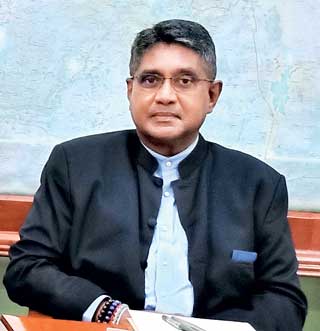
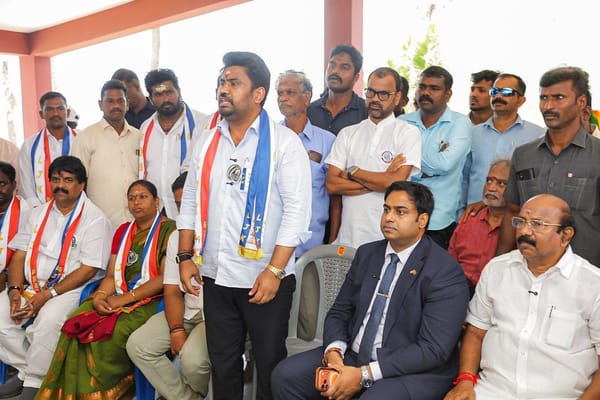
CHENNAI, India — April 6, 2026 — Sri Lanka’s Deputy High Commissioner for South India, Ganesanathan Ketheeswaran, has come under scrutiny following allegations that he attended a politically linked gathering in Puducherry, drawing criticism from Indian opposition figures and raising questions about diplomatic conduct during an election period.
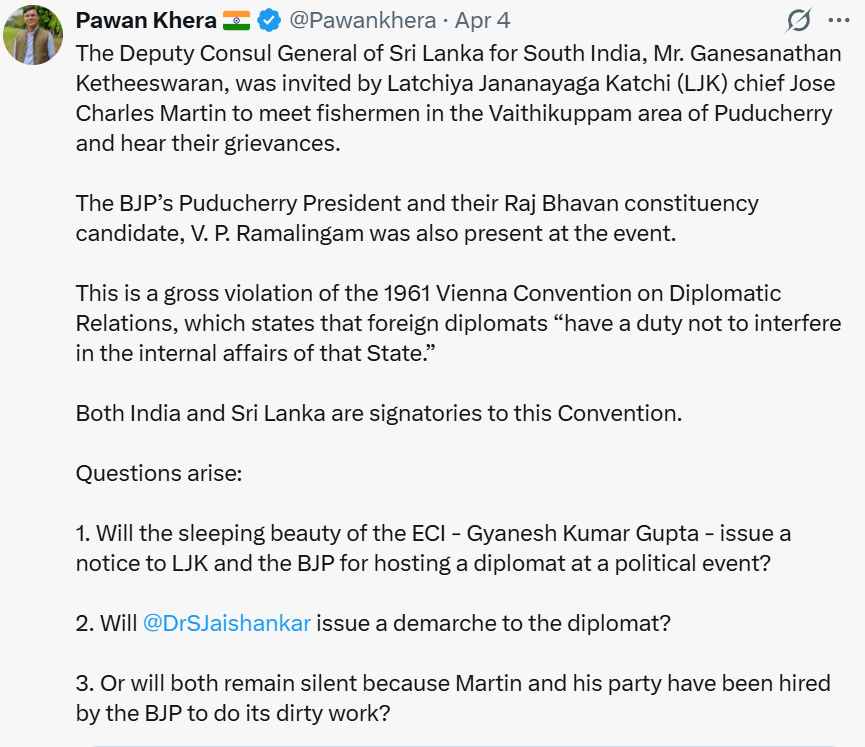
Pawan Khera, a senior leader of the Indian National Congress, alleged in a social media post that Mr. Ketheeswaran participated in an event organized by a regional political party, calling it a “gross violation” of the 1961 Vienna Convention on Diplomatic Relations, which prohibits foreign diplomats from interfering in the internal affairs of a host country.
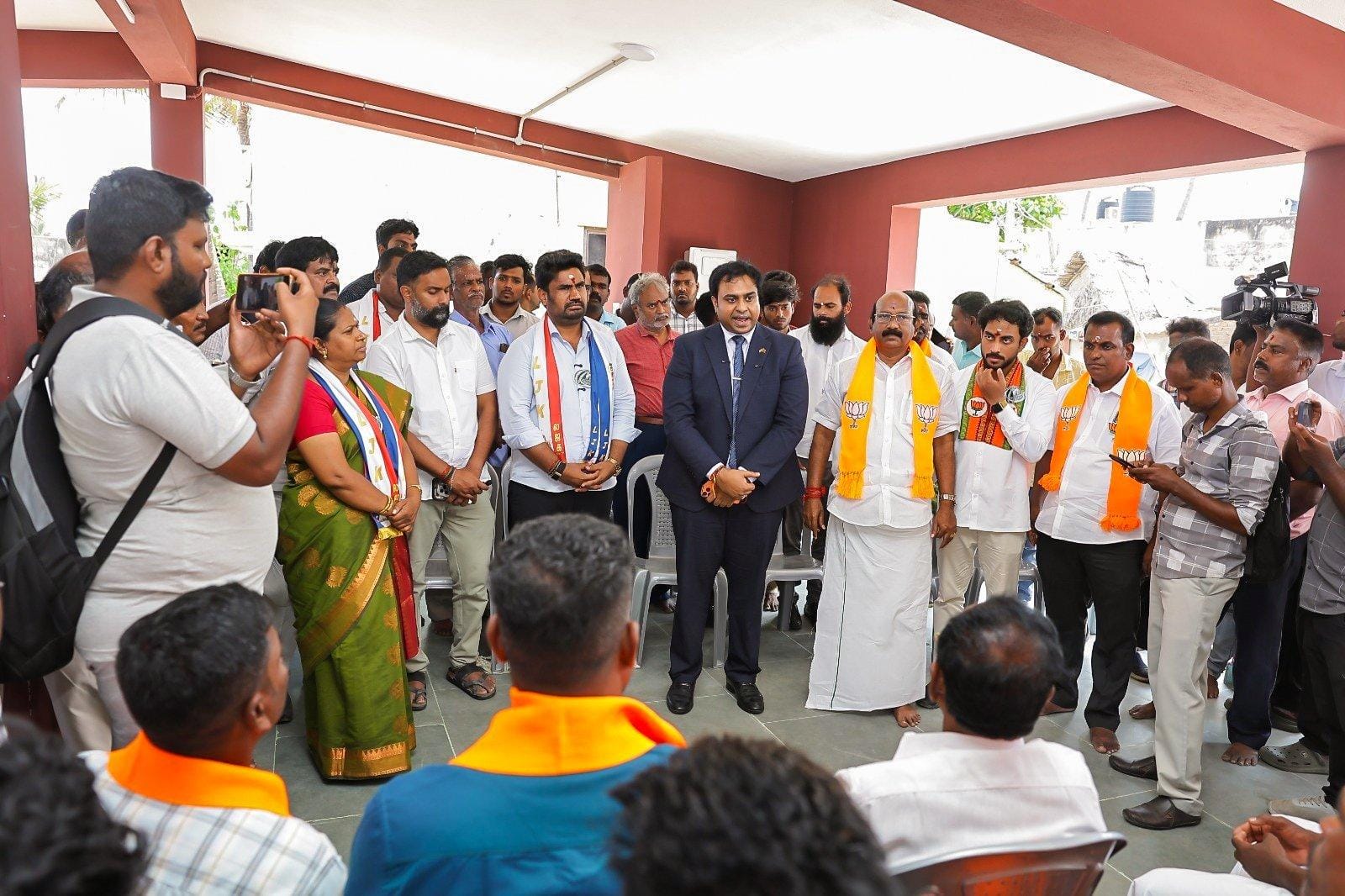
Khera said the diplomat had been invited by Jose Charles Martin — leader of the Latchiya Jananayaga Katchi (LJK) and son of businessman Santiago Martin — to meet fishermen in the Vaithikuppam area of Puducherry. He also noted the presence of V. P. Ramalingam, the Bharatiya Janata Party’s (BJP) Puducherry president and a candidate in the Raj Bhavan constituency.
In his post, Khera questioned whether India’s Election Commission would act against the organizers and whether External Affairs Minister S. Jaishankar would issue a formal diplomatic protest.
The allegations come at a sensitive time, with electoral activity underway in parts of India.
Mr. Ketheeswaran has denied participating in any political campaign, describing the visit as routine engagement with fishing communities.
“I’m not here to do politics,” he said in an interview with The Hindu, adding that the meeting was held in an open, public setting and was not organized by any political party. He said he had regularly met fishermen across Tamil Nadu — including in Puducherry, Nagapattinam and Kanniyakumari — as part of his official duties.
Jose Charles Martin acknowledged inviting the diplomat, describing the interaction as a discussion on issues faced by fishermen in Puducherry and Karaikal. He said the invitation was extended on the basis of a personal relationship and that the meeting focused on livelihood concerns.
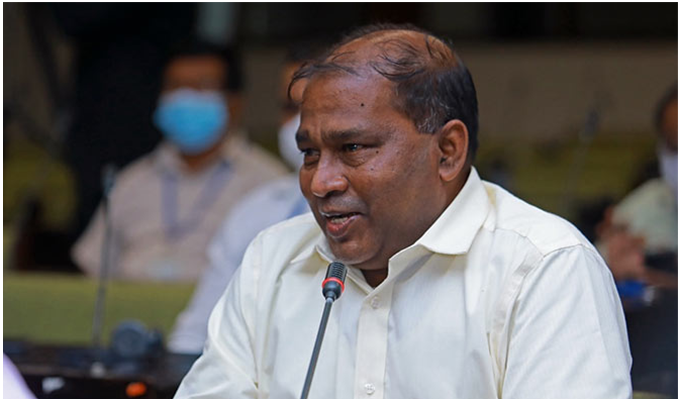
Photographs shared on social media appeared to show the diplomat addressing a gathering that included political figures, intensifying the controversy.
Diplomatic observers say the episode underscores the sensitivities surrounding foreign officials’ public engagements during election periods in India, where even informal appearances can carry political implications.
Some diplomatic sources, speaking to Jaffna Monitor on condition of anonymity, said the incident reflected a serious lapse in judgment and a failure to appreciate the political context in which the interaction took place.
“Diplomats are expected to exercise a high degree of caution during election periods,” one former diplomat said. “Even indirect association with politically affiliated actors at such a time risks being interpreted as interference.”
The sources added that such appearances can signal either inexperience or an attempt to cultivate visibility among politically influential figures — both of which, they said, fall short of expected diplomatic standards.
The controversy has also drawn attention to the political context surrounding the event’s organizers.
Jose Charles Martin is the son of Santiago Martin, a businessman widely known in India’s lottery sector. Originally a returnee from Myanmar who began as a daily-wage labourer, he later built a large lottery business that expanded across India, including into northern states and Nepal. Over the years, he has faced allegations related to his lottery operations, which he has denied.
Public disclosures show that his company, Future Gaming and Hotel Services, purchased electoral bonds worth ₹1,368 crore between 2019 and 2024, making it the single-largest contributor under the scheme.
In the current election cycle, members of the Martin family are aligned with different political parties. Jose Charles Martin is contesting in Puducherry as a BJP ally, while his mother is contesting from the AIADMK, and his brother-in-law is contesting under actor Vijay’s Tamilaga Vettri Kazhagam (TVK).
Critics say the convergence of political interests and influence in this context raises further questions about the appropriateness of a foreign diplomat’s presence at such an event.
The Sri Lankan government has not issued an official statement, and it remains unclear whether the episode will prompt a formal diplomatic response.
A Cautionary Tale Written in Real Time
The episode in Puducherry did not emerge from a vacuum. It was the predictable consequence of a decision made in Colombo.
Ganesanathan Ketheeswaran, sources familiar with the Foreign Ministry say, is not a career diplomat. He has no prior experience in the Sri Lanka Foreign Service or formal diplomatic training. By multiple accounts, he is a known supporter of the Janatha Vimukthi Peramuna (JVP), appointed to one of Sri Lanka’s most sensitive overseas postings.
The appointment, officials say, was met with quiet frustration within the foreign service. “There are officers who have spent years training in diplomacy and international relations,” one senior official said. “This is a posting that requires experience and judgment.”
The Chennai mission is no ceremonial role. It is Sri Lanka’s frontline engagement with southern India — navigating fraught fishing disputes, Tamil Nadu’s volatile political climate, and the enduring sensitivities of post-war relations. It demands a diplomat who understands where the minefields are.
Mr. Ketheeswaran walked straight into one.
The irony is difficult to ignore. The National People’s Power came to office promising to dismantle a culture of political patronage — a system in which diplomatic postings were long treated as rewards for loyalty. That promise now sits uneasily alongside this appointment.
Sri Lanka’s Foreign Ministry now faces uncomfortable questions: how many key diplomatic postings are shaped by political considerations, and how many trained officers have been overlooked? And who approved placing a politically affiliated figure in one of the country’s most sensitive foreign missions?
The answer, for now, was visible in Puducherry.