Translated from the original Tamil short story makkattuc cālvai (மக்கத்துச் சால்வை) from the eponymous 1992 collection of short stories by S.L.M. Hanifa. The original collection is available at noolaham.org. If you have any questions, please contact ez.iniyavan@gmail.com.
“Thambi! Mammanifā, do you remember me, son? That day, your wāppā and everyone else remained mum. You were a little boy. But you spotted it like a vigilant crow. You shouted as if you were raise the alarm.”
“He is hit, he is hit, Aṇṇāviyār is hit on the head!”
“Only you saw the hit, son. Even today, your shout keeps resonating in my ears.”
The fight happened so long ago. But it is still fresh in my heart, as if it happened just yesterday …
In those days, the fragrance of the impending Haj celebration would start wafting in the air three or four days prior to the holy day itself.
On the eve of the Haj, Paiyeṉṉā “hotel” was abuzz with activity. The two showcases sparkled; the delicacies arranged within them twinkled. The fragrance of the muscat, lovingly matured in cow ghee by Paiyeṉṉā’s hand, was irresistible. A piece cost twenty cents. A cup of tea was ten cents.
The tea made by Paiyeṉṉā’s hand using “Nona brand” condensed milk had its own unique deliciousness. It was magical how the touch of his hand blending the condensed milk and the tightly infused tea water elevated the taste.
On exiting the “hotel” after a bite of the muscat and a sip of tea, one noticed the flyer, stuck to the portia tree which was like a natural air conditioner for the hotel.
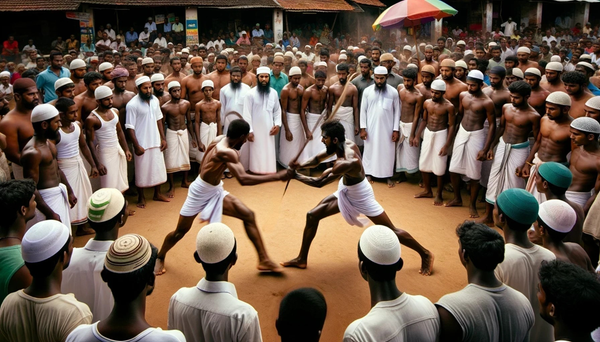
To mark the Haj, there was going to be a grand martial arts competition following the Asr evening prayers at the mosque. Challengers were invited to fight Nūhuththambi, renowned teacher of cheeṉadi—the stick-based martial art in Eastern Sri Lanka inspired by ancient Shaolin monks. The victor would be rewarded with a Meccan Shawl and an entire cluster of paṟangi plantains.
The holy day celebrations that year had been grand. The sun had reached its peak overhead and had started on its lopsided descent towards Uppāṟu. Multitudes from the neighboring villages swarmed towards the village marketplace.
We, the village tots, crouched down on our haunches, squeezing between the legs of adults in the front row.
The village headman and the mattichem trustees from the mosque were managing the crowd. Time crawled. The challenger aṇṇāviyār and his disciples were getting restless. Teacher Nūhuththambi who had issued the challenge was nowhere to be seen. Everyone kept looking at the riverside road. Sarcastic talk and putdowns started raising their heads. At a distance, a bicycle was hurtling fast towards the market.
“Here he is! Hoyrā…!”
A roar went through the crowd instantly rekindling the buzz.
It was indeed Nūhuththambi. He hopped off the bicycle seemingly without slowing down, handing the bicycle over to someone else. The next instant, he leapt to the center of the street where the challenge fight was to take place.
He had a physique like an ebony tree. The years of casting fishnets had reinforced his arms and legs. He looked like a bull that could not be tamed.
Once again, applause and whistles rose up from the crowd. He removed the Indian ‘pazhaiyagād’ sarong he was wearing. The sarong flew from his hand over to the portia tree and stuck to it. Inside he was wearing the siṟuvāl underwear covering his thighs down to his knees, and a sleeved undershirt.
From his buffed chest, two long arms emerged like fine swords. Rooted to the same spot, he swirled his hands bent down suddenly—having first leapt into the air—to kiss the ground, seeking permission and the traditional ritual salām varisai salute of cheeṉadi practitioners. The crowd went into an ecstatic roar and calmed down.
The village headman made the formal announcement: “Anyone who wants to challenge Nūhuththambi, come forward!”
A figure emerged at the far end of the teeming crowd. It swirled and twirled, moving through the lightning streaks traced by the rapid movements of the pole, made of wood from a kalviṇṇāṅku tree, held in its hands. The kalviṇṇāṅku pole whooshed with a high-pitched howl.
In their excitement, the spectators’ feet barely held on to the ground below them. The hands and feet of those who knew how to play cheenadi were itching to get into the arena.
“The winner of this game will be given a cluster of plantains as the prize and will be honored by the draping of a Meccan shawl.”
The village headman’s announcement elicited thundering applause.
Ahmadlebbe Aṇṇāviyār stood on one side, Teacher Nūhuththambi on the other. Each unique in his own ways. A peerless pair.
First, they stood facing each other, sixteen cubits apart. The headman yelled, “Start!” The next instant, both kicked up dust storms as they took their salām varisai.
They swirled like whirlpools—leaping into midair—as four arms sliced the air like lightning…. people’s eyes only saw two amorphous figures spinning like tops.
Having taken their salām varisai, they retreated to their corners and stood there.
Weligāmam Maulana Wāppā was Ahmadlebbe Aṇṇāviyār’s guru. Wāppā’s son took the cheeṉadi stick blessed by Maulana Wāppā and handed it to the Aṇṇāviyār who grabbed onto it respectfully.
The stick stood between the fingers in his hands and danced with a high-pitched drone. The one stick became four, and then sixteen, and exploded into many more, weaving a magic trick for the watching eyes.
On the opposite side, Teacher Nūhuththambi stood holding the cheeṉadi stick blessed by his guru, the Indian nānā.
It was a bamboo cane with silver rings at either end. He lifted it with his right hand and swirled it.
His left hand remained motionless while the right hand twisted and turned. That was a skill and facility that only he excelled in. Like a silver bird flying with its entourage, weaving up and down in pitch-perfect formation before disappearing into the horizon, the silver-ringed cane in Nūhuththambi’s hands just flew hither and thither.
The first round was over and the second began. The two crows glared intently at each other through their fighting sticks and snarled. They chased each other around … they each invited the other to battle, again and again, …. They circled each other, wearing out the opponent, and then suddenly leapt like lightning… grappling with each other…
The dust storm that rose from the ground was a sight to behold!
Out of nowhere, Nūhuththambi’s silver pigeon leapt up to lightly graze Ahmadlebbe Aṇṇāviyār’s shoulder in a flash and returned. Aṇṇāviyār, momentarily shaken, steadied himself by planting his feet firmly on the ground.
“He is hit, he is hit, Aṇṇāviyār is hit on the head!” Mammali and I screamed at the top of our voices. In the village, we had, in fact, earned a reputation for being little rascals.
“Dēy! Shut up. Who do you think you are talking to!” Eerāṅkutti, one of Aṇṇāviyār’s disciples hissed with rage.
“Not hit, not hit… yeah, right, only these misbegotten tots managed to see what all these important people couldn’t see!”
Village headman Buhāri, who was refereeing the fight, did not see what actually happened because he was momentarily distracted. The restless crowd clamored. Aṇṇāvi Ahmadlebbe’s disciples encircled the ring, grinding their teeth.
They were literally shaking, looking as if they wanted to jump on Teacher Nūhuththambi and shred him to pieces.
“Dēy! You think our man can be hit? Bring it on!” each swirled his fighting stick, seething with rage.
Teacher Nūhuththambi stood alone aghast, his hand covering his mouth. Calming Aṇṇāvi Ahmadlebbe’s disciples down was a herculean task for the village mosque’s mattichem trustees.
“Dēy! Shut up, all of you,” the headman yelled in a commanding voice, cane in hand. The crowd calmed down like an obedient kitten.
“Let us resume the fight.”
The village headman decided.
“What! Resume the fight? You must be kidding!” Teacher Nūhuththambi was adamant.
“We didn’t see you hit him…” the bulk of the crowd retorted.
Outrage surged within Nūhuththambi’s heart.
“Not only did they rob me of my victory, but they have also resorted to abuse me for my fisherfolk caste.” Tears welled up in his eyes. As if he was possessed, he picked up his silver-ringed cane in a frenzy. The fight resumed. Everyone’s eyes were fixated on the cane.. and the stick.
As the game proceeded, Nūhuththambi felt as if a fiery pearl flew through the air and struck him in the eyes. His eyes burnt. He lifted a hand towards his eyes. Just at that moment, the serpent thrown by Aṇṇāviyār bit his shoulder and retreated.
“He is hit, he is hit… Aṇṇāviyār has won.”
They lifted Aṇṇāviyār up in the air. The headman and the mattichem trustees draped the Meccan shawl over his shoulder. Paiyeṉṉā took the cluster of paṟangi plantains hanging in his eatery and handed it to Aṇṇāviyār.
They took him in a procession as the salawat prayer praising the prophet, blending with the ululations of the women, reached sky high.
“Thambi, a penny for your thoughts?”
His voice broke my reverie and brought me back from bygone memories to the present.
“I remember very well. Very well, indeed. What happened to you that day was injustice,” I said calmly.
“That day, I left behind this soil and my kith and kin. Now, I have returned after thirty years, and I am glad to see that you have grown into an important man in the village.”
His eyes became moist.
“Mammanifā, two of my kids are attending university in Colombo. My eldest went abroad to work and has returned with two outboard motors to go deep-sea fishing. Now people respect us as somebody. On that day, we didn’t get justice because we are fisherfolk. Today one of ours has become the leader of the village and of Allah’s school. Our rotting fish goes for a hundred rupees per kilo, son. It has become five times more expensive than rice.”
In his heart, the swirl that started all those years ago had grown into a roaring tsunami.
“What should we do now?”
“I want justice. I want a rematch with Ahmadlebbe Aṇṇāviyār. I want to be draped in a Meccan Shawl!” He spoke with passion.
This man has such a desire after all these years? Perhaps he is a little demented?
My heart was anguished.
“Why the hesitation? I will stay the night at my elder sister’s place. I will return after the early morning subhu prayers. Tell me your decision.”
He stroked his silvery beard that hung from his chin like cotton wool and quickly ran down the steps.
“Anybody home?” I called out.
“Come in, come in, thambi!”
Ahmadlebbe Aṇṇāviyār’s wife herself welcomed me.
“Where is Aṇṇāviyār?”
“He has gone to oversee the paddy fields in Padukādu. He should be returning any minute now,” she started moving slowly towards the kitchen …
A teapot climbed up on the clay stove. Even after fifty, her beauty was intact. All her teeth were like white pearls. There was an occasional gray streak in her hair.
“What is it thambi, you have come here after a long time?”
“I want to see Aṇṇāvi chāchā.” Even before I could finish, a bicycle peeked through the front entrance. Our ensuing conversation meandered all over the place and finally arrived at Teacher Nūhuththambi.
“Chāchā, it happened thirty years ago. But it is still fresh in my heart …”
“Yes, son! That day, it was he who …” Aṇṇāvi held himself back. His face reflected the rush of emotions. It was as if the Meccan shawl on his shoulder suddenly became unbearably heavy…
“A rematch? Why not,” he said distractedly, his thoughts dwelling on something.
“What? A cheenadi fight? These old men, at their age?” Chāchi mocked.
It was a Jummah day.
After the Asr prayers, people emerged from the mosque, having forgotten their fears and worries …
Paiyeṉṉā hotel lay in ruins—the market stalls had been long abandoned—its padlock lay rusting.
The crowds jostled as if it was a funeral.
The two seventy-year-old young men stood in the ring…
Ahmadlebbe Aṇṇāviyār tied a rubber band to the temples of his eyeglasses and tied it behind the back of his head. His eyesight had deteriorated after he hit his forties.
None of the mosque mattichem trustees from that day were alive any longer. All of them had been reunited with the soil. New blood was administering the village now.
“Begin!”
The fight started, commanded by the new village headman. Aṇṇāviyār held the same kalviṇṇāṅku-pole; its oils had dried out but still emitted the same low-pitch drone and swayed like a cobra. He squatted, straightened up and whirled, jumping into the air, and bent down again in one smooth motion to touch the soil and kiss it.
Nūhuththambi mastān had the same silver-rimmed bamboo cane. It took wings in his hand, flew around and cackled. His one-handed swirling made the bamboo cane produce an ethereal hum.
The two seventy-year-old crows swam, dived, and resurfaced. Their chests swelled up and subsided.
The fight resumed.
Nūhuththambi mastān brimmed with the thirst for revenge as he swirled like fire.
Ahmadlebbe Aṇṇāviyār stood calmly looking for an opportunity to trap his opponent. He had been parrying every blow of the bamboo cane deftly and cleverly when it happened.
Ahmadlebbe Aṇṇāviyār’s eyeglasses came loose, flew to the other side of road and shattered. At that very instant, Nūhuththambi’s white dove went right next to Aṇṇāviyār’s shoulder …
If the white dove had wanted, it could have pecked at the shoulder. It hesitated just for a moment, and retreated …
Aṇṇāviyār saw hundreds of white doves, making him gasp.
Nūhuththambi mastān slowed down. As the bamboo bird in his hand flew in circles, the train of his thoughts pleaded plaintively at him.
‘His eyesight is hazy. It is not fair for me to fight him. Even at this age, Allah has blessed me with strength and light in my eyes. That is the greatest prize.’ his conscience delivered its judgment.
The next instant, the silver-ringed bamboo dove flew away from his hands as he leapt towards Ahmadlebbe Aṇṇāviyār and embraced him to begin a musaba, the formal two-handed handshake.
Ahmadlebbe Aṇṇāviyār, too, cast away his kalviṇṇāṅku-tree pole.
The two crows embraced each other, did musaba, and kissed …
The spectators had goosebumps and tears in their eyes.
Aṇṇāviyār extricated himself from mastān’s embrace and appeared to be getting ready to say something. The crowd quietened down expectantly.
“Assalāmu alaikum! It was Nūhuththambi who won the fight thirty years ago. My empty vanity did not allow me to acknowledge that victory. He was the victor then and he is, now.” He respectfully removed the Meccan shawl which was tied around his hips. The same shawl that the crowd had draped on his shoulders to honor him for the fight thirty years ago. He brought its two edges together and flapped it vigorously, and in one deft motion, draped it around Nūhuththambi mastān’s shoulders. Tears of joy trickled down from his eyes, relieved at discarding the guilt that weighed on him all these years, and from the satisfaction of having bestowed the honor of the Meccan shawl upon its rightful recipient.
The salawat prayers praising the greatness of the prophet reached sky high. The portia tree smiled with joy. The fragrance of the attar wafting from the Meccan shawl draped around Nūhuththambi mastān’s shoulders filled the air.
– 1991 –