The War That Reached the Temple Gates: Father of LTTE Brigadier Vithusha Passes Away in Jaffna

The War That Reached the Temple Gates: Father of LTTE Brigadier Vithusha Passes Away in Jaffna


Share this post

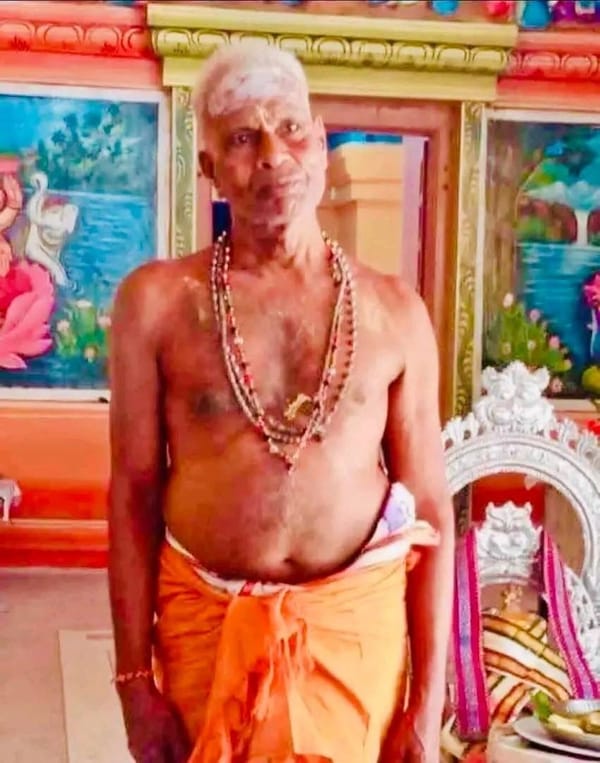
Kanthiah Kurukkal, father of late LTTE commander Brigadier Vithusha and fallen cadre Vithushan, passed away in Jaffna this week.

Hailing from a respected Tamil Brahmin family in Kappoothu, Karaveddy, Kanthiah Kurukkal lost both his daughter and son to the armed struggle. His passing has rekindled reflections on how the war reached even the most traditional families — those once devoted entirely to temple service and religious life.

Born in the Vadamarachchi region, Kanthiah Kurukkal was known for his disciplined and spiritual upbringing of his children. Yet, amid the violence and discrimination faced by Tamils during the early 1980s, both his children were drawn to the Liberation Tigers of Tamil Eelam (LTTE).

His daughter, Brigadier Vithusha, joined the movement after witnessing atrocities such as the 1985 Kumudini boat massacre. She rose through the ranks to command the LTTE’s Malathi Regiment, one of its two major women’s wings — the other led by Brigadier Thurka, commander of the Sothiya Regiment.
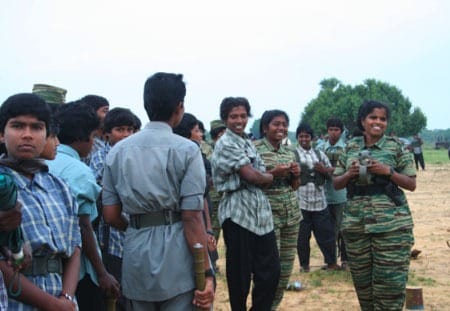
Brigadier Vithusha (right), commander of the LTTE’s Malathi Regiment, seen with her female fighters.

Kanthiah Kurukkal’s son, Vithushan, was killed in combat in 1999. A decade later, Vithusha was killed during the war’s final phase in April 2009, in what became famously known as the Battle of Aanandapuram — the LTTE’s last major attempt to fight back against the advancing Sri Lankan Army.

The Battle of Aanandapuram ended in a crushing defeat for the LTTE. The organization lost several of its top commanders, including Brigadier Manivannan, Brigadier Thurka, Brigadier Theepan, Brigadier Aathavan, Brigadier Kadafi, and many others — along with nearly 800 fighters.

It was widely seen as the LTTE’s final stand. LTTE leader Velupillai Prabhakaran was reportedly present in the area during the early stages of the battle but, after much persuasion from his senior commanders, left for the Mullivaikkal region on March 28, 2009.

A former LTTE commander told Jaffna Monitor that while Prabhakaran remained in the war zone, “the fighters’ morale was unshaken.” However, he added, “within six days of his departure, the battle was over.”

LTTE sources also state that Theepan, Vithusha, Thurka, and several other senior commanders were instructed to withdraw to Mullivaikkal, but they refused to retreat. Choosing instead to fight to the end, they remained in the Aanandapuram region, where they were ultimately killed in action.

Locals in Karaveddy remember Kanthiah Kurukkal as “the father of two maveerar (martyrs)” — a man who bore his immense grief with quiet dignity. His funeral rites were conducted in accordance with Brahmin and Tamil traditions at his son’s residence in Ponnaalai.

Many see Kanthiah Kurukkal’s life as a reflection of how the struggle for Tamil dignity and equality transcended caste and class — turning even families rooted in temple service into symbols of courage, loss, and endurance in Sri Lanka’s long and painful history of war.


Share this post

Be the first to know

Join our community and get notified about upcoming stories

Subscribing...
You've been subscribed!
Something went wrong
PSTA: When the Victims Rewrite the Law That Once Destroyed Them

PSTA: When the Victims Rewrite the Law That Once Destroyed Them

There exists a particular species of political betrayal that cuts deeper than ordinary duplicity. It occurs when those who survived state terror become its architects, when victims of arbitrary detention design new systems of indefinite imprisonment, when revolutionaries who once faced torture codify powers enabling it. Sri Lanka stands at precisely such a moment. The National People’s Power government—led by the Janatha Vimukthi Peramuna, a party whose members were “disappeared,” tortured, and


Kaniyan Pungundran

Kaniyan Pungundran

What Sri Lanka and Gaza Teach Us About the Futility of Armed Struggle

What Sri Lanka and Gaza Teach Us About the Futility of Armed Struggle

“I object to violence because when it appears to do good, the good is temporary; the evil it does is permanent”. Mahatma Gandhi Times of war create the illusion that only force can resolve irreconcilable differences. Some social theorists even justify the inevitability of violence in achieving social change on the basis that groups in power rarely relinquish that privilege voluntarily. In this context, the armed conflicts that plagued Sri Lanka for three decades and continue to unfold in Gaza


Prof. Mahesh Nirmalan

Prof. Mahesh Nirmalan

A Peacemaker’s Belated Wisdom

A Peacemaker’s Belated Wisdom

By: M.R. Narayan Swamy Reading this otherwise invaluable book will give the impression that academic-turned-politician G.L. Peiris was a distant observer of Sri Lanka’s peace process (which collapsed) and not the government’s chief negotiator with the Liberation Tigers of Tamil Eelam (LTTE) and a key player in a dialogue that had been expected to end a protracted and bloody conflict. Peiris raises several vital issues that he feels led the peace process to unfortunately unravel, trig


M.R. Narayan Swamy

M.R. Narayan Swamy

The Promise and Limits of AI in Mental Healthcare

The Promise and Limits of AI in Mental Healthcare

Artificial intelligence (AI) today permeates almost every sphere of modern life, from finance and defence to education and healthcare. While its recent explosion has captured global attention, the roots of AI stretch back several decades. The intellectual groundwork was laid in 1950, when British mathematician Alan Turing posed a revolutionary question in his paper “Computing Machinery and Intelligence”: Can machines think? A few years later, in 1955, computer scientist John McCarthy formally co


Dr Ruwan M. Jayathunga

Dr Ruwan M. Jayathunga