

By Sidhartha Thamby
This is a USD 12 million gift from the Government of India. But let us be clear about what a gift of this scale actually is: it is not merely money transmuted into concrete. It is an act of civilisational faith. India looked at Jaffna — a city that has survived what few cities in the world have been asked to survive — and said: we believe you are worth building for. The only adequate response to that faith is activation. And activation, so far, has not come.
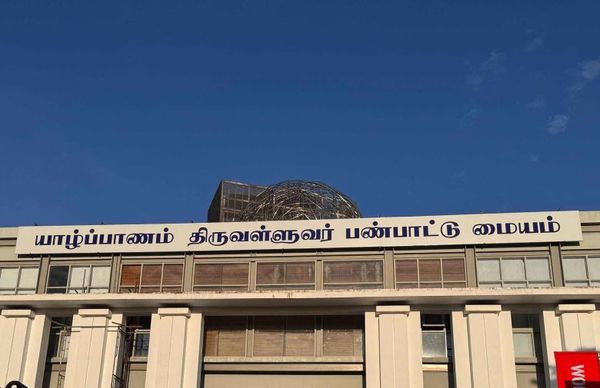
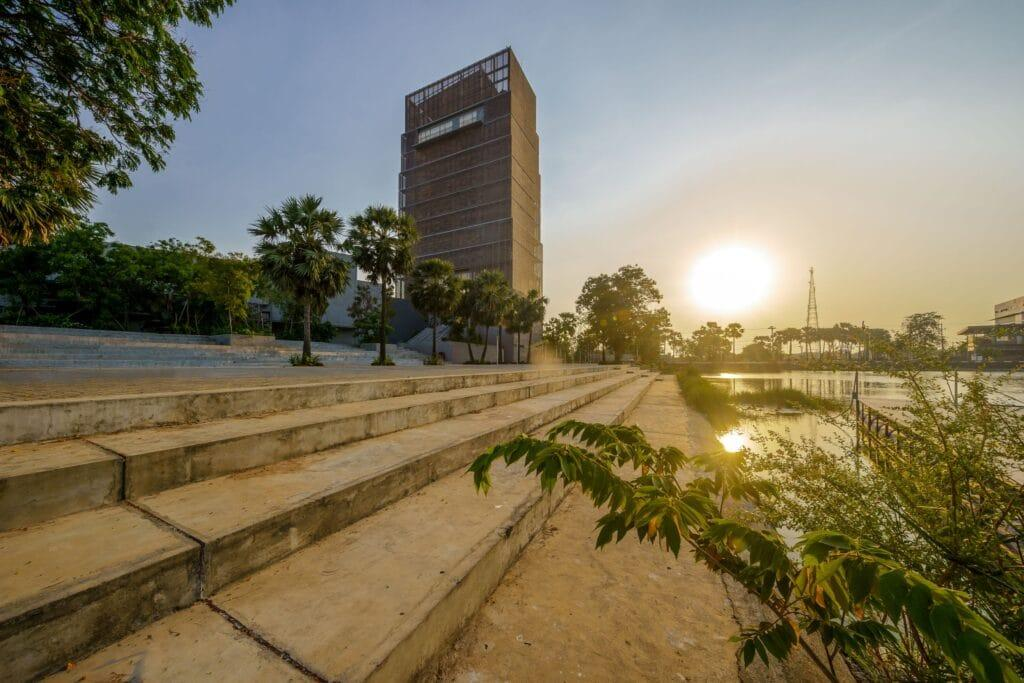
There is a particular kind of grief that attaches itself to wasted consecrated things. Not the grief of loss — for the thing still stands — but the grief of desecration by neglect: the temple whose lamps have not been lit, the tank whose sluices have not been opened, the threshold over which no pilgrim has yet crossed. It is this grief, quiet and accumulated, that I carry when I think of the Thiruvalluvar Cultural Centre standing in Jaffna — eleven storeys of unrealised intention, a 600-seat auditorium in silence, a digital library whose doors have not swung open to the students they were built to receive.
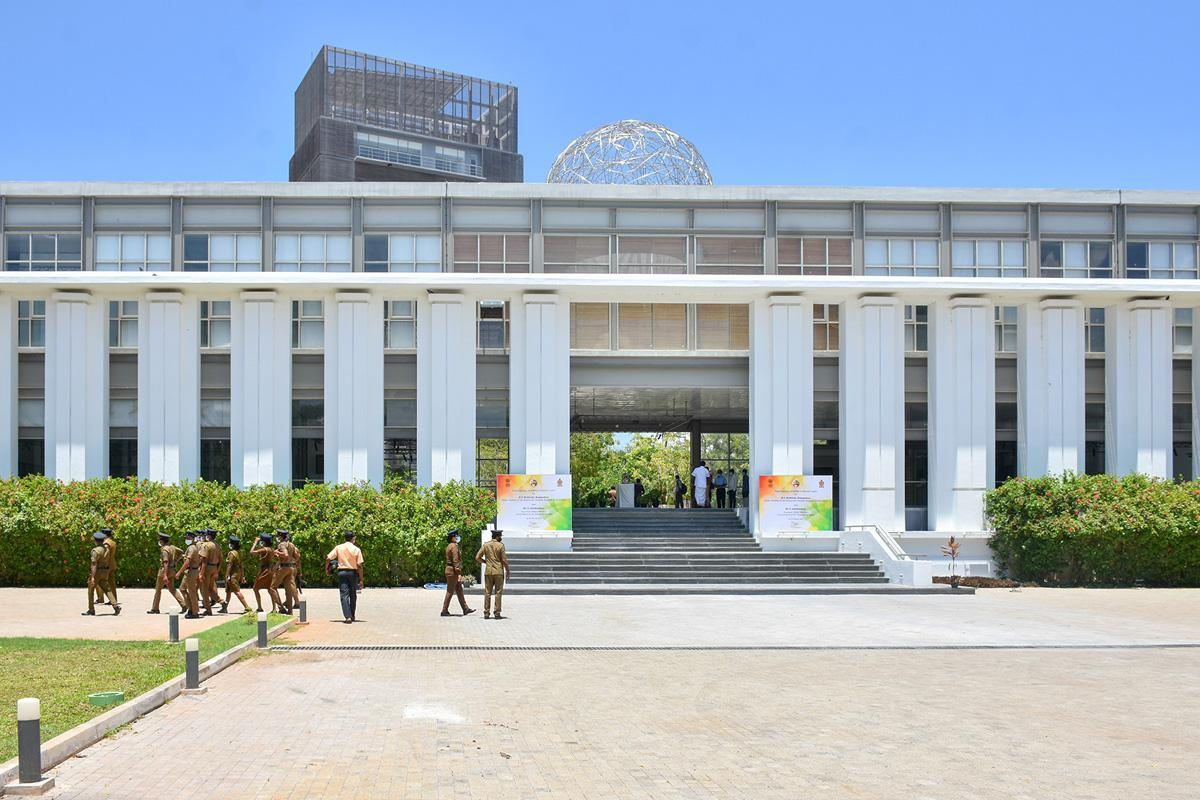
The crisis is not financial. It is not logistical. It is, at its root, a failure of imagination — a collective inability to see what this building could be if we stopped treating it as infrastructure and began treating it as what it truly is: a living institution waiting to be born. The transition required is not administrative. It is spiritual. We must move, without delay and without further excuse, from a maintenance mindset to an activation mindset. One tends what already exists. The other calls into being what has not yet arrived.
What we are actually building
To understand what the Thiruvalluvar Cultural Centre must become, it helps to look at what India has already built for itself — and then to ask, with seriousness, what an equivalent institution would look like on this side of the Palk Strait.
The India International Centre in New Delhi is one of the great intellectual gathering places of the postcolonial world: a club of the mind, where diplomats, scholars, judges, artists, and civil servants have, for sixty years, met to think aloud together about the country and the world. The India Habitat Centre, also in Delhi, demonstrated that cultural infrastructure could sustain itself financially without surrendering its soul — that a centre can generate revenue from its food courts, its galleries, its event spaces, and use that revenue to fund the very intellectual and artistic programmes that give it meaning. And Shanti Niketan, Tagore’s great experiment in West Bengal, proved something more radical still: that the deepest education is immersive, that it happens not in classrooms alone but in the spaces between — in the garden, in the performance, in the conversation between a master and a student sitting under a tree.
What India built across three institutions, Jaffna must build in one. Not as imitation — imitation would diminish both the model and the copy — but as synthesis. A place that has the intellectual gravity of the IIC, the financial self-sufficiency of the IHC, and the living, breathing pedagogical warmth of Shanti Niketan. A place where thought and beauty and commerce are not in tension but in continuous, productive conversation. This is not an impossible combination. It is, in fact, the only combination worth attempting.
“What India built across three institutions, Jaffna must build in one — not as imitation, but as synthesis. The intellectual gravity of the IIC. The financial vitality of the IHC. The living warmth of Shanti Niketan.”
The sacred geography that connects us
But there is a dimension to this centre that goes beyond anything Delhi has built — a dimension that is uniquely available to Jaffna and to no other city in the world. It is the dimension of the sacred.
The Thiruvalluvar Cultural Centre must become the permanent institutional home of this sacred geography. Not a museum of it — not a glass-case commemoration of something that happened in the past — but a living, continuous celebration of something that is happening right now, every day, in the fire of every lamp lit in every shrine along this corridor. A permanent exhibition, yes — but one that breathes, that changes with the liturgical calendar, that brings the priests and the musicians and the scholars and the dancers together in the same space so that the tradition can teach itself, can encounter itself, can be witnessed and transmitted and transformed in public view.
This is what no other institution in South Asia is doing. This is Jaffna’s unique contribution to the intellectual and spiritual map of the region. And it is precisely because this contribution is rooted in something living — not archived, not commemorated, but actively practised — that it demands a medium capable of carrying it beyond the building’s walls to the world.
The channel that never sleeps
Permanence of this kind requires a medium commensurate with its ambition. A 24-hour broadcast channel — streaming continuously from the centre, reaching the global Tamil and South Asian diaspora wherever they have settled — is not a luxury supplement to the physical institution. It is its nervous system. Its voice. The means by which a building in Jaffna becomes a presence in Melbourne, in Toronto, in London, in Singapore, in the living rooms and prayer rooms of the ten million people who carry this civilisation with them wherever they go.
Imagine what this channel carries: live coverage of the great temple festivals as they unfold along the sacred corridor; master classes in Carnatic music and Bharatanatyam taught by the finest practitioners alive; lectures from the visiting scholars and jurists and diplomats passing through the centre’s fellowship programme; debates from the Jaffna Dialogue forums on maritime security and Blue Economy strategy; the performances of young artists from the Northern Province on the 600-seat stage, beamed in real time to audiences who would never otherwise have access to them. A signal of culture and intellect and spiritual life, continuous and uninterrupted — the way a river runs, the way a lamp in a sanctum is never allowed to go out.
This is what Classic FM did for classical music in Britain: it did not create new audiences from nothing, but it reached the audiences who already existed and had simply never been given a channel worthy of their attention. The global Tamil diaspora is that audience. It is vast, it is educated, it is financially capable, and it is — as anyone who has spent time among it knows — profoundly hungry for a cultural institution it can be proud of. The channel is the bridge between the building and that hunger.
“The channel is not a supplement to the physical institution. It is its nervous system — the way a lamp in a sanctum is never allowed to go out.”
Three councils, one meeting point
Governance without capacity is theory. The structure proposed here — three Councils of Management, each led by technocrats and domain experts rather than career administrators — is designed around a single animating principle: this centre must be the meeting point of everything the region most desires to exchange.
The Council for Higher Learning and Research answers the region’s hunger for knowledge and professional formation. Through IGNOU, the centre becomes an Open University hub that democratises access to higher education across the Northern Province. Through IIM Bangalore or Ahmedabad, it hosts Executive MBA programmes oriented toward the Blue Economy — connecting Sri Lankan entrepreneurs directly to the venture capital networks of Bengaluru. Through the Gujarat Forensic Sciences University, it builds a Digital Policing laboratory whose graduates will be equipped for the cyber-crime challenges that no South Asian police force currently has the tools to address. Through the National Judicial Academy and the National Law School, it brings international commercial arbitration and cyber-jurisprudence training to practitioners who have had to travel abroad for these skills. The tower is open around the clock — because knowledge does not keep office hours, and neither should the institution that serves it.
The Council for Arts and Heritage answers the region’s hunger for beauty, for continuity, for the sense that the civilisation it has built over millennia is not merely surviving but flourishing. In partnership with the Kalakshetra Foundation and the National Centre for the Performing Arts, this council curates the museum, manages the auditorium, runs the instructional wings in classical dance and music and sculpture, and animates the sacred corridor exhibition that is the centre’s most distinctive offering. The Young Talent Incubator — identifying gifted young artists from the North, training them with masters, placing them on the main stage — is how the tradition renews itself rather than merely perpetuates itself. The Winter Season extension of the Chennai Margazhi festival is how Jaffna asserts its place on the international cultural calendar rather than watching from the margins.
The Council for Policy and Governance answers the region’s hunger for serious, consequential dialogue about its own future. In partnership with the Indian Council of World Affairs and the Observer Research Foundation, the Jaffna Dialogue series becomes the premier forum for Track 1.5 and Track 2 exchange on the questions that will define the Indo-Lanka relationship for the next half century: maritime security, climate resilience, the Blue Economy, energy grid connectivity, the political economy of the Palk Strait. Jaffna sits at the geographic intersection of all these interests. It is the only logical place from which to anchor this conversation — and the only city whose particular history gives it the moral authority to do so.
“Three councils. One meeting point. The intellectual, the beautiful, and the consequential — not in competition, but in continuous conversation.”
The people and the money
A hybrid staffing model addresses the question of human capacity without pretending that the Provincial cadre alone can carry this weight — or that it should have to. A core of Provincial service officers provides administrative continuity and institutional memory. Around this core, a rotating stream of Executives in Residence — experts from the Indian bureaucracy, Ivy League universities, global think tanks, seconded for three to six months at a time — injects global best practice, mentors the Young Talent Incubator, and creates the revolving door of excellence that keeps an institution alive and self-renewing rather than gradually calcifying.
The funding architecture is multi-tiered and largely already in place, waiting to be assembled with coherent intent. Federal Indian schemes — SWAYAM, NEAT, IGNCA grants, ICCR seminar funding — constitute an untapped resource pool. Tamil Nadu’s interest in language chairs and heritage tourism, Gujarat’s Sister State MOU, provide targeted state-level entry points. Indian corporates with Sri Lankan exposure — L&T, Tata, Lupin, Ashok Leyland — have CSR mandates that have not been strategically courted for specific endowments. Most importantly, a fixed percentage of all commercial revenues must be ring-fenced into a Sovereign Endowment Corpus, governed by an independent Trusteeship of global Tamil jurists and philanthropists — the structure that will finally give the diaspora the credible, transparent channel its generosity has always been waiting for. The interest funds bursaries. The principal funds permanence.
The recently expanded Indian scholarship schemes provide the launch vehicle: earmark a significant quota specifically for programmes hosted at the Thiruvalluvar Centre, and the institution has its founding cohort, its initial revenue, and its academic legitimacy from the first day of operation.
What we owe the flame
In the great shrines of South India and Sri Lanka, there is a specific role — the deeparchaka, the keeper of the lamp — whose sole responsibility is to ensure that the sacred flame is never extinguished. Not to perform the elaborate rituals of the major festivals. Not to manage the temple’s finances or settle its disputes. Simply to tend the light. To be there, in the hours before dawn and after midnight, ensuring that the continuity of the sacred is not broken by inattention.
We have been absent from that role for too long. The Thiruvalluvar Cultural Centre is the lamp. It was lit by an act of friendship and civilisational generosity from India. It has been allowed to dim, not because of any catastrophe, not because of any external force, but because the deeparchakas assigned to it have not shown up. That failure is ours to own and ours to correct.
What the IIC, the IHC, and Shanti Niketan are to India — a place of thought, of gathering, of continuous and luminous becoming — the Thiruvalluvar Cultural Centre must become to this region. Not a monument. Not a storage facility. Not a bureaucratic asset awaiting its next maintenance cycle. A flame. Continuous, unextinguished, beaming outward across the water and across the world, at every hour of every day, for as long as the civilisation it serves endures.
The blueprint is drawn. The hour is late. Let us begin.
Editor’s Note: This article is authored by Sidhartha Thamby, an observer of South Asian geopolitics and cultural policy. The views expressed are solely those of the author and do not necessarily reflect the editorial stance of Jaffna Monitor. The publication welcomes alternative viewpoints and encourages constructive public discourse.