

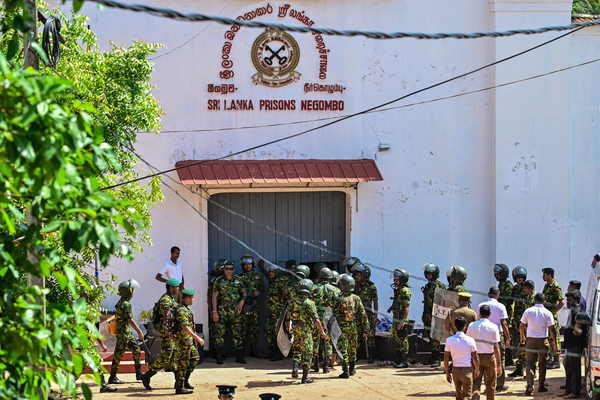
COLOMBO — Prisoners' rights advocates escalated pressure on Sri Lanka's government on Monday, accusing it of concealing the scale of deadly violence at Negombo Prison and of neglecting the overcrowding, staff shortages, and inadequate medical care that they said had pushed the country's prison system beyond its capacity.
At separate news conferences, the Prisoners' Rights Protection Association and Wasantha Mudalige, an activist with the People's Struggle Front, said the authorities had yet to provide a full official account of the unrest, even as they claimed the death toll had risen to 25 and anxiety spread among prisoners' families.
The association warned that it would bring relatives of inmates and prison officers into the streets in protest if the government did not act at once.
Its coordinator, Sudesh Nandimal Silva, said the violence was the product of long-standing structural failures rather than an isolated confrontation. Prisons were operating with roughly a quarter of the officers needed to manage their populations, he said, and facilities designed for about 650 inmates now held more than 2,000. In some blocks, he added, 250 to 300 prisoners shared a single toilet, a level of crowding he said inflicted severe psychological strain on inmates and guards alike.
Mr. Silva also asserted that overcrowding and substandard medical care had contributed to the deaths of five female inmates from dengue fever, and that many prisoners accused of drug-related offences spent years in custody awaiting Government Analyst reports and action on their cases. More than 70 percent of inmates, he said, were dependent on drugs and required rehabilitation programmes rather than imprisonment.
Mr. Mudalige accused the government of obscuring the true scale of the violence and of allowing misleading accounts to circulate, including a suggestion that the unrest was merely a clash between rival underworld groups in the drug trade.
"The government must tell the country the truth," Mr. Mudalige said, calling for an urgent official statement to counter speculation and reassure the families gathered outside the prison.
He also faulted successive governments for filling prisons with low-level drug users while leaving major trafficking networks intact.
Both groups cast the bloodshed as the culmination of years of neglect rather than a lone security lapse, and pressed the government for immediate intervention and wider reforms to ease overcrowding, improve conditions and restore public trust.
The government had not responded publicly to either group's allegations at the time of their remarks.