

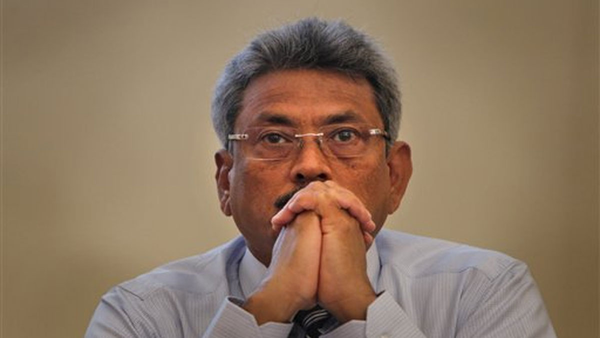
By Jaffna Monitor's Court Correspondent
COLOMBO — Sri Lanka's Attorney General asked the Court of Appeal on Monday to throw out a petition by former President Gotabaya Rajapaksa seeking to block his arrest in the reopened investigation into the 2019 Easter Sunday bombings, contending that he had misled the court and that the case belonged before the Supreme Court.
Mr. Rajapaksa is seeking a court order to prevent his detention as investigators revisit the coordinated suicide attacks, which killed 269 people at churches and hotels on Easter morning.
The case resumed before a two-judge bench: the president of the Court of Appeal, Rohana Abeysuriya, and Justice Sarath Dissanayake.
Appearing for a third day, Romesh de Silva, a President's Counsel representing the former president, said investigators had unfairly singled out his client during the renewed probe. None of the major official inquiries into the attacks — the Presidential Commission of Inquiry, the Jayaki de Alwis report, or the Justice Imam report — had implicated Mr. Rajapaksa, he said.
"Yet the authorities are now attempting to arrest him based solely on a statement made by Azad Maulana," he told the court.
Both the Prevention of Terrorism Act and ordinary criminal law, Mr. de Silva said, require investigators to hold a reasonable suspicion before an arrest — one grounded in evidence from an objective investigation, not an effort to target a particular person. Citing Supreme Court judgments, including rulings by the former Justices Mark Fernando and Gamini Amarasuriya, he maintained that there were no reasonable grounds to arrest his client under Section 6(1) of the Act.
Suharshi Herath, a deputy solicitor general, countered that the authorities cited by the defense addressed the threshold for detention, not arrest. Mr. de Silva rejected that distinction, saying the judgments make clear that reasonable suspicion is required before an arrest under Section 6(1), while preventive detention falls separately under Section 9.
Mr. de Silva further questioned the impartiality of the inquiry, noting that Senior Superintendent of Police Shani Abeysekara — who now leads the Easter Sunday investigation — had been removed as director of the Criminal Investigation Department after Mr. Rajapaksa became president, only to be reinstated later. He suggested that Mr. Abeysekara was pursuing a personal vendetta against his former superior.
"If that is the case, how can this be regarded as a fair investigation?" he asked.
Mr. Abeysekara, he added, bore his own share of responsibility for failing to prevent the attacks and should not be leading the inquiry into them.
After the petitioner's submissions concluded, Ms. Herath opened the Attorney General's response. The petition rested fundamentally on alleged violations of constitutional rights, she contended, and therefore lay outside the Court of Appeal's jurisdiction. Counsel for Mr. Rajapaksa had repeatedly invoked personal liberty and freedom of movement, she noted — relief constitutional in nature, and pursuable only before the Supreme Court under Article 126 of the Constitution.
Under Article 126(3), she said, the Court of Appeal may refer such matters to the Supreme Court. "For that reason, this court should either transfer the petition to the Supreme Court or dismiss it," she submitted.
Ms. Herath also accused the former president of failing to approach the court with "clean hands," saying he had made false statements in his petition. In paragraph 17 of his application, she said, Mr. Rajapaksa had stated that he did not know Azad Maulana and had never met him — a claim the Attorney General's Department disputed with photographs it said showed a relationship between the two men.
"But the evidence is not limited to photographs," she said.
She then cited a statement given to the Criminal Investigation Department by Iniya Bharathi, whom she described as a suspect. Shortly before the 2019 presidential election, according to the statement, Iniya Bharathi was summoned by Kapila Hendawitharana to Mr. Rajapaksa's residence in Mirihana, where he found Azad Maulana — described as the private secretary to Sivanesathurai Chandrakanthan, widely known as Pillayan — along with Prasanthan, another associate of Pillayan; Pillayan's brother; and the group's treasurer, Jeyaraj.
That account, Ms. Herath said, made Mr. Rajapaksa's claim not to know Mr. Maulana false and amounted to misleading the court. Mr. Maulana was not the only witness against the former president, she added; investigators had taken statements from several others.
"The petitioner has concealed the truth while seeking relief from this court," she submitted. "His application should therefore be dismissed at the threshold."
The court adjourned the hearing until July 9.