NEGOMBO, Sri Lanka — At around one o’clock on Sunday afternoon, in a prison built for a fraction of the men it holds, a rumour spread through the wards: that an inmate had informed on a drug-trafficking operation running inside the walls.
Over the next twenty-four hours, as many as 25 people were killed and more than 100 injured. Some of the dead were beaten so badly that they could not immediately be identified. Once again, failures that the country has long documented and long ignored were exposed.
By Monday evening, police put the toll at 25, reported to include five prison officers and twenty inmates, with more than 100 wounded. The figure rose through the day: two, then seven, then fifteen, then nineteen, then twenty-five. Other counts differ.
The director of Negombo Hospital, Pushpa Gamlath, said the facility had received 23 bodies. The most critically injured were moved to the National Hospital in Colombo. Whatever the final number, it is the country’s deadliest prison riot in years.
How it began
Police say the first clash, shortly after 1 p.m. on Sunday, was between a group of remand prisoners and a group of convicted inmates. Two inmates were killed and dozens injured — figures ranging from 34 to 38 across official statements. Groups of male and female prisoners then climbed onto the prison roofs in protest; part of the roof gave way, injuring four more. Police, the Special Task Force, and the army were deployed on Sunday night, and prison authorities announced the situation had been brought under control by midnight.
It had not. On Monday morning, as officers entered to distribute breakfast, the two factions clashed again. According to the Prisons Department spokesman, A.C. Gajanayake, the inmates then turned on the officers pursuing them toward the main gate and trying to force their way out. Officers stationed at the gate said they used the minimum force necessary to restore order. Gunfire was heard from inside; police have acknowledged firing shots to bring the situation under control. Rioting prisoners stormed the prison infirmary and stole officers’ mobile phones.
Sinhala-language outlets reported that the fighting was between two gangs known as "Doom" and "Madda" and was allegedly instigated by a serving prisoner, Katuwellegama Suresh Pushpakumara, described as a close associate of a notorious underworld figure. He was himself wounded and, according to those reports, could not be taken out for treatment because the situation inside remained too dangerous. The same reports also said that when the violence erupted in the prison, which held more than 2,000 inmates, only about 20 officers were on hand to contain it.
The question of the guns
Police sources told Jaffna Monitor that Monday's escalation began after inmates seized firearms from the prison armoury. But other security officials disputed that account, saying the weapons had been removed from the armoury on Sunday night precisely because authorities feared prisoners might try to take them. If that account is correct, the firearms used in the violence on Monday could not have come from the armoury. Police have confirmed that officers opened fire during the unrest.
What the government says
Justice Minister Harshana Nanayakkara delivered the government's first official account of the violence, attributing it to a clash between rival inmate factions and saying the incident was being treated with the utmost seriousness. He acknowledged that overcrowding and chronic staff shortages had long plagued Sri Lanka's prison system, pledged a full inquiry, and accepted responsibility in his capacity as minister in charge of both justice and prisons. As is often the case in Sri Lankan politics, however, accepting responsibility stopped short of offering to resign.
The machinery of investigation moved quickly into motion. The Commissioner General of Prisons appointed a special inquiry team, police opened a parallel investigation, a magistrate began a judicial inquiry, and three inmates identified as key figures in the unrest were transferred to the Pallansena prison camp. Yet in the crucial early hours of Sunday's violence, according to local media reports, the Justice Minister, the prisons spokesman and the police spokesman could not be reached for comment.
What the opposition says
The Leader of the Opposition, Sajith Premadasa, called for an independent and transparent investigation and said the government must be held accountable for the loss of life, arguing that the episode exposed a breakdown in prison administration under an administration elected on a promise of systemic change. He pointedly recalled that the President, Anura Kumara Dissanayake, had himself maintained, while in opposition, that governments should be held accountable for deaths that occur inside prisons.
A sharper critique came from a figure who once held responsibility for the prisons himself. In a statement circulated on social media, former Foreign Minister Ali Sabry — who also served as Justice Minister, with the prison-affairs portfolio, under the previous government — argued that a government consumed by pursuing its predecessors has little energy left for the harder work of governing. He named the country’s overcrowded prisons directly among the problems going unaddressed while the state busies itself with arrests and prosecutions, warning that “a prison cell is not evidence of good governance” and that the instruments of coercion a government celebrates today may one day be turned against itself. Sabry presided over the same overcrowded system during the lethal prison unrest of 2020, though he was publicly critical of the congestion even then. The failure he describes belongs to every recent government, his own included.
Rights advocates were more specific still. The president of the Committee for Protecting the Rights of Prisoners, attorney Senaka Perera, said the Negombo unrest reflected long-standing problems — severe overcrowding, staff shortages, and the absence of rehabilitation for drug-dependent inmates. Three weeks earlier, his organisation had submitted a detailed account to the United Nations Subcommittee on Prevention of Torture alleging entrenched torture, overcrowding, and impunity, and noting that Sri Lanka’s prisons still operate under a Prison Ordinance dating to 1877.
A system four times over capacity
The scale of that overcrowding is not in dispute. Official figures cited on Sunday put the national prison population at 41,250 — roughly four times the system’s intended capacity. Even in a calmer accounting, the prisons held 29,789 people against a capacity of 10,395, an occupancy rate of some 287 percent. Negombo, holding between 1,800 and more than 2,000 in a facility built for far fewer, is one instance of it.
Experts who have studied Sri Lanka's prison system told Jaffna Monitor that many of the country's prisons have fallen below even basic living standards. They describe a network that is overcrowded, understaffed, and dysfunctional, where rehabilitation is minimal and criminality, corruption, and repeat offending flourish. Cells designed for a single prisoner now routinely hold between three and eight inmates, while first-time offenders are housed alongside hardened repeat offenders. "What do you think we can do about separating prisoners?" one senior jailor at Welikada Prison asked a national commission, underscoring the constraints prison officials say they face.
In wards this crowded, under tropical heat and with poor ventilation, prisoners often organise themselves into gangs. Much of that violence is fuelled by the drug trade. Nearly two-thirds of those in Sri Lanka's prisons on any given day have not been convicted of a crime but are awaiting trial. Drug-related charges alone accounted for about half of all remand admissions in 2024, while drug offences made up roughly two-thirds of convicted admissions. Yet, experts say, those filling the cells are rarely major traffickers. They are overwhelmingly poor and marginalised people arrested with small quantities of drugs, many imprisoned simply because they cannot afford a lawyer or pay a fine. Wealthier drug users, they argue, are far less likely to enter the prison system. The government's anti-narcotics campaign, Operation Yukthiya, arrested tens of thousands of people and drew criticism from the United Nations and human rights organisations over allegations of arbitrary arrests, torture and military-run rehabilitation. The result, they say, is a prison system operating at more than four times its intended capacity, filled largely with low-level offenders while organised traffickers continue to direct criminal networks from behind bars — a struggle that police believe lay behind the violence in Negombo.
The consequences are reflected in prisoners' mental health. Experts told Jaffna Monitor that psychological distress is far higher inside prisons than in the general population, driven by overcrowding, violence, isolation, lack of privacy, and inadequate mental health care. Regional research has estimated the prevalence of psychiatric disorders in South Asian prisons — among the world's most overcrowded — at between 40 and 100 percent, even as prison mental health services remain severely limited. Men struggling with addiction and untreated mental illness are frequently confined together without adequate supervision or treatment, in conditions that often deepen both problems.
Experts also argue that the corruption exposed by the Negombo violence is less the cause of Sri Lanka's prison crisis than a symptom of it. The movement of drugs, mobile phones, and even firearms through prisons reflects a system that has long ceased to function effectively, they say, and neither tougher crackdowns nor further militarisation are likely to solve the underlying problem. Instead, they point to weaknesses that run across the criminal justice system, including repeated allegations of police collusion with drug traffickers. Prisoners interviewed during official inquiries described being framed with planted evidence, entering prison as first-time detainees, and leaving with criminal connections and hardened attitudes. The lesson, experts argue, is that a prison system that strips people of dignity is unlikely to rehabilitate them; it is more likely to send them back into society angrier, more violent, and better connected to organised crime.
A pattern the state keeps repeating
Sri Lanka has been here before. In December 2012, Special Task Force officers killed 27 prisoners at Welikada during what began as a search operation and what a court later found had included premeditated killings carried out by officials acting beyond their lawful authority. In March 2020, two inmates were shot dead at Anuradhapura during a protest over pandemic restrictions. Eight months later, prison officers opened fire during unrest at Mahara, killing 11 prisoners and wounding more than 100.
Each episode was followed by the appointment of an inquiry. None of the resulting reports has been made public. The Welikada case ultimately resulted in a single conviction over a single death, while other defendants were acquitted. No one has been held criminally accountable for the killings at Anuradhapura or Mahara. The investigations announced after the Negombo violence now enter a history in which inquiries have been plentiful, but public disclosure and accountability have been far harder to find.
Where It Stands
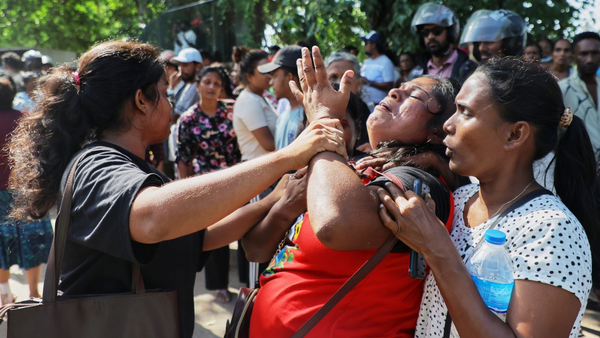
By Monday night, prison authorities again said the situation was under control — the same assurance they had given late Sunday, hours before the violence escalated. Additional police officers had been deployed, inmates had been transferred, and security around the prison had been tightened. The prisoner authorities say instigated the violence remained hospitalized under guard, while the families of those killed continued to wait for answers.
The investigations have begun. Whether they produce accountability — or simply another unpublished report — remains to be seen.