

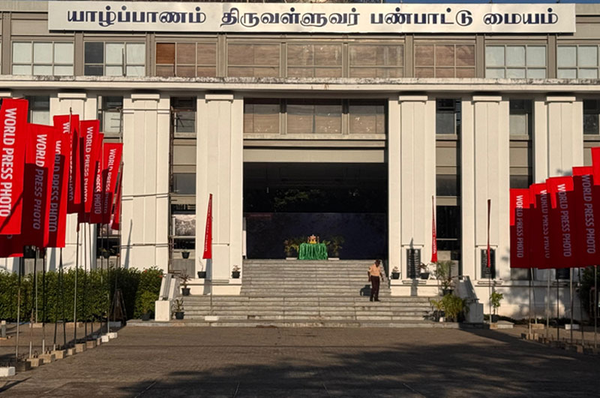
Sri Lanka's Cabinet last Monday approved the establishment of a trust fund to manage the Jaffna Thiruvalluvar Cultural Centre, an 11-storey landmark built with approximately $12 million in Indian grant assistance — a move critics say effectively places a centre intended for Tamil cultural life under the influence of a Colombo ministry responsible for Buddhist, religious and cultural affairs, while marginalising the elected local authority on whose land the facility stands.
The Cabinet decision, taken on May 11 and signed off by the Minister of Buddhasasana, Religious and Cultural Affairs, was presented in official language as a technical formality: the establishment of a trust, backed by a deed already cleared by the Attorney General, to "continue the management activities" of the center once construction and handover formalities are complete. But in Jaffna, where the center has become a charged symbol of post-war promises made and promises deferred, the move has landed differently.
A Building With a Complicated History
The cultural center was conceived as a gesture of Indian solidarity with Sri Lanka's Tamil-majority north following the end of the country's brutal 26-year civil war. Prime Minister Narendra Modi laid the foundation stone during a visit to Jaffna in 2015. It was virtually inaugurated in 2022 with Indian External Affairs Minister S. Jaishankar presiding, and formally opened in February 2023 by President Ranil Wickremesinghe.
The facility is located on land owned by the Jaffna Municipal Council, near the city's historic public library. It includes a 600-seat auditorium, a conference hall, an amphitheatre, and digital library spaces. From the outset, its political symbolism was clear: this was presented as a gift to the people of the north — a space for local culture, reconciliation, and the preservation of Tamil heritage.
Under the original Memorandum of Understanding, upon completion of construction, the Sri Lankan government was obliged to transfer the center to the Jaffna Municipal Council. A Cabinet decision in February 2022 went further, providing for the establishment of a Joint Management Committee to oversee operational decisions following that handover, thereby granting the elected local authority a clearly defined management role.
What Monday's Decision Actually Does
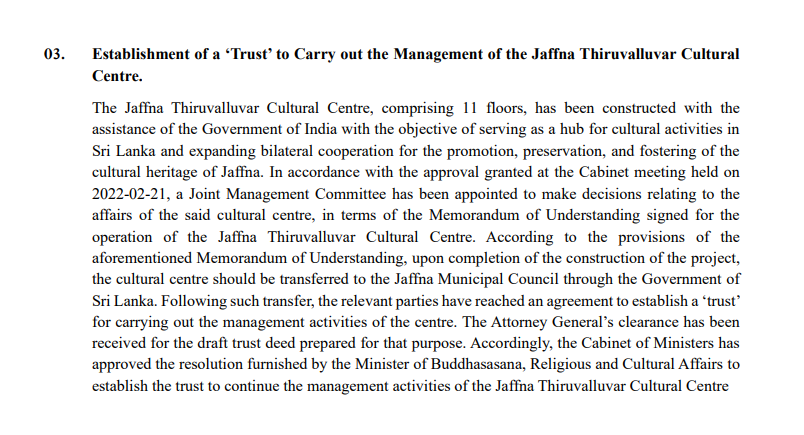
The Cabinet's approval last week does not undo the transfer obligation, at least not formally. The official decision paper states that the trust is to be established following the handover to the Jaffna Municipal Council, not instead of it. But critics argue that the sequencing and the choice of ministry matter enormously.
The proposal came from the Minister of Buddhasasana, Religious and Cultural Affairs. That ministry also formally carries the Cultural Affairs portfolio — making its involvement administratively defensible. But critics point out that the ministry's institutional culture and historical mandate have centered overwhelmingly on Buddhist religious affairs, and that a portfolio nominally covering all culture has, in practice, rarely engaged with Tamil cultural institutions in the north. That a ministry of this character would be the proposing and constituting authority for a trust governing a facility explicitly dedicated to Tamil cultural heritage has not gone unnoticed in Jaffna.
More concretely, the trust deed — the document that will define who sits on the governing board, who controls expenditure, and who has day-to-day authority — has been cleared by the Attorney General, and the Cabinet has authorised the minister to formally constitute the trust under it. But the composition of that board has not been made public.
An earlier proposal circulating in Colombo and leaked to civic groups in Jaffna envisaged a seven-member governing body comprising the Jaffna Municipal Commissioner, the Northern Province Governor, a representative from the Ministry of Cultural Affairs, two representatives from the Government of India, and two from the Government of Sri Lanka. Critics note that the Northern Province Governor is a Presidential appointee and the Municipal Commissioner operates within the central administrative structure — meaning that together they would represent Colombo's interests rather than those of Jaffna's elected councillors.
"It looks devolutionary on paper," a Colombo-based constitutional lawyer told Jaffna Monitor. "But when you count the votes and trace who appoints whom, you find a structural majority for the central government."
The Jaffna Municipal Council's Silence — and an Unresolved Gap
Conspicuously absent from Monday's Cabinet decision paper is any reference to the Jaffna Municipal Council having been consulted on, or having consented to, the specific form of the trust now approved.
The council owns the land on which the center stands and was meant to be the primary governance body under the original MOU. Yet a significant question precedes even the trust debate: the center was formally opened in February 2023, but the Cabinet decision paper implies that the formal handover from the Government of Sri Lanka to the Jaffna Municipal Council has not yet taken place. If that transfer — which the MOU requires — remains incomplete more than three years after inauguration, the reasons for that delay are themselves a matter of public interest that neither the Cabinet communiqué nor the ministry has explained.
The council has not publicly commented on the Cabinet decision as of the time of publication. Jaffna Monitor sought a response from the Municipal Commissioner's office; no reply had been received by press time.
What Remains Unknown
The key facts that would allow a definitive assessment of whether the trust constitutes a governance capture or a workable compromise remain undisclosed. The full text of the trust deed approved by the Attorney General has not been published. The composition of the trust's governing board — who sits on it, how they are appointed, what quorum is required for decisions — has not been confirmed. Whether the Joint Management Committee established under the 2022 Cabinet decision will continue to function alongside the trust, or be superseded by it, is unclear.
Until those documents are public, the Cabinet decision of May 11, 2026, stands as a half-visible move: consequential in what it authorises, but opaque in the details that will determine whether the Jaffna Thiruvalluvar Cultural Center ends up, in any meaningful sense, belonging to Jaffna.