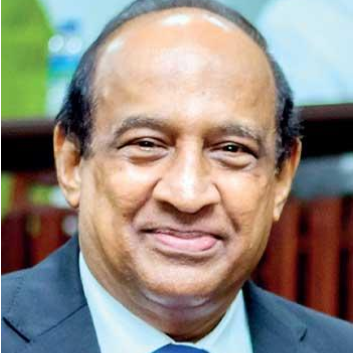
By: Dr. Gamini Goonetilleke
I first met Charith in the early hours of 19th November 2008, in Ward 8 of Sri Jayewardenepura General Hospital. He arrived as a wounded soldier from the war front, bearing injuries that would change the course of his life forever. For three months he remained under my care, during which time our relationship grew beyond that of surgeon and patient. Years later, Charith recognizes me not by sight but by the sound of my voice. Sadly, he lives in permanent darkness.
Charith lost his vision completely and underwent amputation of his right arm below the shoulder following injuries sustained on 18th November 2008. At that time, his future seemed uncertain, overshadowed by pain, disability, and the long road of rehabilitation ahead. Yet his story did not end within the walls of a hospital ward. Instead, it marked the beginning of a remarkable journey of resilience and renewal.
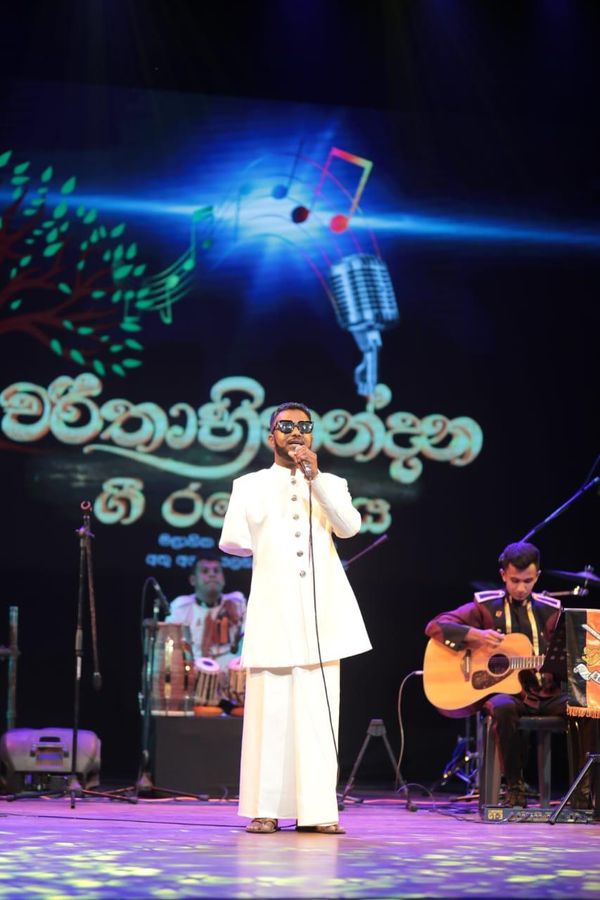
Today, Charith is no longer defined by his injuries. Following medical retirement from the army, he rebuilt his life with extraordinary determination. Married with three children, he has discovered and nurtured a deep talent for music, performing at festivals, producing musical DVDs, running his own YouTube channel and operating his smart phone. Despite profound disability, he has become a source of inspiration to fellow soldiers and civilians alike. His life is not merely a story of survival, but a testament to courage, dignity, and the human spirit’s capacity to rise above adversity. Charith is, in every sense, truly unique.
Charith’s Journey to the Army, his Training, and the Battlefield Operation that Changed his Life Forever.
Charith was an eighteen-year-old unemployed youth from a remote village in Mihintale, in the North Central Province of Sri Lanka. He was the third of four children and the only son of poor farming parents. Seeking a better future and a sense of purpose, he enlisted in the Sri Lanka Army in 2007. After completing three and a half months of intense military training at the Army camp in Puttalam, he joined the 5th Battalion of the Vijayabahu Regiment as a Lance Corporal. The regiment was actively engaged in operations on the Northern war front during the civil conflict. On 25th May 2007, together with other newly trained recruits, Charith was deployed to active military service.
Following his initial training, Charith underwent further specialised preparation for high-risk assignments. His duties involved reconnaissance missions, gathering intelligence on enemy bunker positions, and relaying vital information to commanding officers during the planning of attacks. He was also trained in “bunker blasting,” a dangerous role that required infiltrating enemy lines, creating confusion within defensive positions, and assisting troops in capturing forward enemy defences. It was a task demanding courage, precision, and constant awareness of danger.
On 18th November 2008, Charith embarked on one such mission. The target was an enemy bunker at Kilali, near the Jaffna lagoon. As darkness fell, an eight-man squad led by an instructor set out quietly toward the objective, located nearly five kilometres away. Charith led the group, carrying his weapon, wearing a helmet and body armour, and bearing a backpack that contained a two-kilogram explosive intended for the bunker.
The mission depended on secrecy. Every effort was made to avoid detection as the team moved silently through shrub jungle terrain known to be heavily mined. Equipped with night-vision goggles, Charith crept forward in darkness, carefully scanning the ground. His task was to identify hidden mines, defuse them where possible, and clear a safe path for the soldiers following behind.
Around 11 p.m., after nearly one and a half hours of crawling toward the target, tragedy struck. Charith detected what appeared to be a buried mine and attempted to remove and defuse it. Unbeknown to him, it was an unusual device known as an “Earth Mine.” The mine exploded directly in front of him. The blast severely injured his right arm and face. He later recalled seeing a sudden flash of bright light — the last light he would ever see.
His body armour saved his life. Writhing in pain, he cried out as the soldier behind him, his friend Lance Corporal Ratnayake, rushed to his aid. Ratnayake carried Charith to safer ground, where the full extent of his injuries became apparent. His right arm had been blown off below the shoulder, one eye was severely damaged, the other was hanging out and his face had sustained devastating injuries. Surrounded by darkness, unable to see, and in severe pain, Charith received preliminary first aid before being evacuated by van to hospital. The mission was abandoned.
Initial Treatment and Rehabilitation
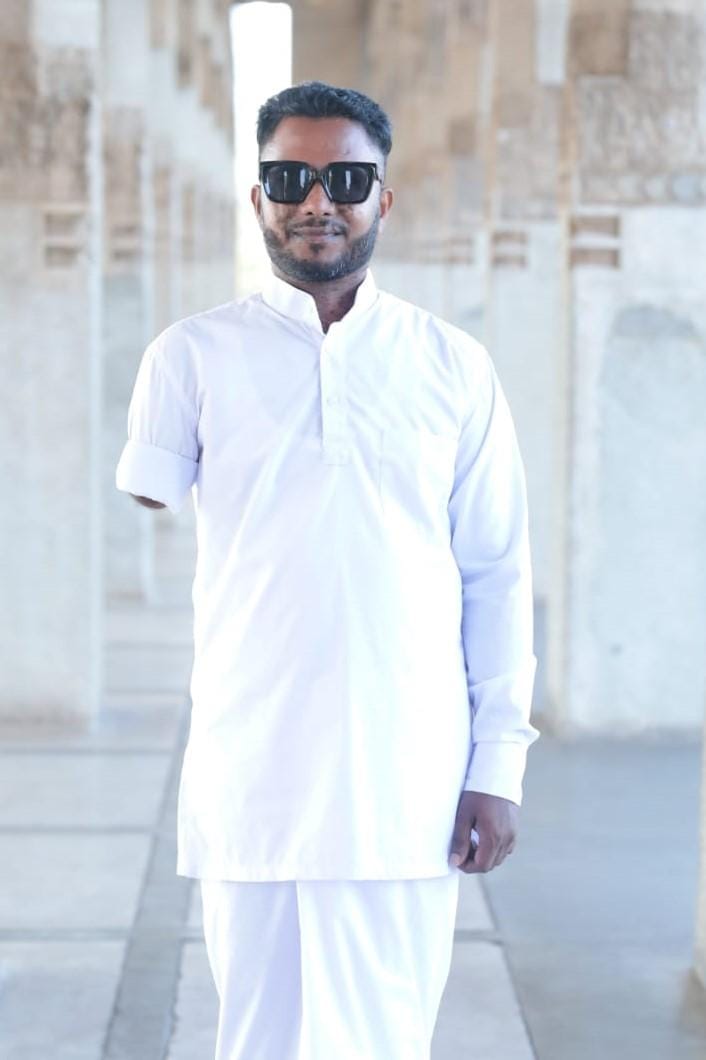
Charith was first taken to the Base Hospital at Palaly, located within the Military High-Security Zone. After initial resuscitation and stabilization, he was airlifted to Colombo along with several other injured soldiers for further treatment. From Ratmalana Airport, he was transported by ambulance to my ward at Sri Jayewardenepura General Hospital (SJGH), Nugegoda, where he was admitted in the early hours of 19th November 2008. From that point onward, his care became my responsibility.
Following the principles of war surgery, I performed a formal amputation of his right arm below the shoulder joint. His facial wounds were extensively cleaned and irrigated with normal saline to remove debris and contamination from the blast, thereby reducing the risk of infection. The wounds were left open initially for delayed suturing. His face was swollen beyond recognition. Unfortunately, the damage to both eyes was irreversible. After assessment, the ophthalmic surgeon confirmed that his vision could not be restored and that he would remain permanently blind.
Charith remained in the surgical ward for nearly three months, receiving intensive medical care and treatment. Thereafter, he was transferred to the Military Hospital for rest, psychological evaluation, and the early stages of rehabilitation. His next destination was the Ranaviru Rehabilitation Centre in Ragama, north of Colombo, a facility established by the Sri Lanka Army to provide long-term rehabilitation for war-injured personnel.
Charith spent approximately one year at the centre, and this period proved invaluable. Rehabilitation specialists introduced him to Information Technology using a software package specially designed for the visually impaired. He also learned to use a mobile phone through this accessible technology. In addition, he began training in music. These rehabilitation programs not only restored his confidence but also equipped him with skills that would greatly support him in the years ahead. He was allowed to visit his home in Mihintale time and again.
Charith Meets His Sweetheart: “Love Has No Barriers”
Charith regularly travelled by bus from his home in Mihintale to Ranaviru Sevana, accompanied by his father. The 11th of September 2011 became a lucky and unforgettable day in his life. On that journey, an 18-year-old girl named Suvini Sewwandi sat beside the 23-year-old Charith. Sewwandi, a nursing student, was travelling to her nursing school.
During the journey, she noticed the young blind man gazing upward toward the sky and felt compelled to speak with him. A simple conversation led to an exchange of phone numbers, and soon regular telephone conversations became part of their daily lives.
Through these conversations, they came to understand one another deeply. Friendship gradually blossomed into love, and they eventually decided to marry. It was a courageous decision on Sewwandi’s part. Although her parents initially objected to her marrying a blind soldier, they could not stand in the way of their daughter’s determination and, in time, gave the couple their blessings.
Further Rehabilitation
Meanwhile, Charith continued his rehabilitation and was later transferred to Abimansala in Anuradhapura, a centre established by the Sri Lanka Army to provide lifelong medical care and support for battle-injured veterans living with permanent disabilities. Charith was one among many soldiers whose lives had been permanently altered by war.
A recipient of nine medals for bravery, Charith gradually discovered a new direction in life through music. His interest in singing and musical performance led to his transfer to the Abimansala facility in Dehiwala, known as Mihindu Seth Madura, where he could receive specialised training. There, he attended classes and workshops conducted by several distinguished Sri Lankan musicians,
including the legendary Pandith W. D. Amaradeva.
As his skills developed, Charith joined a musical group made up of disabled soldiers and began performing at concerts and public events. His talent flourished quickly, and his passion for singing deepened. Over time, he gained recognition not only within the local music community but also among audiences overseas. He went on to produce his own songs, distributing them through DVDs and social media, while building a growing following through his personal YouTube channel, which became popular among Sinhala music lovers.
The Wedding
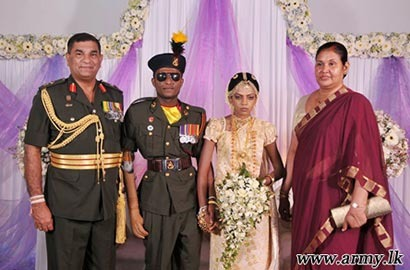
Six months after their first meeting, a grand wedding was held at Abimansala, Anuradhapura. The ceremony took place on 25th March 2012 and marked a historic occasion, as it was the first wedding of a disabled soldier to be celebrated at the facility. In recognition of its significance, the authorities organised the event on a grand scale, inviting nearly 500 guests, including senior Army officers and the Army Commander.
At the auspicious time of 9.21 a.m. on 25th March 2012, Suvini Sewwandi lovingly said “I do” as she stood beside Charith on a beautifully decorated Poruwa, in the presence of a distinguished gathering. Their union was not only a celebration of love, but also a powerful testament to resilience, hope, and commitment beyond adversity.
Today, fourteen years later, they are blessed with three children and continue to share a life built on courage, devotion, and enduring love.
Charith’s Ambition
Today, Charith’s greatest ambition is to care for his family, especially his aging and unwell parents, while continuing to progress in life and inspire others. Despite the hardships he has endured, he remains focused on helping those facing similar challenges. He says, “Sir, my mission and vision today is to inspire those who are similarly disabled, give them mental strength and courage, and guide them to move forward rather than lament what has been lost.” Charith has become a source of hope and motivation, with many disabled soldiers looking up to him as a respected role model and symbol of resilience.
The Futility of War and the Plight of the Soldier
The war in Sri Lanka ended in 2009, yet its consequences continue to shape countless lives. Many young men and women on both sides of the conflict remain permanently disabled, carrying physical and emotional scars long after the guns fell silent. While some, like Charith, have found pathways to rehabilitation and regained purpose through family, community, and meaningful work, others continue to struggle in poverty and isolation. Their stories remind us that the true cost of war extends far beyond the battlefield, leaving lasting wounds on individuals, families, and society. As this story concludes, the words of General Douglas MacArthur remain deeply relevant: “The soldier, above all other people, prays for peace, for he must suffer and bear the deepest wounds and scars of war.”