

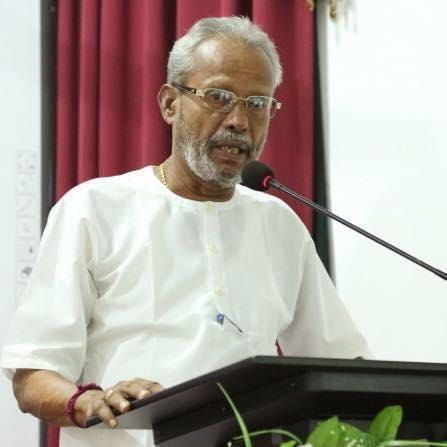
CVK Sivagnanam Accuses Gajendrakumar Ponnambalam of Political Self-Contradiction

CVK Sivagnanam Accuses Gajendrakumar Ponnambalam of Political Self-Contradiction


Share this post

Ilankai Tamil Arasu Katchi (ITAK) leader C.V.K. Sivagnanam has publicly challenged Tamil National People's Front (TNPF) leader Gajendrakumar Ponnambalam over what he describes as inconsistencies between his constitutional criticisms and electoral participation.

Speaking to reporters in Jaffna recently, Sivagnanam questioned how Ponnambalam can reject the 13th Amendment as a framework that "traps Tamils within a unitary state" while simultaneously contesting elections under that same constitutional structure.

"While he repeatedly argues that the 13th Amendment traps Tamils within a unitary state, he is nevertheless expected to contest Provincial Council elections, which are conducted under the very same constitutional framework," Sivagnanam said. "Making claims that contradict one's own political actions runs contrary to democratic political discourse."

The ITAK leader stressed that his party has never presented the Provincial Council system as a final solution. "We have consistently viewed it as part of a broader struggle for meaningful power-sharing," he said.

The Constitutional Dilemma

Ponnambalam has been among the most vocal critics of the 13th Amendment, arguing it fails to deliver meaningful self-determination and instead entrenches Sri Lanka's centralized unitary state. His party has consistently called for substantial devolution beyond what the amendment provides.

However, critics point to what they describe as an apparent contradiction: Ponnambalam contested parliamentary elections, took his oath as a Member of Parliament, and formally pledged to uphold the Constitution, including its unitary character. He currently serves as a Member of Parliament representing the Jaffna District.

When questioned about this discrepancy in an interview, Ponnambalam argued that participation in Parliament enables his party to “expose the system’s inadequacies from within,” while continuing to maintain its principled opposition to what it views as insufficient constitutional arrangements.

Provincial Council Elections in Limbo

The exchange comes as Provincial Council elections remain postponed indefinitely. The Northern Provincial Council, last elected in 2013 under Chief Minister C.V. Wigneswaran, has been without an elected body for over a decade following the expiry of its term in 2018.

The government has repeatedly delayed elections, citing the need for electoral reforms and new delimitation. In October 2024, President Anura Kumara Dissanayake told Tamil National Alliance representatives that Provincial Council elections would be held "after necessary constitutional reforms," without providing a specific timeline.

ITAK has consistently demanded that elections be held under the existing framework while pursuing broader constitutional reforms separately.


Share this post

Be the first to know

Join our community and get notified about upcoming stories

Subscribing...
You've been subscribed!
Something went wrong
Accountability for Others, Immunity for One’s Own

Accountability for Others, Immunity for One’s Own

On March 27, Kumara Jayakody walked into the Colombo High Court, was formally indicted on corruption charges, posted bail, and had his fingerprints taken. Then he returned to his ministerial office. On April 10, 153 Members of Parliament from the National People's Power voted to keep him there. He remains Sri Lanka's Energy Minister today — attending Cabinet, drawing a public salary, governing a portfolio that just lost seven billion rupees of public money. If this had happened under Mahinda Ra


Kaniyan Pungundran

Kaniyan Pungundran

The Tamil Renaissance

The Tamil Renaissance

By Jeevan Thiyagaraja Generations have scattered across the globe while others remained, tending to the soil of their ancestors through the unimaginable. Though separated by oceans and time, all share the same roots. The time has come for the North to reclaim its narrative—a Tamil Renaissance where a smart, confident, and contented North acts as catalyst for a proud, cultured, and developed community found around the world. I. The Ancient Maritime Spirit: A Legacy of Global Connection Long b


Jeevan Thiyagaraja

Jeevan Thiyagaraja

Iluppai Tree and the Young Generation

Iluppai Tree and the Young Generation

Translated from the original Tamil short story iluppai maramum iḷanñcantatiyum (இலுப்பை மரமும் இளஞ்சந்ததியும்) from the 1976 collection of short stories titled kōṭukaḷum kōlaṅkalum (கோடுகளும் கோலங்களும்) by Kuppilan Ai. Shanmugan. He woke up at around seven in the morning, when it was already rather bright. His little sister shook him awake, calling out, “aṇṇai, aṇṇai.” He stretched lazily, rolled up the reed mat and stood it next to the wall. The house was buzzing with activity. His sibling


Eḻuttukkiṉiyavaṉ

Eḻuttukkiṉiyavaṉ

After Assurances, Thaiyiddy Landowners Agree to Survey in Temple Dispute

After Assurances, Thaiyiddy Landowners Agree to Survey in Temple Dispute

THAIYIDDY, Sri Lanka — For more than three decades, Sarujan Sukumari and many others were unable to set foot on their family lands. Seized by the military and designated a High Security Zone, the area remained inaccessible even after the war ended in 2009. Years later, as the country settled into an uneasy peace, a Buddhist temple rose on what had once been their ancestral property. Recently, she and other landowners sat in a government conference room in Jaffna as a cabinet minister and senio


Our Reporter

Our Reporter