
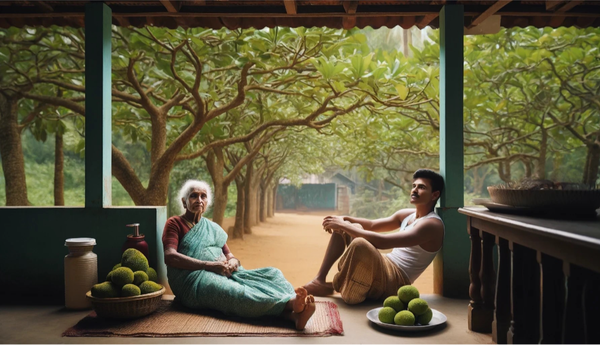
Translated from the original Tamil short story iluppai maramum iḷanñcantatiyum (இலுப்பை மரமும் இளஞ்சந்ததியும்) from the 1976 collection of short stories titled kōṭukaḷum kōlaṅkalum (கோடுகளும் கோலங்களும்) by Kuppilan Ai. Shanmugan.
He woke up at around seven in the morning, when it was already rather bright. His little sister shook him awake, calling out, “aṇṇai, aṇṇai.” He stretched lazily, rolled up the reed mat and stood it next to the wall.
The house was buzzing with activity. His siblings were bustling about getting ready for school.
“Ammā, the seven-fifteen bus is about to leave; please get me my lunch parcel quickly.”
“Aṇṇai, aṇṇai, I’ll take your pen to school today.”
“Geetha, how many days has it been since you had a bath? Today, you cannot go to school until you have had a bath.”
“Aṇṇai, Vathaṉi wants you to give her a bath.”
“All of you stay in bed for too long in the morning. Now you are all scrambling at the same time.”
A mist enveloped the sky. Morning rays drew smoky lines on the front verandah. A gentle cool breeze drifted by.
He broke off a twig from the neem tree and started chewing it. He fetched his little sister and gave her a bath. “Aṇṇai, when did you arrive?” the little girl next door asked. She was his little sister’s friend.
“I came already yesterday. Didn’t you see?” he said.
“Liar, liar,” she grabbed his hands and shook them vigorously.
The bustle within the house dissipated away. Everyone had gone their respective ways. Ammā relaxed on the floor, cutting arecanuts noisily using a nutcracker. The calf came galloping towards him, frowned at him from a distance, and galloped away. A crow sat on top of the chimney and cawed. Ammā got up to shoo it away.
“The first thing in the morning – we get the crow cawing.”
As the morning advanced, the sun rose higher, and its heat started to prickle. He was looking at the flower bushes in the front yard as he brushed. The lush white-and-red night-blooming jasmine that sways in full bloom was missing. In its place a royal jasmine creeper was rising up, sprouting green buds. Tender green fruits dangled from the guava tree. Some insects had devoured the leaves of the Indian gooseberry tree. The queen-of-the-night was shedding leaves.
“It is getting rather late in the morning! Wash up, won’t you? I do have to get on with my chores, don’t I?
He silently went to wash up wondering how he was going to spend the day. ‘Chee.. it is really boring to spend my vacation here. At least if there was a bicycle, I could go somewhere. But then the boys won’t be around either. They would have all gone to work…!”
After breakfast, he took the book of Bhārathiyār short stories, leaned against a wall and started to read. Gñāṉaratham, The Story of Little Saṅkaran, The Weighing Scale, … his eyes glanced through the story titles. The dark print irritated his eyes. He had the urge to close his eyes, as if he wanted to just lean over and sleep.
‘I am not going to sleep now. I spend all my vacation sleeping in late, and then sleeping through the day.’
He peered at a distance through the treeless space in the garden. The large iluppai tree that stood on the northeast corner of the yard had been cut down. They sold it when he was still a tot, not wise to the ways of the world. They said they were taking the trunk to build a wooden boat.
His appāchchi, paternal grandmother, used to live in a thatched hut under that tree. She would secretly make him roti from raw wheat flour. Her life was deeply intertwined with the tree. Flowers will bloom on the tree when it is the right season; the time when the flowers start to shed, falling down with their characteristic smell, was a magical time. Buds would sprout; buds would be shed; fruits would ripen; bats and birds would chatter; having shed the leaves, the bald tree would stand erect; the jauntiness of spring would make it sprout fresh green leaf buds.
Appāchchi’s hut would smell of iluppai flowers. Up front iluppai fruit would dry in the sun, looking like pearls. Women who come to buy them would bargain noisily.
“I swear on your head āchchi! I will not give you a cent more than one and a quarter rupees.”
“Old woman, how much do you want for your garbage?”
“Forty-five rupees.” “Ok, ok, I will give you forty rupees. Don’t quibble.”
A double-oxen cart would show up to collect the old woman’s garbage, collected over the previous year within a fenced off square in the yard. They would disengage the oxen while the garbage was being loaded onto the cart and tie them to the coralbush tree. The oxen would graze while swinging their tails to shoo away the flies on their backs, making their cowbells jingle.
For two months after selling her garbage, the golden necklace will adorn appāchchi’s neck. Appāchchi would be the embodiment of happiness during those months. Thereafter, it would make its way back to the pawn shop. One morning in the rainy season, appāchchi died.
“When did thambi return?” Startled, he looked up. Periyān stood obsequiously, yellow teeth grinning through the white beard. He had crossed his hands, holding his palms tightly on the sides of his belly above his waist.
“I came by the mail train yesterday, Periyān.”
“That is what I heard over there.”
He wanted to ask where, but once he could guess where, he just stared silently at Periyān. Thoughts rushed into his head and started sprouting. A certain sadness engulfed his chest. He bowed his head towards the ground.
He collected himself and looked up, his eyes settling on Periyān. He could not help noticing the sense of pity in Periyān’s eyes. Periyān had watched over their childhood links and dreams with limitless fondness and had silently blessed them in his heart. When they met their unexpected demise, he silently conveyed his limitless condolences and comforted him. He knew everything but pretended not to know anything. “Periyān you know everything.”
“Thambi seems to be mulling over bygones.”
“No, Periyān,” he rested his cheek on his palm and remained silent for a while.
Periyān stood staring at him with his back bent and pleading eyes.
“What is the going rate now, Periyān?”
“Fifty cents, thambi.”
He silently stood up, walked inside, returned with a one rupee coin, placed it in Periyān.s outstretched palm, and sat back down leaning against the wall.
“So, I guess I’ll get going.”
“Thambi… tell Periyān to wait a little,” ammā yelled from the kitchen.
“No piḷḷai; thambi gave me a rupee; I am going to leave.”
“Oh, so you won’t have tea now! Then come back later.”
“I’ll see you later thambi.”
He saw Periyān leave with long strides, stooping, arms folded across his belly, palms on hips, and cross the gate in the southern fence. He was utterly bored.
“Thambi,do you want some tea?”
“Not now, ammā.”
“Then shall I mix some lemon juice for you?”
“Nothing for now.”
His mind kept straying. ‘What would I be doing now if I were at the office? I would be sitting in that dark corner reading something. Or perhaps I would be at the canteen having tea with my friend discussing politics or literature.’
‘The girls who sit at the desks across the aisle from me would be chattering gaily as usual, throwing bits of paper at one another.’
‘I have the urge to see her once. To somehow find a reason to chat with her in my half-broken Sinhala. I feel like I want to see that dazzling, meaningful, eager gaze and smile and return her smile!”
His maternal grandmother was walking along the edge of the yard, under the tamarind tree. She was swinging her arms rhythmically as she walked, balancing a huge palmyra leaf basket on her head. She put the basket down on the veranda, nodded towards him and smiled brightly. He smiled back emptily.
“When did you come back, thambi?”
“Yesterday; How is your health ammammā?”
“Nothing wrong with our health!”
She sat down next to him and leaned against the wall.
“How is the food in Colombo? You look like you have lost weight.”
“I have always been like this,” he smiled sheepishly and continued, “The heart has to be content for the body to flourish.”
“Why? What is wrong with your heart?”
“I don’t like this job; in order to be content one has to have a job that matches one’s education.”
“Why, how much are they paying you?”
“About three hundred. I am not complaining about the salary, ammammā.”
He was silent for a few moments, pondering how he could convey his complex feelings and sorrows to her.
“People can be happy only if they like their jobs.”
Ammammā did not say anything. Once again, he immersed himself silently into his own thoughts. How wonderful life is! How many different dreams, how many kinds of captivating beauties; how many types of sorrows; how much naivete; how many pretensions; how many guileless innocences.
He looked at ammammā. She had stretched her legs along the floor and was busy cutting arecanuts with a nutcracker on the betel leaf tray.
“Ammā, ammammā is here!” He yelled.
“My dear! The betel leaf tray is over there. Keep talking to thambi. I will finish my chores and come to chat with you,”ammā stepped out of the kitchen and announced.
“He is not saying anything piḷḷai, just merely responding to questions.”
“What do you want me to say?”
Ammammā went into the kitchen with ammā.
He was left alone.
It was already ten o’clock. The sun had already started to scorch outside. The lush leaves of the jackfruit tree in the yard swayed noisily in the wind. Underneath the tree, spots of light drew beautiful lines and shapes.
He looked through the eastern fence that was not fully covered. At a distance, he could see the coconut trees by the well in her aunt’s yard. Some woman was washing clothes on the wash stone by the well. She was lifting the saree she was washing above her head and brought it down to beat against the wash stone.
Sleep clouded his eyes. He rubbed them.
‘If I go to aunt’s house, I might find Rāṇi or Baby. Perhaps I can chat with them.’
“Ammā, I am going to visit Gnana aunty.”
1974