
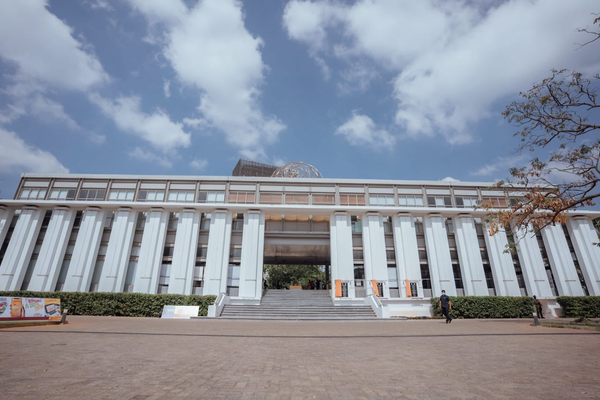
JAFFNA, Sri Lanka — Sri Lanka’s Cabinet is expected to consider a proposal to place the Jaffna Thiruvalluvar Cultural Centre under a new seven-member governing body dominated by central government representatives, according to officials familiar with the plan.
If approved, the move would formalize national oversight of a complex built with Indian grant funding on land owned by the Jaffna Municipal Council — and presented, repeatedly, as a gift to the people of the North.
The proposal has not been made public. But its details have circulated among civic leaders and local officials in Jaffna, reviving a long-standing concern: that a project intended to signal postwar reconciliation may, in practice, follow the same centralizing logic that has long shaped Colombo’s relationship with the Tamil-majority North.
“The land belongs to the Jaffna Municipal Council,” said one local official, who spoke on condition of anonymity because Cabinet deliberations are ongoing. “The funding came from India, as a gift to this city. The question people are asking is: who ultimately decides what happens inside that building?”
A Landmark Born of Diplomacy
The origins of the cultural centre trace back to March 2015, when Indian Prime Minister Narendra Modi visited Jaffna — the first Indian leader to do so in decades — and laid its foundation stone. The visit carried symbolic weight, marking New Delhi’s effort to reposition itself as a partner in Sri Lanka’s postwar recovery.
Funded through an Indian government grant of approximately $11 to $12 million, the centre was constructed on municipal land and conceived as a space for cultural exchange between two countries linked by a shared Tamil heritage. It includes a two-level museum, a 600-seat auditorium, a multistory learning tower and an open public square designed for performances and community gatherings.
Construction was largely completed by 2020, but the facility remained unused as Sri Lanka moved through a period of political uncertainty and economic crisis. It was formally inaugurated in March 2022 in a virtual ceremony attended by then Prime Minister Mahinda Rajapaksa and India’s External Affairs Minister S. Jaishankar.
The centre opened to the public nearly a year later, in February 2023, in a ceremony attended by President Ranil Wickremesinghe and India’s Minister of State L. Murugan.
The Architecture of Control
According to officials briefed on the Cabinet paper, the proposed governing body would include seven members: the Jaffna Municipal Commissioner, the Northern Province Governor, a representative from Sri Lanka’s Ministry of Cultural Affairs, two representatives from the Government of India and two from the Government of Sri Lanka.
On paper, the structure appears balanced. In practice, critics say, it is not.
The Northern Province Governor is appointed by the president, not elected locally. The Municipal Commissioner, while based in Jaffna, operates within a national administrative framework. Together, officials aligned with the central government would hold a structural majority, with no directly elected representatives from Jaffna included in the body.
A Familiar Pattern in the Postwar North
The dispute reflects a broader tension that has defined governance in Sri Lanka’s Northern Province since the end of the civil war in 2009. While successive governments have invested in reconstruction, they have also retained firm control over how that reconstruction is administered — often at the expense of elected provincial institutions.
The 13th Amendment to the Constitution provides for a degree of provincial autonomy, including over cultural affairs. But its implementation in the North has remained uneven and contested. The Northern Provincial Council has repeatedly accused the central government of bypassing its authority on issues ranging from land to development planning.
The cultural centre sits squarely within that pattern. For many in Jaffna, it has become a symbol of a larger, unresolved question: what devolution means in practice, and who ultimately exercises authority in the region.
“This is not about one building,” said a Jaffna-based civil society leader, who spoke on condition of anonymity. “It is about whether institutions in the North have real authority over what is placed in their midst. So far, that answer has largely been no.”