By M.R. Narayan Swamy
“One month is too short a time to be disappointed!”
The comment from a middle-aged Chennai resident, who voted for cinema star-turned-politician Vijay and remains one of his loyal supporters, neatly sums up the mood on the ground as Tamil Nadu’s first coalition government in decades completes its first month in office.
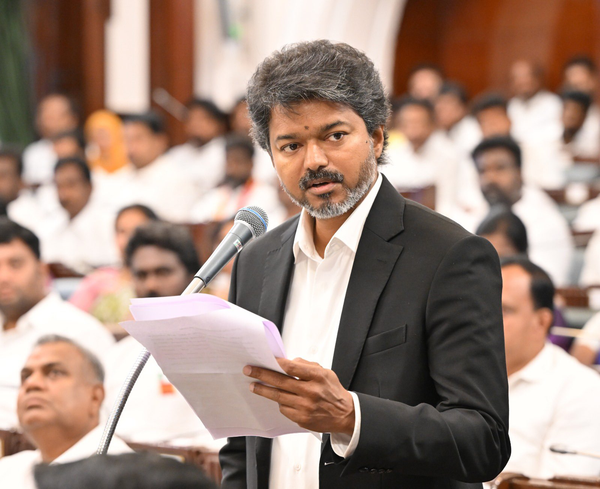
As Chief Minister, C Joseph Vijay retains much of his personal popularity that propelled millions in Tamil Nadu to vote for his two-year-old Tamilaga Vettri Kazhagam (TVK) party in a manner no political pundit anticipated.
His enviable fan base and strong social media support combined to help TVK secure an impressive 108 seats in the 234-member Assembly, a result that routed Tamil Nadu’s Dravidian giants. He then quickly secured the backing of smaller parties, giving him the legislative support needed to form a government.
One month after he took the oath of office on May 10, few have forgotten that Tamil Nadu — one of India’s most economically developed states — is being governed by its first non-Dravidian administration since 1967, when the Dravida Munnetra Kazhagam (DMK) ousted the Indian National Congress, the country’s oldest political party.
Most of those who voted for Vijay remain in his camp even if the enthusiasm that marked his road to electoral victory has subsided. But no one is shedding tears for the Dravidian parties, which lost the race.
On his part, Vijay has made a mark with some initial moves.
For one, people in Tamil Nadu are suddenly getting used to seeing a Chief Minister in a black coat, more like a lawyer (which Vijay is not), than the traditional white associated with Indian politicians.
If and when Vijay addresses a public rally, the crowd response is roaring – an indication that most people are still largely with him.
Vijay further proved his political mettle when he won a vote of confidence in the Tamil Nadu Assembly with 144 votes in his favor — far more than the number of seats won by his party in the election — thanks in part to a split within the once-monolithic AIADMK.
The chief minister’s decision to ensure 200 units of free power to every household has been warmly embraced, along with the farm loan waivers. He has also set up task forces to battle drug smuggling and protect women.
His cabinet has outlined 436 vision statements divided into 10 key pillars, focusing on Tamil identity, agriculture, education, and transparent governance – the last an electoral pledge.
This is mostly where many admirers stop patting Vijay.
Randomly selected Chennai residents, including some who voted for TVK, say it is evident that most of Vijay’s ministers, with a few exceptions, lack political and administrative experience.
“It is a dormant government,” one resident, Elangovan, who has seen many elections and governments in Tamil Nadu, told Jaffna Monitor. “Vijay is yet to meet the press, and there have been no major policy departures.”
Admirers and critics are waiting for the start of the Assembly session later this month to learn about Vijay’s vision. This is when Tamil Nadu’s budget is expected to be passed.
The widespread feeling is that most ministers, unaware of the ways of dealing with bureaucracy or the art of governance, are busy making media-savvy trips to various departments and making impromptu statements.
It was certainly not a pleasant moment when a young minister heading the Hindu Religious and Charitable Endowment Department confronted a shopkeeper near the famous Srirangam temple as to why the murukku packets he was selling carried no manufacturing or expiry dates.
“At a time when the endowment department is facing a major crisis, imagine this silly query?” asked a private sector employee. “Do prasadam given away in temples have manufacturing or expiry dates?”
The man had an explanation for the minister’s conduct.
“Vijay’s ministers have no knowledge of administration. This particular minister betrayed his immaturity,” he said. “We cannot forget that many ministers were merely Vijay’s fans. They have not changed.”
A total of 34 hard drives containing sensitive records, including coal procurement and tender-related data, were stolen from the headquarters of the Tamil Nadu Electricity Board (TNEB) in Chennai.
Although the disks were recovered from Bengaluru and arrests followed, the brazen security breach embarrassed the government.
While Royal Enfield’s decision to establish a new manufacturing facility in neighboring Andhra Pradesh may have been made earlier, its announcement has dealt a blow to the Tamil Nadu government. It marks the first time in decades that the motorcycle maker has expanded its manufacturing footprint outside Tamil Nadu.
That the facility will be located in Tirupati district, located just 50 km from the Tamil Nadu border, is no consolation for the loss of a unit that would have ensured many jobs.
In his characteristic style, Vijay is urging patience from those who voted for him.
Some agree. “I think he is on the right track, and he should be given time to show results. Some YouTube media persons are needlessly gunning for him. This is unfair,” K. Narayanan, now visiting the US, told Jaffna Monitor.
A company accountant, R.S. Sampath, added: “Who knows, the government might improve in six months. Vijay, unlike politicians, doesn’t speak too much. His ministers do all the talking. Let us hope he doesn’t slip up badly.”
TVK itself, however, remains upbeat.
“Our first month in office has been a success,” a Vijay confidant told Jaffna Monitor. “For the first time, we have a coalition government. Around 300 to 400 office bearers from districts across the state have joined us. The DMK’s grassroots organization will begin to crumble soon.”
The Chief Minister has also reportedly told senior party colleagues and ministers not to attack or criticize the AIADMK as corrupt, an indication that TVK is seeking to quietly win over the AIADMK’s support base.
But it has been noted that, unlike neighbouring Kerala, where a new Chief Minister has quickly made public a White Paper on the state’s finances, Vijay is yet to make true his own promise to bring out a similar White Paper.
No wonder the main opposition DMK, which Vijay defeated, is starting to make critical noises, though its leader and former Chief Minister, M.K. Stalin, had promised to keep quiet for six months.
“Will this government last even three months?” Stalin asked publicly the other day.
That, some residents say, may be too uncharitable an assessment.
A school teacher in his 50s said, besides the Chief Minister, the one minister acting with maturity was K.A. Sengottiyan, a nine-time legislator who quit the AIADMK to join the TVK before the elections. No wonder the TVK has named him the Leader of the House in the Assembly.
Far from Tamil Nadu, Vijay’s surprise victory has sent unexpected tremors through India’s national opposition alliance, after the Congress party embraced the actor-turned-politician by abandoning the DMK, its ally of several decades.
A furious DMK has, after a long period, turned bitterly against the Congress and refused to sit with its MPs in parliament anymore. The DMK has also distanced itself from the opposition INDIA alliance, a development that is bound to please Prime Minister Narendra Modi.
The INDIA bloc is a pale shadow of its original self. The Aam Aadmi Party has quit it. The Trinamool Congress, which recently lost power in West Bengal, has uneasy ties with the Congress. Now the DMK, one of its earliest constituents, has turned against the Congress, which is in decline in most parts of India.
This is an unintended gift from Vijay to India’s national politics. If he succeeds in establishing TVK as a major force in Tamil Nadu — a state that elects 39 members to Parliament — national parties will be more than eager to court him.