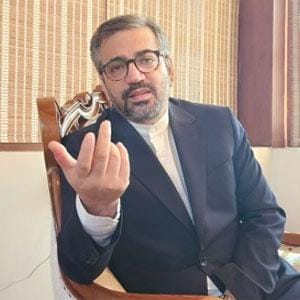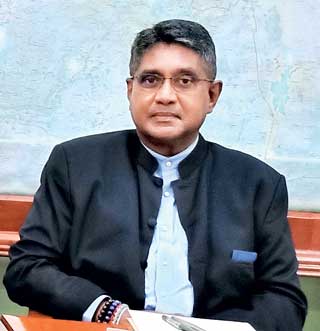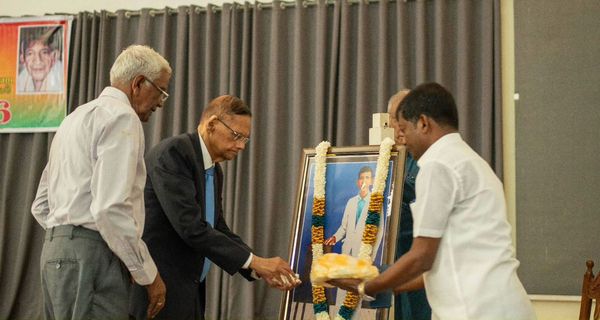
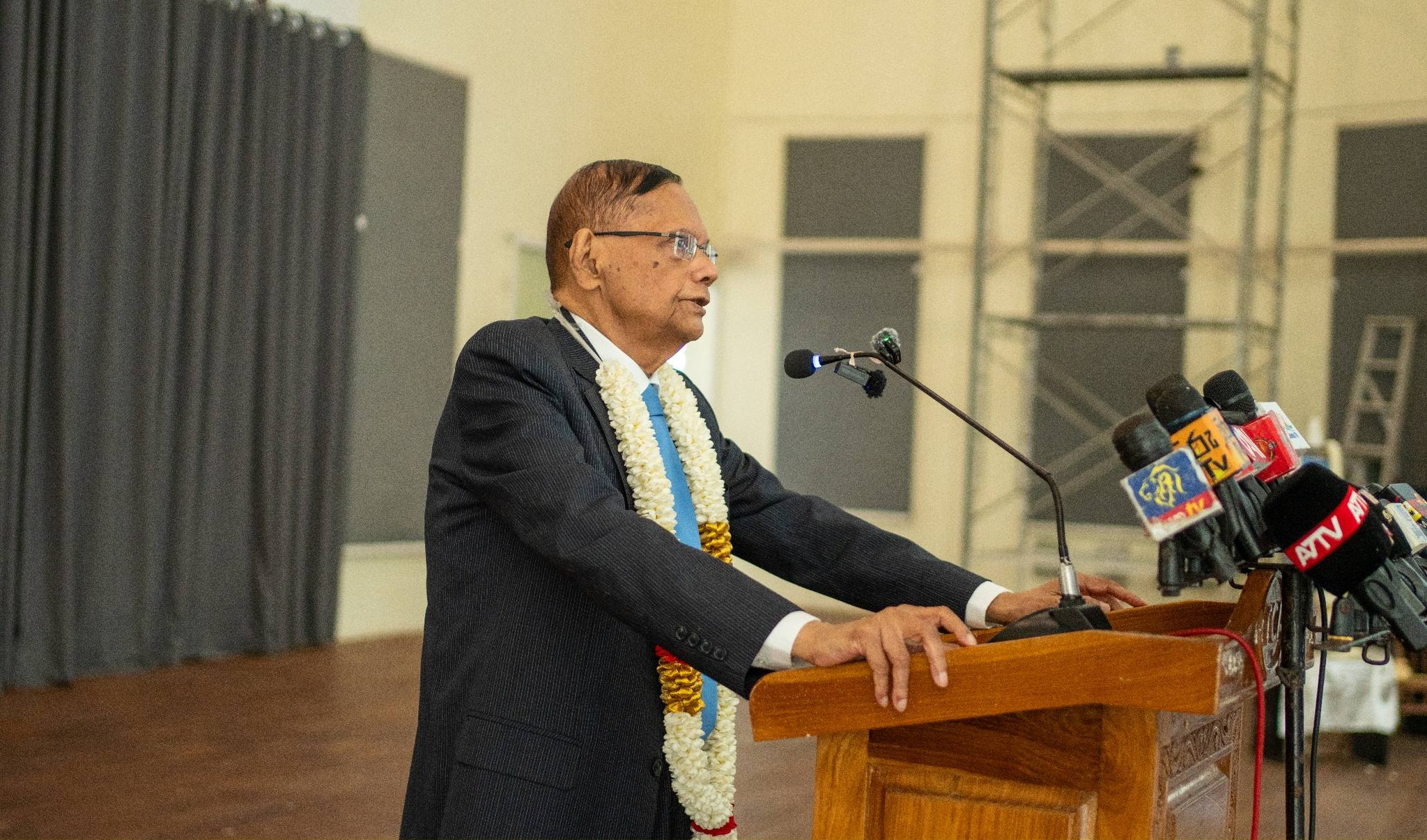
Delivering the S.J.V. Chelvanayakam Memorial Oration at Jaffna Central College, the legal scholar and former minister traced decades of missed opportunities for political accommodation. The full text of his address is published below.
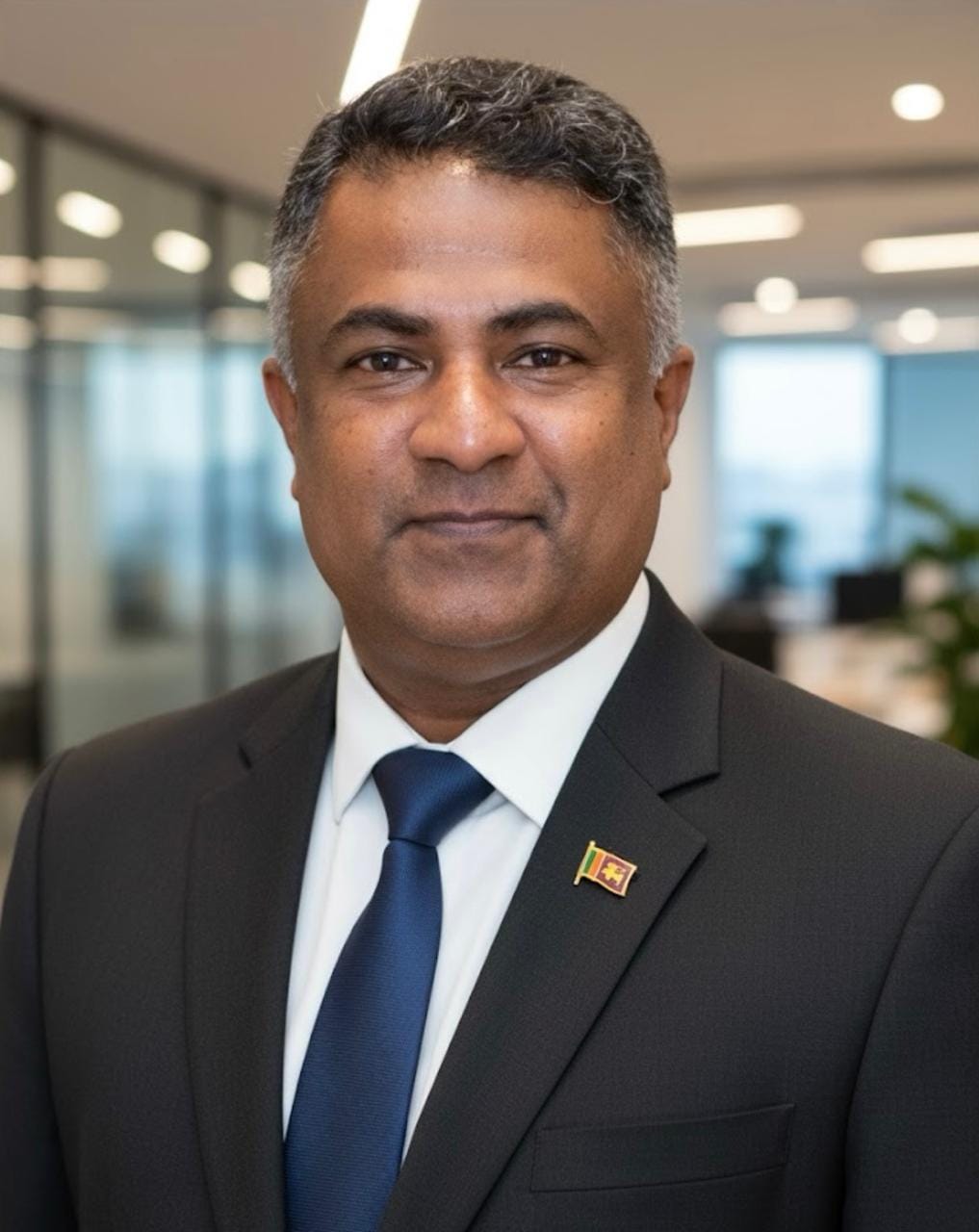
JAFFNA, Sri Lanka — On the forty-ninth anniversary of the death of S. J. V. Chelvanayakam — the lawyer who founded the Federal Party and gave the Tamil demand for self-rule its modern political form — G. L. Peiris on Sunday delivered the S.J.V. Chelvanayakam Memorial Oration at Jaffna Central College, telling an audience of Tamil political leaders, lawyers and members of the Ilankai Tamil Arasu Kachchi that Sri Lanka’s descent into nearly three decades of war had not been inevitable.
Prof. Peiris — a former minister of foreign affairs, education and constitutional affairs — opened his address by invoking the words of the Sangam-era poet Kaniyan Pungundranar: “Yaadhum Oore, Yaavarum Kelir,” which translates to, “Every place is my homeland; everyone is my kin.”
He said the trajectory toward armed conflict had been “gradual and potentially reversible,” shaped by a series of political choices rather than historical inevitability. At several critical moments, he said, there had been opportunities to change course, but “these windows of opportunity” were not taken.
The lecture, organized jointly by the Thanthai Selva Memorial Trust and ITAK, offered a detailed account of successive efforts at constitutional accommodation that failed to take hold. These included the Bandaranaike–Chelvanayakam Pact of 1957 and the Dudley Senanayake–Chelvanayakam Pact of 1965, both of which sought forms of regional autonomy but were either abandoned under political pressure or left unimplemented.
He also pointed to later initiatives — including the District Development Councils Act of 1980 and the Mangala Moonesinghe Committee of 1991 — as limited attempts that did not command sufficient consensus to address underlying grievances.
Prof. Peiris, who was closely involved in drafting constitutional reform proposals in the 1990s, referred to the Constitution Bill of August 2000 as the most far-reaching effort to restructure the state along devolved lines. The bill was ultimately withdrawn during its parliamentary debate.
“It was the nation’s misfortune,” he said, “that the culture of adversarial politics trumped a national initiative.”
Reflecting on that period, he paid tribute to Dr. Neelan Tiruchelvam, a key collaborator in the reform process who was later assassinated by the Liberation Tigers of Tamil Eelam.
He also recounted a private exchange with the LTTE’s chief negotiator, Anton Balasingham, who, he said, had acknowledged the limits of persuasion within the group’s leadership. According to Prof. Peiris, Balasingham had conveyed that he had attempted to present the realities of the situation to Velupillai Prabhakaran, but that further efforts carried risks to his own safety.
Prof. Peiris rejected the interpretation that the LTTE had, during the Norwegian-facilitated peace talks, accepted the principle of internal self-determination within a united Sri Lanka. That reading, he said, was “a total delusion,” arguing that the organization had consistently retained the option of secession.
He concluded on a more cautious note, drawing on his years in academia to suggest that younger generations may be less constrained by communal divisions than political narratives often assume.
“The youth of our country are not prey to narrow communal attitudes,” he said, pointing to patterns of interaction among students across ethnic lines.
The full text of Prof. Peiris’s address follows.
S.J.V. CHELVANAYAKAM: VISIONARY AND STATESMAN
FEDERALISM AND PATHS TO CONSTITUTIONAL REFORM
I. Life and Career
Had Mr. Chelvanayakam been with us today, he would no doubt be profoundly unhappy with the state of our country and the world.
Samuel James Velupillai Chelvanayakam was born on 31 March 1898 in the town of Ipoh in Malaya. When he was four years of age, he was sent by his father, along with his mother, for the purpose of his education to Tellippalai, a traditional village at the northern tip of Sri Lanka, or Ceylon as the country was then called, in close proximity to the port of Kankesanturai. He attended three schools, Union College in Tellippalai, St John's College Jaffna and S. Thomas' College Mount Lavinia, where he was a contemporary of S. W. R. D. Bandaranaike, with whom he was later destined to sign the Bandaranaike-Chelvanayakam Pact.
He graduated in Science as an external student of the University of London in 1918. In 1927, he married Emily Grace Barr-Kumarakulasinghe, daughter of the Maniyagar, or administrative chief for the area appointed by the colonial government. He had four sons and a daughter. His son, S. C. Chandrahasan, worked closely with me during my time as Foreign Minister on the subject of repatriation of refugees from India. Chandrahasan's wife, Nirmala, daughter of Dr. E. M. V. Naganathan, was a colleague of mine on the academic staff of the University of Colombo.
Mr. Chelvanayakam first contested the Kankesanturai constituency at the parliamentary election of 1947. His was a long parliamentary career. He resigned from his parliamentary seat in opposition to the first Republican Constitution of 1972, but was re-elected overwhelmingly at a by-election in 1975. He died on 26 April 1977.
There are many strong attributes which shine through his life and career.
He consistently showed courage and capacity for endurance. He had no hesitation in resigning from employment, which gave him comfort and security, to look after a younger brother who was seriously ill. As his son-in-law, Professor A.J. Wilson remarked, he learned to move in two worlds: a product of missionary schools, he was a devout Christian who never changed his religion for political gain. He was, quite definitely, a Hindu by culture, and never wished to own a house in Colombo for fear that his children would be alienated from their roots.
Gentle and self-effacing by disposition, he manifested the steel in his character by not flinching from tough decisions. Never giving in to expediency, differences of principle with Mr. G. G. Ponnambalam, the leader of the All Ceylon Tamil Congress, of which Mr. Chelvanayakam was a principal organizer, led him to break away from the Congress and to form a new party, the Ilankai Tamil Arasu Kachchi, or the Federal Party.
During the disturbances in March and April 1958, he was charged in the Magistrate's Court in Batticaloa and sentenced to a week's imprisonment. He was also subject to house arrest, but he never resorted to violence and used satyagraha to make his voice heard. When, in 1961, he was medically advised to travel to the United Kingdom for surgical treatment, he had to be escorted to the airport by the police because he was still under detention. Although physically frail and ailing in health during his final years, he lost none of the indomitable spirit which typified his entire life.
II. Advocacy of Federalism: Origins and Context
At the core of political convictions he held sacrosanct was his unremitting commitment to federalism. A moment of fruition in his life was the formation of the Federal Party, Ilankai Tamil Arasu Kachchi, on 18 December 1949.
Contrary to popular belief, however, federalism in our country had its origin in issues which were not connected with ethnicity. At its inception, this had to do with the aspirations not of the Tamils, but of the Kandyan Sinhalese. The Kandyan National Assembly, in its representations to the Donoughmore Commission, in November 1927, declared: "Ours is not a communal claim or a claim for the aggrandizement of a few. It is the claim of a nation to live its own life and realize its own destiny".
Mr. S. W. R. D. Bandaranaike, soon after his return from Oxford, as a prominent member of the Ceylon National Congress, was an ardent advocate of federalism. He went so far as to characterize federalism as "the only solution to our political problems". With Thomas Hobbes in his famous work, The Leviathan, he conceived of liberty as "political power broken into fragments". Bandaranaike went on to state in a letter published in The Morning Leader on 19 May 1926: "The two clashing forces of cooperation and individualism, like that thread of golden light which Walter Pater observed in the works of the painters of the Italian Renaissance, run through the fabric of civilization, sometimes one predominating, sometimes the other. To try and harmonize the two has been the problem of the modern world. The only satisfactory solution yet discovered is the federal system".
Federalism had a strong ideological appeal, from a Marxist-Leninist perspective. The constitutional proposals, addressed by the Communist Party of Ceylon to the Ceylon National Congress on 18 October 1944, go very far indeed. They envisioned the Sinhalese and the Tamils as two distinct "nations" or "historically evolved nationalities". The high watermark of the proposals was the assertion that "Both nationalities have their right to self-determination, including the right, if they so desire, to form their own separate independent state".
These proposals received further elaboration in a memorandum submitted to the Working Committee of the Ceylon National Congress by two leading members of the Communist Party, Mr. Pieter Keuneman and Mr. A. Vaidialingam. Their premise was set out pithily as follows: "We regard a nation as a historical, as opposed to an ethnographical, concept. It is a historically evolved, stable community of people living in a contiguous territory as their traditional homeland".
The Soulbury Commission, which arrived in the country in December 1944, had no hesitation in recognising that "The relations of the minorities - the Ceylon Tamils, the Indian Tamils, Muslims, Burghers and Europeans, with the Sinhalese majority - present the most difficult of the many problems involved in the reform of the Constitution of Ceylon".
They took fully into account the apprehension expressed by the All Ceylon Tamil Congress that "The near approach of the complete transfer of power and authority from neutral British hands to the people of this country is causing, in the minds of the Tamil people, in common with other minorities, much misgiving and fear".
III. Constitutional Provisions at Independence
The Souldbury Commission, like the Donoughmore Commission before it, was not friendly to the idea of federalism, principally because of their commitment to the unity of the body politic. Opting for a solution falling short of federalism, they adopted the approach that, if the underlying fear related to encroachment on seminal rights by capricious legislative action, this anxiety could be convincingly assuaged by enshrining in the Constitution a nucleus of rights placed beyond the reach of the legislature.
The essence of the solution which commended itself to the Soulbury Commission was a carefully crafted constitutional limitation on the legislative competence of Parliament, encapsulated in Article 29(2) of the Independence Constitution. The gist of this was incorporation of the principle of non-discrimination against racial or religious communities by explicit acknowledgement of equal protection under the law.
The assumption fortifying this expectation was the attribution of an imaginative role to the judiciary in respect of interpretation. It was lack of fulfillment in this regard that precipitated a setback which time could not heal. Judicial attitudes, including those of the Judicial Committee of the Privy Council, which constituted at the time the highest tier of the judicial hierarchy, were timid and diffident.
When the Citizenship Act of 1948, by means of a new definition, sought to deprive Tamils of Indian origin of the suffrage, no protection was forthcoming from the courts on the ground of impermissible discrimination. This refusal of intervention was premised on an implausibly narrow construction of the word "community", in that, according to the Courts' reasoning, in the landmark case of Kodakkan Pillai v. Madanayake, Indian Tamils were not identifiable as a community distinct from the larger community of the Tamils of Ceylon. It is hard to disguise the reality that this was, at bottom, a refusal to deal with the substantive issues candidly and frontally.
The resulting vulnerability of minority rights, which judicial evasion laid bare, was a major contributory cause of the erosion of confidence on the part of minority groups. This mood of suspicion and despair, arising from an ostensibly weak method of protection of human rights, presaged ensuing developments.
IV. Further Quest for a Constitutional Solution
The central theme of this lecture, in honour of a statesman who was an epitome of restraint and moderation, is that the deterioration of ethnic relations, which culminated in a war of unrivalled savagery over a span of three decades, was progressive and incremental. There was no inevitability about the denouement. It was gradual and potentially reversible. At several crucial points, there was opportunity to arrest a disastrous trend. These windows of opportunity, however, were not utilized: extremist attitudes asserted themselves, and polarization became the outcome. This trajectory was no doubt met with dismay by far-sighted leaders of the calibre of Mr. Chelvanayakam.
The formation of the Federal Party was a turning point. With Mr. S.J.V. Chelvanayakam, King's Counsel, as founder-president, and Dr. E.M.V. Naganathan and Mr. V. Navaratnam as joint secretaries, the party embarked on a journey which marked a radical departure from the conventional thinking of the past. This was plain from the text of seven resolutions adopted at the national convention of the party held in Trincomalee in April 1951. The foundation of these resolutions was the call to establish a Tamil state within the Union of Ceylon, and the uncompromising assertion that no other solution was feasible.
The path was now becoming manifest. The demand up to now had been for substantial power sharing within a unitary state. This was now giving way to a strident demand for the emergence of a federal structure, destined to be expanded in the fullness of time to advocacy of secession.
Although standing out boldly as a landmark in constitutional evolution, the Federal Party resolutions did not carry on their face the hallmark of finality or immutability. The call of the Tamil leadership for secession yet being some years away, the ensuing decades saw further attempts by different governments to resolve the vexed issues around power sharing.
The first of these was the Bandaranaike-Chelvanayakam pact, signed by the Prime Minister and the leader of the Federal Party on 26 July 1957. There was an air of uneasy compromise surrounding the entire transaction. This was evident from the structure of the pact, which, as one of its integral parts, contained a section not reduced to writing in any form, but consisting of a series of informal understandings.
The essence of the pact was the proposed system of regional councils which were envisaged as an intermediary tier between the central government and local government institutions. This did break new ground. Not only did the pact confer on the people of the North and East a substantial measure of self-governance through these innovative councils, including in such inherently controversial areas as colonization, irrigation and local management, but territorial units were conceived of as the recipients of devolved powers. Of particular significance, the regional councils were to be invested with some measure of financial autonomy. The blowback, however, was so intense as to compel the government to abrogate the pact.
The next attempt, eight years later, was by the United National Party, which had vehemently opposed the Bandaranaike–Chelvanayakam Pact. This was the Dudley Senanayake–Chelvanayakam Pact, signed between the leader of the United National Party, at the time Leader of the Opposition, and the leader of the Federal Party. It differed from the Bandaranaike–Chelvanayakam Pact both contextually and substantively.
As to context, it was signed on 24 March 1965, on the eve of a parliamentary election, to ensure for the United National Party the support of the Federal Party. A disheartening feature was the plainly evident element of duplicity. Once in government, the Prime Minister’s party showed little interest in implementing the pact. Within three years, the Federal Party left the government, and its representative in the cabinet, Mr M. Tiruchelvam QC, Minister of Local Government, relinquished his portfolio.
Substantively, the lynchpin of the pact was a system of district councils, but there was entrenched control of these bodies by the central government, even in regard to action within their vires. This was almost universally seen as a sleight of hand.
Despite the collapse of these efforts, room for resilience and accommodation had by no means disappeared. Nowhere is this better exemplified than in the events which led up to the drafting and adoption of the "autochthonous" Constitution of 1972. This involved the historic task of severing the centuries-old bond with the British Crown and bringing into being the Republic of Sri Lanka.
One of the Basic Resolutions, which eventually found expression as Article 2 of the new Constitution, characterized Sri Lanka as a unitary state. The Federal Party proposed an amendment that the word "federal" should be substituted for "unitary". Mr. V. Dharmalingam, the spokesman for the party on this subject, in his address to the Constituent Assembly on 16 March 1971, showed flexibility by declaring that the powers of the federating units and their relationship to the centre were negotiable, once the principle of federalism was accepted. Indivisibility of the Republic was emphatically articulated, self-determination in its external aspect being firmly ruled out.
There was no reciprocity, however. Mr. Sarath Muttettuwegama, administering a sharp rebuke, declared: "Federalism has become something of a dirty word in the southern parts of this country". The last opportunity to halt the inexorable march of events was spurned.
The pushback came briskly, and with singular ferocity. This was in the form of the Vaddukoddai Resolution adopted by the Tamil United Liberation Front at its first national convention held on 14 May 1976. The historic significance of this document is that it set out for the first time, in the most unambiguous terms, the blueprint for an independent state for the Tamil nation, embracing the merged Northern and Eastern Provinces. The second part of the Resolution contained the nucleus of Tamil Eelam, its scope extending beyond the shores of the Island. The state of Tamil Eelam was to be home not only to the people of the Northern and Eastern Provinces, but to "all Tamil-speaking people living in any part of Ceylon and to Tamils of Eelam origin living in any part of the world who may opt for citizenship of Tamil Eelam".
The most discouraging element of this sequence of events was the timid and evasive approach adopted by prominent actors at crucial moments. The District Development Councils Act of 1980 presented a unique opportunity. Disappointingly, however, the Presidential Commission presided over by Mr. Victor Tennekoon QC, a former Chief Justice and Attorney General, lacked the courage even to interpret the terms of reference as permitting allusion to the ethnic conflict. Despite the persevering efforts of Professor A.J. Wilson, son-in-law of Mr.Chelvanayakam, and a confidant of President J.R. Jayewardene, and Dr. Neelan Tiruchelvam, the majority of the members were inclined to adopt a narrow, technical interpretation of the terms of reference. The setting of the legislation was one in which Tamil formations, such as the Tamil United Liberation Front, were struggling to maintain their moderate postures in an increasingly polarized environment, with pressure from radical elements proving almost irresistible.
The whole initiative paled into insignificance in comparison with a series of tragic events, including the burning of the Jaffna library during the run-up to the District Development Council elections in the North and the calamitous events of Black July 1983. Policymakers at a critical juncture had once again let a limited opportunity slip through their fingers.
The next intervention occurred in the sunset years of the United National Party administration. This was the Parliamentary Select Committee on the ethnic conflict, known after its chairman as the Mangala Moonesinghe Committee, appointed in August 1991.
The Majority Report made a detailed proposal which was intended to serve as the basis of a compromise between two schools of thought—one stoutly resisting any idea of merger of the Northern and Eastern Provinces, and the other demanding such merger as the indispensable basis of a viable solution. An imaginative via media was the concept of the Apex Council, which formed the centrepiece of the Majority Report. It adopted as a point of departure two separate Provincial Councils for the North and the East. This dichotomy would characterise the provincial executive as well: each Provincial Council would have an Executive Minister as the head of the Board of Ministers. However, over and above these, the two Provincial Councils together would constitute a Regional Council for the entire North-East region. Although presenting several features of interest as a pragmatic mediating mechanism, the proposal did not enjoy a sufficiently broad support base for implementation.
V. Subsequent Initiatives
Federalism, integral as it was to the value system which anchored the political life of Mr. Chelavanayakam, defies easy definition. Indeed, as the facilitators of the Sri Lanka peace process, when it was pursued at the international level, the Royal Norwegian government considered it central to their function to inculcate in the LTTE an understanding of the nuances of federal systems of government in practice in order to overcome inherent inhibitions. To this end, they arranged extensive travels for the political affairs committee of the LTTE in Nordic countries. Subsequent to his defection with almost the entirety of the cadres in the Eastern Province, arguably the greatest blow sustained by the LTTE in its entire history, Karuna was to declare that it was this exposure which opened his eyes to a world outside the jungles of the Vanni.
Federalism, as a concept, represents a spectrum rather than a split. This is brought out clearly in three sets of constitutional proposals by the Chandrika Kumaratunga administration during the period 1995 to 1997. They oscillated from one end of the spectrum to the other in establishing the line of demarcation between the functions of the central government and the periphery, in a coherent constitutional scheme.
I would like, at this point, to pay tribute to the legacy of a valued friend and colleague, Dr. Neelan Tiruchelvam, who co-authored with me, as Minister for Constitutional Affairs, Ethnic Affairs, and National Integration, with the support of many others, including Dr. Jayampathy Wickramaratna, the proposals of 1995, 1996, and 1997. Neelan, who had been a fellow undergraduate in the University of Sri Lanka, had proceeded to Harvard University while I was the recipient of a Rhodes Scholarship at Oxford. A further coincidence was the entry of both of us together into the Parliament of Sri Lanka in August 1994. He was brutally assassinated because he stood in the way of the LTTE’s claim to exclusivity of representation of the interests and aspirations of the Tamil people. The future might well have been different, had he lived.
The Constitution Proposals of 1995 embodied strong features of federalism, and indeed went well beyond. Regional Councils, forming the gist of the proposals, were vested with executive, legislative and judicial competence in the subjects assigned to them. In all key areas, these powers were to be protected against encroachment by the centre. With regard to finance, Regional Councils were to have powers of taxation, including international borrowings and the power to promote foreign investment, international grants and development assistance. In the crucial area of law and order and policing, provision was to be made for a regional police service headed by a regional police commissioner appointed by the Chief Minister. Land was clearly identified as a devolved subject, and state land within a region was to be vested in the Regional Council, with limited reservations in respect of requirements by the central government. This document represents the strongest movement towards a federal structure in the entire evolutionary process in Sri Lanka.
The Proposals of 1995 were modified by a more detailed draft in 1996, which represented a regressive development. The basic weakness consisted of conferment of awesome powers on the Presidency, fundamentally altering the balance of power between the Centre and the regions, and making the latter vulnerable to capricious exercise of discretion which could strike at the very root of the regions' authority. The mere ipse dixit of the President was to prevail in a situation where the entire sweep of the regions' powers, entrenched by constitutional provisions, was sought to be negated by executive action at the Centre, no recourse being available to the region for access to the courts. This was hardly likely to inspire confidence.
A corrective trend then set in, resulting in a further set of Proposals published in 1997. The solution chosen this time was conferment on the regions of a power, to veto proposed constitutional amendments to the content of the chapter on devolution of power to the regions and the two schedules to the draft constitution which dealt with the scope of the regions' powers and the division of powers between the centre and the regions. A drastic curtailment of Parliament's powers, this was movement from one extreme to the other. Invitation to arbitrary action was shifted from centre to periphery. It is scarcely surprising that these Proposals were seen to contain within them the seeds of their own destruction.
The most elaborate and thorough response to the widely acknowledged imperative of constitutional reform was contained in the Constitution Bill which, as Minister for Constitutional Affairs, I presented on behalf of President Kumaratunga on 3 August 2000.
While the nomenclature of federalism was not specifically invoked, its essence was captured in the provision that the Republic of Sri Lanka shall consist of "the institutions of the centre and the regions". The legislative power of the people was to be exercised "by Parliament and by Regional Councils", while the executive power of the people was to be exercised not only by the President, but also by "the Governors acting on the advice of the respective Chief Ministers and Regional Boards of Ministers". Governors of regions were to be appointed by the President "in consultation with the Prime Minister and with the concurrence of the Chief Minister of the region". Exclusivity of legislative power in respect of devolved subjects was explicitly conferred on the regions. No element of equivocation characterised treatment of the controversial subjects of land and police powers. With regard to the former, the applicable provision was that "Every region shall succeed to all state land within the region and be at the disposal of the regional administration of that region for the purposes set out in the regional list". As for the latter, there was to be "a regional police service for each region, headed by a regional police commissioner who shall be appointed by the regional police commission with the concurrence of the Board of Ministers of the region". Equally striking on the subject of finance was the amplitude of authority conferred through the Consolidated Fund of the region.
Robust hostility of the LTTE to implementation of these proposals as the core of a constitutional settlement had its gruesome manifestation in the brutal killing of Dr. Neelan Tiruchelvam. The chilling effect on the major Tamil formation in Parliament, the Tamil National Alliance, of which Dr. Tiruchelvam had been an active member, was overbearing.
Compounding the problems was the attitude of the main opposition party, the United National Party, which was disinclined to cooperate after their narrow defeat in the presidential election of December 1999. It was the nation's misfortune that the culture of adversarial politics trumped a national initiative, compelling the government to withdraw the Bill during the debate in Parliament.
VI. Elevation to an International Profile
It was against the backdrop of failure of the constitutional process that direct negotiations were embarked upon between the Government of Sri Lanka and the LTTE, with Norwegian facilitation in September 2002. The insuperable obstacle, it soon became evident, was the ethos of the LTTE. Dominant in their mindset was the unshakable conviction of military invincibility. In light of this, Prabhakaran saw no necessity to make any significant concession and believed fervently that the state of Tamil Eelam was well within reach.
Anton Balasingham, who represented Prabhakaran in six rounds of direct discussions across the world, was the only member of the LTTE delegation with a grasp of underlying issues. As my relationship with him grew less formal, I decided to put to him a candid question outside the conference floor. I told him that I saw events moving relentlessly, much in the manner of a Greek tragedy, from the LTTE's point of view, towards the climax. There was nevertheless a narrow window of opportunity, and I asked him why they were intractably resolved to make no use of it.
His response remains indelibly etched in my mind. He told me that he had nothing to reproach himself with: he had done his best to present the reality of the situation to his leader, but the latter, intransigent in his convictions, resisted reason to the point where Balasingham was convinced that further attempts at persuasion involved peril to his own life. Erik Solheim, who had a conversation with him a few days before his death in London, told me that Balasingham died, dispirited and disillusioned.
The theory that the LTTE, at a decisive phase of the peace negotiations, deliberately jettisoned the option of external self-determination, is total delusion. This was a myth around what came to be known as the "Oslo Declaration" during the third session of talks in the Norwegian capital. At the end of this session, the official communique by the facilitators declared: "The parties agreed to explore a solution founded on the principles of internal self-determination in areas of historical habitation of the Tamil-speaking peoples, based on a federal structure within a united Sri Lanka".
The LTTE's understanding of "internal self-determination", however, was set out with clarity in the following statement: "We are prepared to consider favourably a political framework that offers substantial regional autonomy and self-government in our homeland on the basis of our right to internal self-determination". But the sword of Damocles was ever present. The caveat was added, with unrelenting emphasis, that "If this internal element of self-determination is blocked and denied, and the demand for regional self-rule is rejected, we have no alternative other than to secede and form an independent state". The LTTE, then, left wide open the option of external self-determination.
They purported to derive authority for their position from the United Nations Declaration in 1970 on Principles of International Law concerning Friendly Relations and Cooperation among States and from the judgment of the Supreme Court of Canada in 1998 in the Quebec Secession case.
The LTTE's rigid stance was expressed with precision in their proposal for the establishment of an Interim Self-Governing Authority and the conferment of all-encompassing jurisdiction upon it: "The ISGA shall have plenary power for the governance of the North-East, including powers in relation to resettlement, rehabilitation, reconstruction and development, including improvement and upgrading of existing services and facilities, raising revenue, including imposition of taxes, revenue, levies and duties, law and order, and over land". It was added for good measure that "These powers shall include all powers and functions in relation to regional administration exercised by the government of Sri Lanka in and for the North-East". This was, in all but name, the blueprint of a separate state.
This went well beyond the solution which Mr. Chelvanayakam, in his mature judgment, deemed feasible in the political and economic context of our country.
VII. A Final Opportunity
Events, then, seemed to be moving rapidly towards an impasse incapable of resolution through dialogue. One final opportunity, albeit in uniquely distressing circumstances, appeared to present a lifeline.
This was the tsunami which struck Sri Lanka on Boxing Day, 26 December 2004. Since much of the destruction, especially on the east coast, was in areas controlled by the LTTE, there was the urgent need for a collaborative mechanism between the government and the LTTE to deliver relief and undertake immediate reconstruction. Consequently, a painstaking attempt was made to formulate a pragmatic framework for collaboration, its parameters strictly confined to the matter in hand and devoid of political controversy to the maximum extent possible. President Kumaratunga attached great importance to the resulting P-TOMS mechanism, which, in her judgment, held out the last chance for a successful peace negotiation.
However, the Supreme Court, in an Interim Order, struck down vital portions of the Agreement dealing with control of resources for urgently required construction and rehabilitation work. The ensuing message was unfortunate, in that serious doubt was cast on the capability of structures of the Sri Lankan state to evolve an appropriate mechanism, even in the face of as excruciating a disaster as the tsunami which claimed more than 35,000 lives.
VIII. Conclusion
Despite this unprepossessing trajectory of events, I would make bold to suggest that a sanguine outlook is not entirely unrealistic. The basis of my confidence in this regard is my experience, over the span of 26 years, as a teacher, Dean of the Faculty of Law, and Vice-Chancellor of the University of Colombo. It is my firm conviction that the youth of our country are not prey to narrow communal attitudes and prejudices.
Relations among the different ethnic communities in the environment of the country's universities are typified by camaraderie rather than mutual acrimony or suspicion. Language, certainly, is a barrier. In my own undergraduate days in Peradeniya and Colombo, we made friendships on the basis of shared interests and values and were able to communicate comfortably in the English language. Stratification and compartmentalization are the implacable enemy of the forging of a national consciousness, especially in sentient minds.
When as Minister of Education and Higher Education, I was invited to preside over the annual prize-giving at the oldest girls' schools in Sri Lanka and even South Asia, situated in Uduvil, I drew attention to the need for greater interaction with peers in the South through activities such as sports, debating, drama, and cultural pursuits. Reciprocally, I spoke to the leadership of schools in the South, urging them to reach out with enhanced vigour to the North to forge bonds which could potentially last a lifetime.
These are the values which informed the bedrock of the life and career of S. J. V. Chelvanayakam. The tempests of politics, in substance if not in style, were just as intense then as they are now, but the unwavering strength of what he held sacred, never succumbing to expediency, formed the wellsprings of the fortitude which sustained him through these tempests. He made his tryst with destiny in a fulfilling and inspiring career of dedicated service, which stands out today as a beacon of light, all the more redeeming amid the cynicism and apathy so sadly evident around us. It is my privilege this evening to honour a Colossus whose influence survives long after him.