By M.R. Narayan Swamy
When Indian spiritual guru Sri Sri Ravi Shankar flew into Colombia in 2015, the peace process in the South American country was on the verge of collapse.
President Juan Manuel Santos had announced he was freezing negotiations with the notorious Revolutionary Armed Forces of Colombia (FARC) after it killed some young and unarmed soldiers, sparking nationwide outrage.
That was when Gurudev, as Ravi Shankar is addressed, reached Bogotá to meet President Santos following appeals from a clutch of politicians keen that the peace process be back on track with the leftist rebels.
It helped that Santos’ daughter followed the Art of Living leader online.
Under pressure, the president agreed to meet Gurudev for just 15 minutes. But once they began talking, the conversation lasted more than an hour.
Santos was so impressed at the end of it that he urged the Indian guru to travel to Havana, Cuba, to meet the leaders of the FARC camping there.
That is what Ravi Shankar did, speaking with warmth and positivity to leading representatives of the insurgent group who had been battling the Colombian state for over half a century.
Gurudev’s meetings with the FARC leaders lasted three days. Helping the Indian was the Colombian head of the Art of Living group, a former right-wing minister who was otherwise a sworn enemy of the FARC.
“What set the Art of Living apart from other organisations involved in the Colombian peace process was the level of trust and personal connection it established with the FARC leadership,” Juan Carlos, one of the youngest members of the Colombian parliament, recalled in a published commentary.
Indeed, the FARC, dubbed intransigent by many, was won over. One of its top leaders announced the group would embrace Gandhian non-violence. It agreed to abide by a ceasefire, signed a historic peace deal in 2016, and disarmed the next year. (It is another matter that disgruntled elements broke away and have continued their violence spree.)
The Colombian president acknowledged the unique role played by Ravi Shankar. The Indian guru was invited to a 2016 ceremony where he sat with then US Secretary of State John Kerry. The Colombian House of Representatives awarded him the Simon Bolivar Oder of Democracy for his efforts in promoting peace and nonviolence in the country.
Although many years have rolled by, Ravi Shankar’s role is still remembered fondly in Colombia.
Eight years before he made it to Colombia, the Gurudev flew into Sri Lanka for a well-publicised meeting with Velupillai Prabhakaran, leader of the Liberation Tigers of Tamil Eelam (LTTE). The LTTE had agreed to host the interaction. And President Mahinda Rajapaksa gave his approval to the visit.
Ravi Shankar’s aim was to see if he could help bring about peace in Sri Lanka, whose government was then on a punishing offensive against the Tamil Tigers.
The one person in the LTTE who badly looked forward to a meeting between the Gurudev and Prabhakaran was S.P. Thamilselvan, who headed the political wing of the Tigers.
Little did Ravi Shankar know that the LTTE had no intention of letting him meet Prabhakaran. The ugly truth, as revealed to one of his aides by a LTTE prisoner in Sri Lankan custody after the war ended, became public knowledge when Swami Virupaksha published his book, The Tiger’s Pause: The Untold Story of Gurudev Sri Sri Ravi Shankar’s Peace Efforts in Sri Lanka. (As we shall see below, this version has been contested by those sympathetic to the LTTE.)
Not only this, but the LTTE had, most foolishly, hatched a plan code-named Bunker 21 to take Ravi Shankar hostage and hold him for some three months, the book alleged. He was to be used as a bargaining chip to force Colombo to end its military blitzkrieg.
The LTTE intelligence, led by Prabhakaran-confidant Pottu Amman, had prepared three bunkers to hide the Indian guru and shift him every two days. A set of white dhotis and shirts had been brought for his use. The LTTE intelligence had found out his food habits. Prabhakaran approved the plan but made it clear that no harm should ever come to Ravi Shankar.
The decision to abduct the Gurudev sparked unheard of disaffection in the Tigers even amid the war. Thamilselvan was livid that a promised meeting between the Indian and the LTTE chief had been axed so callously.
It became clear much later that the LTTE had agreed to the meeting only to draw Ravi Shankar into its den. The Tigers had also dispatched a woman spy to keep an eye on him once he landed in Sri Lanka. (This woman disappeared after she was detained once the war ended.)
Fortunately, the planned kidnapping never took place. Ravi Shankar went to Kilinochchi, a long-time LTTE administrative capital, but left after waiting for a long time for a summons to meet Prabhakaran, which never came. LTTE cadres, strictly told not to harm the Indian guru, did not physically try to stop him from leaving.
An upset Thamilselvan secretly sent a handwritten letter in Tamil to Ravi Shankar in Bengaluru, where the Art of Living is headquartered, apologizing for the cancelled meeting with Prabhakaran and describing it as “a last missed chance for peace”.
“Our leader was reluctant to meet you as he was misguided by some of his senior aides,” the LTTE leader wrote, in an obvious reference to Pottu Amman, who was intent on holding Ravi Shankar forcibly. “Our leader did not take my advice, and it hurts me.”
In a pointer to the state of affairs in the LTTE-controlled territory, Thamilselvam underlined that he had written the letter in his personal capacity and that he was not in a position to talk to Ravi Shankar on the telephone.
One doesn’t know whether the letter was received by Art of Living before or after Thamilselvam was killed in November 2007. In any case, Ravi Shankar did not undertake any further peace efforts vis-à-vis Sri Lanka, where he enjoys a wide following, both among Tamils and Sinhalese.
In just 18 months from the time Ravi Shankar went to Kilinochchi but could not meet Prabhakaran, the LTTE leader was dead, and the curtains came down on the decades-long armed struggle for Tamil Eelam. Also dead was Pottu Amman, who blew himself up with a suicide jacket packed with kilos of explosives.
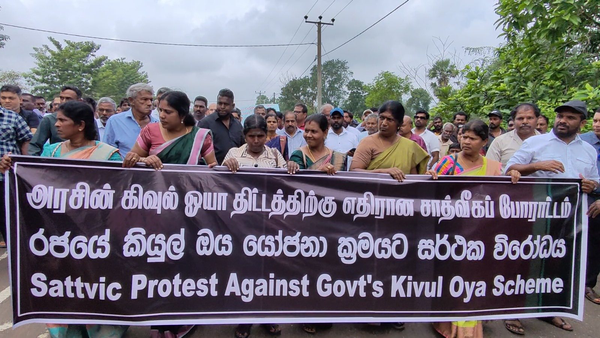
Tamils sympathetic to the LTTE have dubbed the claims in the book as false and imaginary. According to them, Thamilselvam could not have written any letter to Ravi Shankar, and that the claims were aimed at tarnishing the Tigers’ image. In 2011, a group of Tamils in Batticaloa organised a street protest against the Indian guru.
The Gurudev’s aides say that even as Ravi Shankar was making small talk with junior LTTE functionaries in Kilinochchi, some of the latter boasted that an independent Tamil Eelam would be a reality soon and that the LTTE would defeat the Sri Lankan military. If true, the Tigers, unlike the FARC in distant Colombia, were living in a dreamland.
It is not that the FARC was less militarily powerful than the LTTE. Indeed, at the peak of its power, it was one of the most feared insurgent groups in Latin America, and it functioned like a state within a state. It commanded 15,000-20,000 combatants and controlled over 42,000 square miles of territory, roughly the size of Switzerland. Like the LTTE, it had evolved over the years from a guerrilla group into a semi-conventional army, attacking and defeating Colombian military garrisons in major battles. It no doubt weakened in later years due to a combined pushback by the Colombian and US armed forces.
The key difference between the FARC and LTTE leaderships lay in understanding the evolving world and accordingly changing strategies. The FARC brass grasped that the armed struggle could not go and on and decided to make peace; Ravi Shankar’s role – and the fact he was respected on both sides of the Colombian divide- helped the group to shake hands with the government in Bogota.
In contrast, the LTTE leadership concluded long ago that no force on the earth could ever defeat it and that it was led by a leader who had all the answers even to the most difficult and unpredictable situations. (One reason Anton Balasingham fell out of favour in Prabhakaran’s eyes was his advocacy that the LTTE needed to change gears – and soon.) By the time the reality dawned and Pottu Amman confided to his aides (shortly before his own death) the blunders the LTTE had committed, it was too late.
I must add a personal bit to the Gurudev’s Sri Lanka story.
A month or so before he left for Sri Lanka, Ravi Shankar called me for a meeting, knowing my long years of work on the island’s ethnic conflict. He told me about his proposed trip and sought my opinion. He did not give too many details, and I did not probe matters that may have been confidential. Our meeting incidentally took place at a plush bungalow of one of his devotees on Delhi’s tree-lined Sardar Patel Marg, the very same street which houses Hotel Diplomat – where I had met Prabhakaran for the first time in 1985.
I made it clear to the Gurudev that his mission was unlikely to succeed because of the LTTE’s mindset, because the group viewed even well-meaning peace moves as a sign of compromise. I said the Tigers lacked a long-term strategic vision. Ravi Shankar asked me a few questions, and I wished him all the best on his proposed peace journey.
I was not surprised that the Indian guru was spurned by the Tigers. But even I was shocked when I learnt that the LTTE, with Prabhakaran’s blessings, had planned to kidnap the internationally known personality. The Sanskrit proverb which came to my mind then was: Vinash kale viprit buddhi. In English, it means: When downfall is imminent, the intellect works against one’s own best interests.