

In Jaffna Killing, Family Seeks Justice as Police Conduct Comes Under Scrutiny

In Jaffna Killing, Family Seeks Justice as Police Conduct Comes Under Scrutiny


Share this post

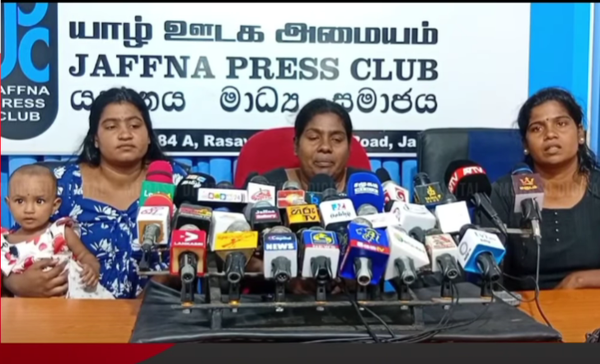
JAFFNA, Sri Lanka — The family of Arul Payas, the youth killed in a police shooting in Jaffna’s Allaipiddy area earlier this year, publicly accused Sri Lankan authorities on Wednesday of denying them justice, alleging intimidation, institutional indifference, and political abandonment in the months following his death.

Speaking through tears at a press conference held at the Jaffna Media Centre, relatives said their efforts to seek accountability, including a visit to Colombo in hopes of meeting President Anura Kumara Dissanayake, ended in humiliation.

“We went seeking justice for our son, but we were not even treated with basic dignity,” family members said, accusing officials of turning them away while false information was being spread about both the deceased and his relatives.

Arul Payas was shot dead by police on February 10 in Velanai’s Allaipiddy area.

While security sources have alleged that the youth and his family were linked to cattle smuggling and other illicit activities, his death has intensified debate in the Northern Province over police conduct and the growing perception that sections of the local police force, including some Tamil officers, are operating like thugs.

Even among those who acknowledge that some allegations may have existed, critics argue that criminal suspicion, if true, cannot justify extrajudicial violence.

“The law does not grant the police the right to act as judge, jury, and executioner,” several civil society voices in Jaffna have argued, reflecting a broader sentiment that the killing bore the hallmarks of an encounter-style execution rather than lawful enforcement.

Relatives further alleged that police have sought to suppress the truth surrounding the shooting while monitoring and intimidating the family.

Public frustration has also been directed at local political leadership.

Family members sharply criticized ruling party parliamentarian Ilankumaran, saying he initially visited their home and promised support but later became unreachable.

“How can someone who ignores the suffering of his own people be called a people’s representative?” they asked.

In contrast, they acknowledged that ITAK MP Sivagnanam Shritharan, though not personally visiting the family, at least raised the matter in Parliament.


Share this post

Be the first to know

Join our community and get notified about upcoming stories

Subscribing...
You've been subscribed!
Something went wrong
The Dam They Can't Account For

The Dam They Can't Account For

By Sidhartha Thamby Somewhere in the ledgers of Sri Lanka's Cabinet Office, between the fiscal crisis minutes and the debt-restructuring files, sits a two-paragraph decision that will reshape rivers, forests, and livelihoods across Vavuniya, Mullaitivu, and the wider northern dry zone. Approved quietly in January 2026, it revived the Kivul Oya Reservoir Project — suspended only two years earlier because the country had run out of money — at a cost of Rs. 23,456 million. That figure is not a typ


Sidhartha Thamby

Sidhartha Thamby

Tamil Families Displaced Since 1990 Vow Weekly Protests Until Military-Held Lands Are Returned
A banner at the protest site read: “Even after 36 years, must our lives still remain those of refugees?”

Tamil Families Displaced Since 1990 Vow Weekly Protests Until Military-Held Lands Are Returned

JAFFNA, Sri Lanka — Holding faded land deeds — some preserved for more than three decades as the last legal proof of ownership — displaced Tamil residents of Valikamam North gathered Friday outside the gates of the military’s Commando bungalow in Sri Lanka’s Jaffna Peninsula, demanding the return of ancestral lands they have been barred from entering since their forced displacement in June 1990. The demonstration, organized by landowners and their families, marked the start of what participants


Jaffna Monitor

Jaffna Monitor

Reconciliation in Sri Lanka: Enough Promises, Time for Proof

Reconciliation in Sri Lanka: Enough Promises, Time for Proof

Seventeen years after the end of Sri Lanka’s civil war, reconciliation remains more slogan than substance. It is invoked in speeches, embedded in policy frameworks, and repeated in international forums, but for many citizens, particularly in the North and East, it has yet to translate into meaningful, lived change. The uncomfortable truth is this: Sri Lanka does not suffer from a lack of reconciliation mechanisms. It suffers from a lack of political will, consistency, and sustained execution. R


Colonel Nalin Herath

Colonel Nalin Herath

India-Sri Lanka Fishing Row Risks Dangerous New Escalation After Violent Sea Assault

India-Sri Lanka Fishing Row Risks Dangerous New Escalation After Violent Sea Assault

By M.R. Narayan Swamy “The fishermen issue is an unnecessary irritant that has been allowed to fester for too long,” says Yashvardhan Kumar Sinha, a former Indian High Commissioner to Sri Lanka, hitting the nail on the head. A diplomat who has studied the dispute from close quarters, Sinha made the comment in a just-released book on India-Sri Lanka relations. Like many other Indians, Sinha is aghast that bottom trawlers from Tamil Nadu are causing enormous and lasting environmental destruction


M.R. Narayan Swamy

M.R. Narayan Swamy