
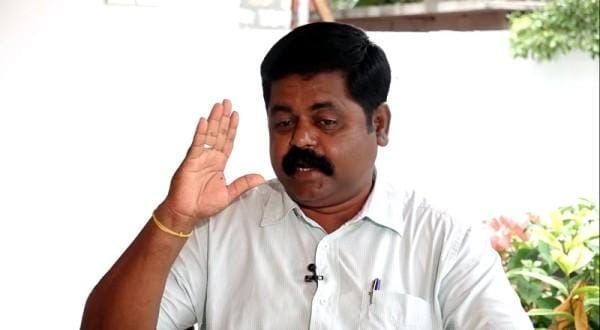
The Ilankai Tamil Arasu Kachchi (ITAK) Political Committee has directed Member of Parliament Sivagnanam Sritharan to resign from his position on Sri Lanka’s Constitutional Council, citing his repeated support for government positions, including on matters related to militarisation.
The decision was taken at a recent Political Committee meeting in Vavuniya, attended by party leader C.V.K. Sivagnanam, General Secretary M.A. Sumanthiran, and other senior members. Sritharan did not attend the meeting.
According to party sources, all members present unanimously endorsed a resolution instructing Sritharan to resign from the Constitutional Council.
Voting record under scrutiny
The central issue discussed was Sritharan’s voting record as the Constitutional Council representative of non-main opposition parties. Party sources state that he supported government positions on eight occasions, with at least four of those votes involving appointments linked to former military officers or issues related to militarisation—an especially sensitive concern for ITAK’s core constituency in the Northern Province, where communities continue to report military surveillance and unresolved land occupation.
These actions were seen as contradicting guidance previously issued by the ITAK Central Committee regarding how party representatives should act on such issues. Sources say this has placed the party in a politically difficult position, given its public opposition to militarisation and its broader stance on governance and accountability.
Legal and procedural questions
Uncertainty remains over whether a Political Committee decision can legally compel a sitting MP to resign from a statutory body such as the Constitutional Council. It is also unclear what steps may follow if Sritharan declines to comply with the directive.
While the Political Committee is ITAK’s highest policy-making body responsible for ideological direction and political positioning, disciplinary authority formally rests with the Central Committee. Party insiders note, however, that Political Committee decisions are generally treated as authoritative expressions of leadership policy, even if the legal mechanisms for enforcement have yet to be tested.
Parallels with earlier criticism
The Political Committee’s stance echoes earlier public criticism by Tamil National People’s Front (TNPF) leader and MP Gajendrakumar Ponnambalam, who has often aligned with Sritharan on Tamil nationalist positions.
Ponnambalam had previously stated that Sritharan admitted to voting in favour of militarisation-related decisions within the Constitutional Council. He described this as unacceptable and called on Sritharan to apologise and reverse his position.
Allegations of business interests influencing votes
Party insiders have raised concerns that Sritharan's voting pattern may be influenced by business interests that could leave him vulnerable to government pressure.
According to sources within ITAK, Sritharan obtained multiple bar licenses in Kilinochchi during the previous administration. Some party members believe he may be supporting government positions on the Constitutional Council to avoid potential scrutiny or regulatory action against these business interests.
"There's a view within the party that he's compromised," said one insider who requested anonymity. "If he doesn't vote the way the government wants, they could expose irregularities in how those licenses were granted or use regulatory mechanisms to cause problems for his businesses."
Attempts to obtain comment from Sritharan on these allegations were unsuccessful.
Stakes for Tamil representation
Sritharan holds the Constitutional Council seat designated for non-main opposition parties under the 19th Amendment to Sri Lanka's Constitution. The body makes appointments to the Elections Commission, Public Service Commission, National Police Commission, and other independent oversight institutions, as well as to the superior judiciary.
For Tamil political parties, representation on the Constitutional Council has been viewed as critical to ensuring minority perspectives inform key institutional appointments, particularly given historical patterns of Sinhalese-Buddhist dominance in state institutions and ongoing concerns about military influence in civilian governance.
Constitutional lawyers consulted by Jaffna Monitor noted that while political parties may discipline their members through internal procedures, removing a Member of Parliament from a position to which they were appointed or elected by Parliament would typically require either a voluntary resignation or a formal disciplinary process carried out in accordance with the party’s constitution and relevant parliamentary procedures.