

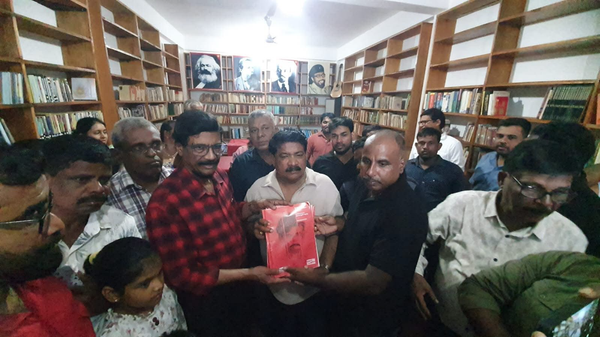
The newly opened library at the NPP/JVP office on Palaly Road, Jaffna. In the background, portraits of JVP founder Rohana Wijeweera are displayed alongside leftist icons.
The newly opened, small yet symbolically significant public library at the National People’s Power (NPP) / Janatha Vimukthi Peramuna (JVP) headquarters in Jaffna has already stirred controversy within the local Tamil community. While it may be the first library in Jaffna to house a notable collection of leftist literature, what has drawn the most attention are not the books but the portraits on its walls. Alongside Marx, Lenin, and Friedrich Engels hangs the image of Rohana Wijeweera — the nationalist Marxist founder of the JVP, remembered as much for political violence as for ideology, and accused of ordering thousands of killings during the party’s two bloody insurrections.
The inclusion of Wijeweera’s portrait has sparked a blunt and unavoidable question: if a Tamil political party were to display a portrait of LTTE leader Velupillai Prabhakaran — another figure who led a violent armed struggle against the Sri Lankan state — would the government and security forces allow it, or would it be branded an act of glorifying terrorism? That double standard lies at the heart of the debate.
The display, inaugurated by JVP General Secretary Tilvin Silva, took place in the presence of public members and local political figures. Supporters have defended the choice as a reflection of historical legacy and ideological continuity. Critics, including several from the Tamil community, warn that it may send unsettling signals.
Rohana Wijeweera, founder of the JVP, led the party through two violent insurrections — in 1971 and again between 1987 and 1989 — both marked by armed conflict, mass casualties, militant activity, and widespread suspensions of political rights. Under his leadership, the JVP unleashed a campaign of assassinations that claimed some of the most prominent intellectuals and public figures of the time.
Professor Stanley Wijesundera, Vice Chancellor of the University of Colombo, was gunned down in his office in March 1989, while Professor Chandratne Patuwathavithane of the University of Moratuwa was also slain for defying the movement. At Peradeniya University, Assistant Registrar Captain T.E. Nagahawatte was murdered, and Daya Pathirana, a fiery student leader who resisted JVP control, was killed in 1986. The media, too, became a target: Thevis Guruge, Chairman of ITN, was shot dead in July 1989, followed weeks later by the killing of Rupavahini’s Chief News Editor, K. Amaratunge. Broadcaster Premakeerthi de Alwis was also assassinated that year, though blame for his murder remains contested between JVP gunmen and pro-government paramilitaries. Perhaps the most politically explosive killing of the period was the assassination of Vijaya Kumaratunga, the immensely popular actor-turned-politician, in 1988
Tamil Community Voices Concerns
Several Tamil elders and political activists have begun questioning whether the state would ever tolerate a similar portrayal of Velupillai Prabhakaran, the founder of the Liberation Tigers of Tamil Eelam (LTTE), whose image remains legally proscribed. They argue that the freedom to display certain controversial historical figures is not applied equally, raising fears of selective enforcement and deepening perceptions of bias in how political symbolism is treated.
One local civil society activist told Jaffna Monitor: “If Tamil organisations display Prabhakaran, charges are likely, arrests possible. But when the leader of the JVP displays Wijeweera, there is no backlash.
Another resident observed that the JVP must recognize it did not win the last election because people suddenly embraced its ideology, but because the public was exhausted by decades of failure from successive governments. He noted that the JVP did not contest and triumph alone, but relied on a cosmetic rebranding as the NPP to face the electorate. “The JVP should not think people have forgotten the atrocities and killings committed during its first — and especially its second — insurrection. Those memories remain fresh in the minds of many. By glorifying a man who masterminded that violence, the party risks provoking a backlash,” he elaborated.