By Jeevan Thiyagaraja
From the riots of 1958 to a Charter that awaits— the long arc of a promise made, deferred, and still owed.
Language is never merely a tool for communication. It is the vessel through which a person experiences dignity — or its absence. It was this question, left dangerously unanswered, that ignited the riots of July 1958. Decades of armed conflict followed. The path to healing has, in fact, been laid — in Parliament, in the Constitution, and in a Language Charter that now awaits the political will to implement it. To understand where we are, we must understand how we got here.
Genesis: A Crisis Made, Not Born
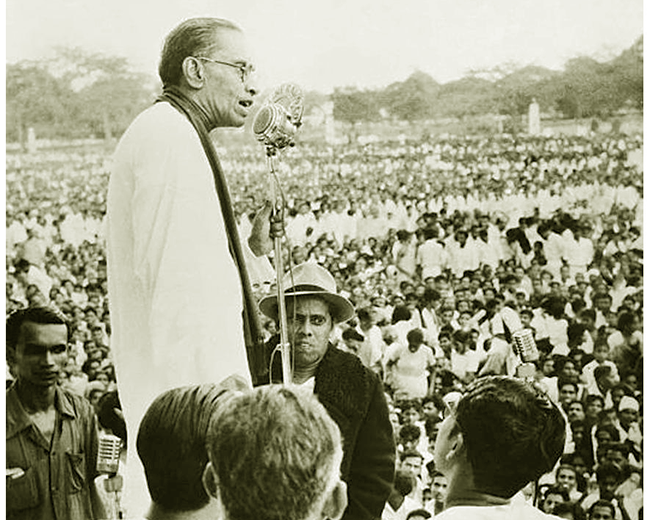
S.W.R.D. Bandaranaike and the Sri Lanka Freedom Party won the 1956 election on an explicit promise to make Sinhala the sole official language within 24 hours of taking office, and delivered: the Sinhala Only Act was passed that year.
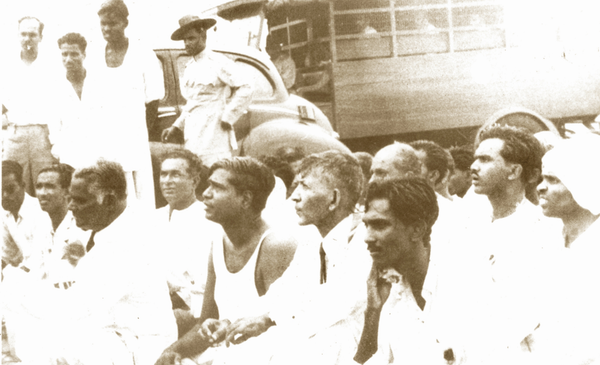
The Tamil Federal Party, under S.J.V. Chelvanayakam responded with organised, non-violent satyagrahas. When peaceful Tamil demonstrators — including MPs — gathered at Galle Face Green in June 1956, a pro-government mob beat and stoned them and threw some into Beira Lake. Police stood aside. Bandaranaike called the injuries "honourable wounds" — a phrase that was not mere insensitivity.
By 1958, with tensions mounting, Bandaranaike negotiated the B-C Pact with Chelvanayakam — proposing regional councils for the North and East and recognising Tamil in education and administration. He abrogated it on 9 April 1958, with a young parliamentarian named J.R. Jayewardene among its most prominent opponents. The irony of what followed would only become apparent two decades later.
The Pogrom: What Tarzie Vittachi Witnessed
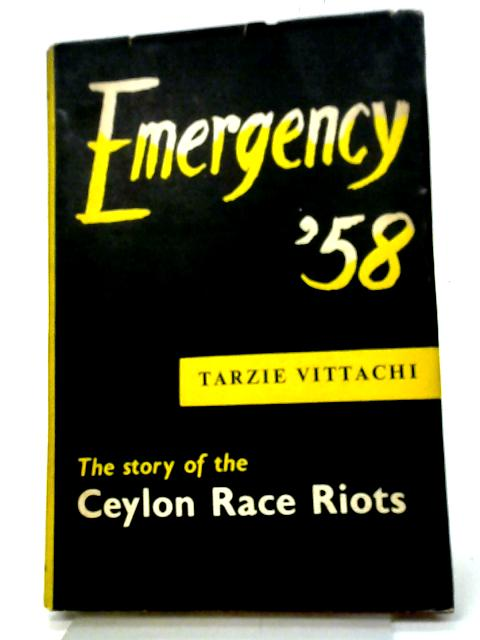
The primary chronicle of what followed comes from Tarzie Vittachi — editor of The Ceylon Observer and recipient of the Ramon Magsaysay Award for Journalism in 1959, widely regarded as Asia's equivalent of the Nobel Prize. His book Emergency '58: The Story of the Ceylon Race Riots was written while the conflict was still smouldering.
The trigger came on 22 May 1958, when a mob boarded the Yaldevi train at Polgahawela and attacked Tamil passengers. Prime Minister Bandaranaike delayed declaring a State of Emergency. When he spoke at Gampola on 24 May, he did not condemn the rioters but pleaded with Sinhalese crowds not to "destroy your good name.”
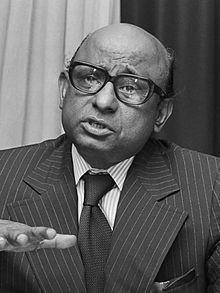
Vittachi's verdict was unsparing. Writing while the embers were still warm, he observed that what had held in Ceylon was not the government, nor the institutions of the state, but the conscience of individuals — officials, clerks, police officers, soldiers — who chose to do what was right precisely when the machinery around them had ceased to function. Ceylon, he wrote, had lost its innocence in 1958.
Those Who Stood Firm
A record of individuals who defied mob pressure and upheld the law at personal risk
Government Agents
Among the district administrators, four Government Agents stood apart — refusing to bow to extremist pressure, coordinating the evacuation of Tamil refugees to government schools, and working closely with the military when police were overwhelmed.
Deryck Aluwihare, Government Agent, Anuradhapura and Polonnaruwa: With Polonnaruwa lacking its own GA, Aluwihare held personal charge of both districts. He led jeep patrols to locate refugees, established camps near the Parakrama Samudra, and held firm even when a mob threatened to kill him for protecting Tamil civilians.
P. Navaratnarajah, Government Agent, Jaffna: Operating in the Tamil-majority North, he maintained calm while ensuring the safety of Sinhalese civilians and police officers — effectively preventing a cycle of revenge killings that would have spread the violence further.
R.R. Crosette-Thambiah, Government Agent, Batticaloa: In the Eastern Province, he enforced the law impartially and contained the violence before it could escalate into the full-scale pogrom seen elsewhere.
The Civil Service
In the kachcheris across the country, Sinhalese clerks hid or destroyed voter-registration lists — the very documents rioters used to locate Tamil homes. Others secretly escorted Tamil families to safety or sheltered them in their own houses, knowing they risked being branded traitors. These individuals are largely unrecorded by name. Their anonymity does not diminish what they did.
The Police
The police force was under enormous pressure — some officers complicit in the violence, others actively heroic.
DIG Sydney Soysa, Western Province: Pushed hard for the early declaration of a State of Emergency, mobilised resources, and ensured that Tamil refugee camps in Colombo — including at the Racecourse — were properly protected.
SP J.F. "Bunny" Bede Johnpillai: Celebrated for physical courage — he personally dispersed mobs in the field and refused, under immense pressure, to surrender Tamil civilians sheltering in police stations to rioters demanding them.
IP G.H. Perera, North-Central Province: Held out against thousands of rioters with minimal ammunition, defending Tamil enclaves alone until army reinforcements arrived.
Across mixed areas, unnamed Sinhalese officers fired tear gas and warning shots into their own ethnic communities to disperse mobs, and physically guarded station doors against crowds demanding Tamil prisoners — paying a lasting social cost for doing so.
Non-Commissioned Officers and Other Ranks
Below the gazetted ranks, it was the sergeants, constables, and ordinary soldiers — Sinhalese men, almost all of them — who faced the mobs at ground level with no cover of rank and no guarantee of support from above. Vittachi records their actions collectively rather than by name: the station sergeant who kept his doors locked against a crowd demanding Tamil detainees; the constable who stood alone in a doorway while colleagues stood aside; the soldier who obeyed a shoot-on-sight order in his own village.
These men had no career protection and no political patron. They had only their sense of what the uniform required. Vittachi's verdict on them, rendered without names, is the most damning indictment of the failure above them: that ordinary men in ordinary posts did what governments and ministers would not.
The Military
The military proved ultimately decisive in halting the violence, though it too faced internal discord.
Rear Admiral R.K. "Robin" van Langenberg, Trincomalee: Confronted a mutiny when Sinhalese sailors refused orders to fire on rioters. He contained the mutiny, maintained naval discipline, and deployed loyal units to protect Tamil civilians — preventing a total collapse of order at one of the country's most volatile ports.
Colonel F.C. de Saram: Enforced strict military discipline across his zone of operations, ordering shoot-on-sight for curfew violators and arsonists — a command carrying personal legal and political risk, but one that halted the violence wherever it was applied.
Major D.S. Attygalle (later General): Organised the rapid deployment of troops to hotspots including Kurunegala, personally leading rescue convoys to extract trapped Tamil refugees from areas where mobs had cut road access.
Squadron Leader Harry Goonetileke, Air Force: Commanded air evacuation operations, personally flying Dakota aircraft to lift Tamil civilians stranded in towns where every road was blocked. His flights were among the most direct acts of rescue in the entire crisis.
Their names deserve to be recorded. Their example deserves to be honoured.
They were, in the truest sense, the thin blue line — and the gold standard. Not because they were exceptional people, but because they chose, in an exceptional moment, to be exactly what their office and their country required: servants of all citizens, equally and without distinction. That choice, made under threat and without reward, is the measure against which governance must still be held.
The Long-Term Consequences
The three long-term consequences of 1958 were profound and lasting. First, a brain drain: the English-educated Tamil middle class, excluded overnight from the civil service by the Sinhala Only Act, emigrated in large numbers. Second, the gradual rise of separatism: trust in the constitutional process was fatally broken, and the Federal Party's demand for autonomy within Ceylon gave way, over a generation, to the demand for a separate state. Third, a constitutional precedent that legally encoded the marginalisation of the Tamil minority in the framework of the state itself. These grievances were cited as foundational causes of the civil war that broke out formally in 1983 and continued for twenty-six years.
The Irony of 1978: JRJ's Constitutional Redemption
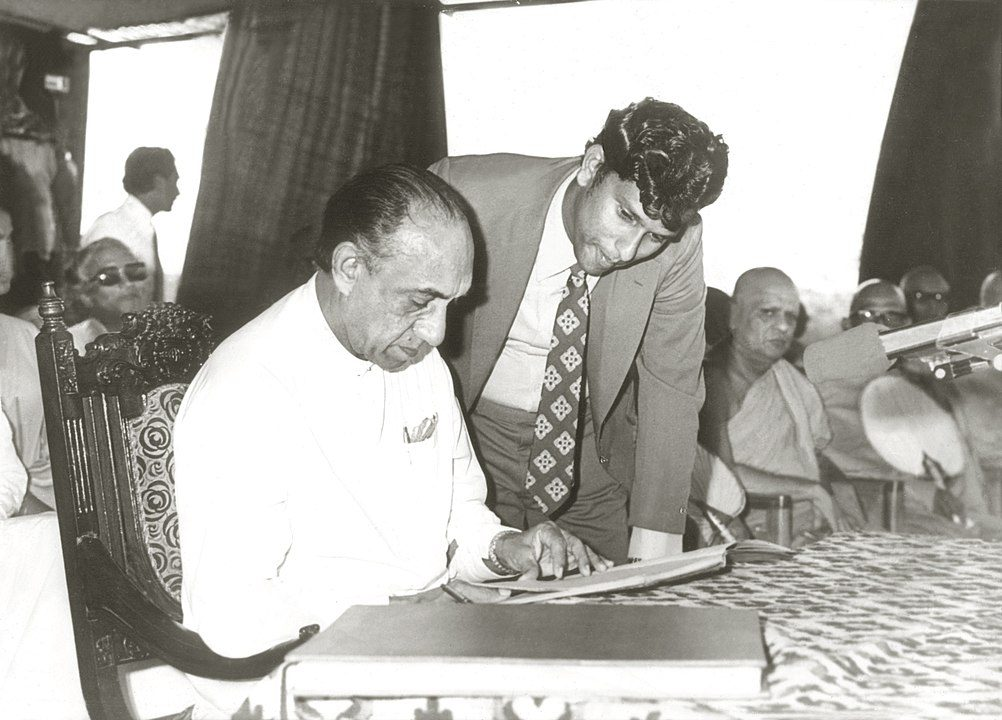
History offers one of its sharper ironies here. J.R. Jayewardene — the man who led opposition to the B-C Pact and thereby helped foreclose the most reasonable constitutional accommodation available in 1958 — became President and introduced the 1978 Constitution. That constitution brought parity to the two languages, with English restored as a link language. It was a meaningful step, laying the constitutional foundation for everything that followed.
But the stakes had changed. By 1978, the politics of language had been overtaken by the politics of survival. What had begun as a reasonable demand — for the use of Tamil in administration and education — had escalated into the demand for a separate state. The Tamil Eelam movement was not born from nowhere. It was born from the accumulated consequence of pacts abrogated, rights denied, and violence condoned.
This is the history that must not be forgotten. Not to assign permanent blame, but because the lesson is precise: the cost of deferring reasonable accommodation is not merely delay. It is escalation. What could have been settled in 1958 with a modest pact required a constitutional amendment in 1978, a civil war lasting generations, and a reconciliation process that continues today.
The Architecture of Repair: 1987 to 1991
The 13th Amendment of 1987 enshrined Tamil as an official language alongside Sinhala. The 16th Amendment of 1988 guaranteed Tamil speakers the right to interact with any government office in their own language. These were significant steps.
Then, in 1991, something remarkable happened. The Official Languages Commission Act, No. 18 of 1991, was passed without a division. In a legislature accustomed to partisan fracture, this was a moment of quiet, principled consensus. Saumyamoorthy Thondaman — who understood better than most what it meant to live between two languages and two communities — ensured that multipartisan support held firm. Cabinet papers had been drafted under Minister U.B. Wijekoon. I was privileged to co-draft that Act alongside the late Shibly Aziz. We believed then, as I still believe, that legislation alone was insufficient — but that it was indispensable.
The Machinery That Followed
In the years since, the machinery has not been absent. Circulars have been issued — PA Circular 18/2020 and successive amendments through to 2025, most recently PA Circular Letter 01/2026, extending concessions for public officers to acquire second-language proficiency until October 2026. Incentive payments have been gazetted. Examinations have been designed. The National Institute of Language Education and Training was formally established in 2007. The Official Languages Commission conducts language audits and maintains a public complaints hotline — 1956 — for citizens whose rights are being ignored.
The LLRC Action Plan: A Blueprint for Integration
Running alongside this legislative architecture is the LLRC Action Plan on Language, Education and Integration, whose core goal is to build national unity through language rights, trilingual education, and ethnic integration across public life.
On language policy, the plan calls for making Sinhala, Tamil, and English official in practice — not just on paper. All government offices and police stations must have Tamil-speaking and bilingual staff around the clock, with complainants guaranteed the right to give statements in their own language. The Language Commission is to receive real enforcement powers with provincial branches. Interim measures — software translation tools and retired bilingual police officers serving as interpreters — are intended to bridge the gap until permanent staffing is in place.
On education reform, Tamil and Sinhala language learning is to become compulsory in schools to shift attitudes between communities. Trilingual education is to begin from early childhood, backed by dedicated budget allocations for teacher training. The university admission quota system is to be reviewed toward merit-based entry, and educational resource gaps between regions are to be systematically closed.
On integration in schools and universities, schools are to be actively mixed across ethnic and religious lines through twinning programmes, student exchanges, Reconciliation Clubs, and National Youth Council exchange programmes. Universities are to maintain ethnically diverse student bodies with courses offered in all three languages. Inter-provincial and national sports competitions are identified as a practical, ground-level integration tool.
The plan, in short, treats language access as a rights issue, trilingualism as a nation-building instrument, and mixed schooling as the primary mechanism for long-term attitudinal change between communities.
The Language Charter: Long Drafted, Long Awaited
That document exists. Drafted between 2015 and 2016 and adopted as an Official Languages Commission document in 2016, its stated purpose is to set out the obligations of institutions with respect to the official languages of Sri Lanka, giving effect to Article 18(4) of the Constitution.
The Charter mandates that all public institutions — and specified private and voluntary entities — provide services and communications to the public in both Sinhala and Tamil, ensure bilingual work environments and equitable employment representation, and establish an enforcement mechanism through the Official Languages Commission with powers to investigate complaints and seek judicial redress for non-compliance. It extends these obligations to third-party service providers and regulated entities in health, safety, and security, and mandates that institutions proactively inform the public of their language rights through "active offer" measures, bilingual signage, and effective communication media.
It establishes the right of public officers to use either Sinhala or Tamil as a language of work, and imposes a duty on institutions to create work environments that accommodate the effective use of both. On employment, it commits the government to ensuring that Sinhala and Tamil-speaking Sri Lankans — without regard to ethnic origin or first language learned — have equal opportunities to obtain employment and advancement, and that the composition of institutional workforces tends to reflect the presence of both official languages, subject always to merit-based selection.
Three illustrative provisions from the Charter's text convey the practical character of these obligations. On citizens commuting, the Charter states that every institution providing services to the travelling public has the duty to ensure that any citizen can communicate and obtain those services in either official language from any office or facility where there is significant demand for those services in that language. On equal employment, the Charter commits the Government of Sri Lanka to ensuring that Sinhala and Tamil-speaking Sri Lankans, without regard to their ethnic origin or first language learned, have equal opportunities to obtain employment and advancement in institutions, and that the composition of the workforce tends to reflect the presence of both official languages. On the language of work, the Charter establishes the participation of Sinhala and Tamil-speaking Sri Lankans as a right, imposing on institutions a positive duty to create work environments conducive to and accommodating of the effective use of both official languages — not merely tolerating their use, but actively enabling it.
Canada's experience with official bilingualism demonstrates that substantive language equality can be built deliberately over time — not as a gift from the majority, but as a justiciable entitlement, enforced through institutions and courts. The lesson is not a model to be transplanted wholesale, but a principle: where there is will, the architecture of equal dignity can be constructed.
The Language Charter has now been handled by two Ministers over a period of ten years. It remains unenacted — a measure of the distance between expressed commitment and actual delivery.
Why We Must Not Forget
History is not an exercise in blame. It is an instruction manual — one that we ignore at collective cost.
1958 — something that must not be buried beneath the weight of what went wrong. In the Government Agents, the police officers, Military Officers, the other rankers who held the line, and the unnamed clerks who quietly destroyed the lists that would have directed mobs to Tamil homes — they were the thin blue line. They remain the gold standard of what it means to serve citizens without distinction of language, ethnicity, or faith.
Governance is not a transaction between the state and an abstraction called "the public." It is a daily covenant with real people — people who today connect globally, compare experiences across borders, and know, with precision, when they are being offered less than they deserve — before the cost of deferral rises again beyond what any generation should have to pay.
The lesson of 1978 remains equally instructive: repair is possible. Good work deserves acknowledgement even when it comes late. The 1978 Constitution, the 1991 Act, the circulars since, and the Charter now pending — each represents genuine effort to honour what the Constitution promises.
The Charter is ready. The rights are established. The machinery, imperfect as it is, exists. What remains is the political will to make the promise real — and the collective memory to insist that it must be.
The author drafted the Language Charter (2015–2016) for the Official Languages Commission, which was adopted as a Commission document in 2016. He co-drafted the Official Languages Commission Act No. 18 of 1991 alongside the late Shibly Aziz, and has served twice as a Commissioner of the Official Languages Commission, later going on to serve as a Provincial Governor. This account draws on the historical record as he has been able to reconstruct it. Where individuals deserving of recognition have been inadvertently omitted, he welcomes correction — their place in this story is no less real for their absence here.