

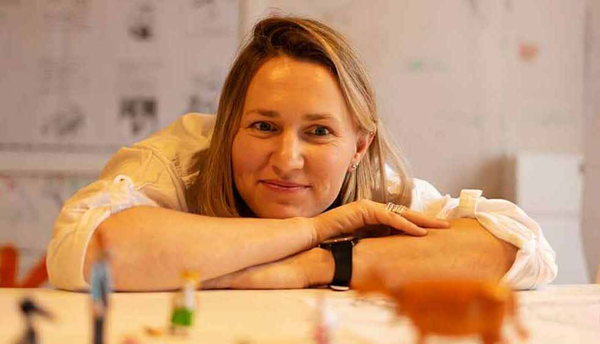
"The Quiet Power of Words”: Jaffna Monitor Speaks with Nadia Kandrusevich

"The Quiet Power of Words”: Jaffna Monitor Speaks with Nadia Kandrusevich


Share this post

Jaffna Monitor speaks to Nadia Kandrusevich-children’s book publisher and co-recipient of the 2024 IPA Prix Voltaire-about censorship, courage, and why quiet storytelling can be the loudest form of resistance.

The IPA Prix Voltaire honours publishers who have faced pressure, threats, and harassment in the pursuit of free expression. When you learned you had been named a co-recipient, what was your immediate reaction? What does this recognition mean to you personally-and to the wider community of Belarusian publishers still resisting censorship? The award citation spoke of the “quiet power of words to shape minds, open hearts, and build bridges across languages, cultures, and generations.” Do you feel your work-especially with young readers embodies that quiet power?

Jaffna Monitor posed these questions to Nadia Kandrusevich.

She responded: "When I learned that I had been named a co-recipient of the IPA Prix Voltaire, I felt a deep mix of emotions-honor, disbelief, and a quiet sadness. It’s not an award anyone sets out to win. It means that your work has come under threat simply because you chose to publish stories, to speak freely, to give voice to something that others want silenced. But it also felt like a powerful moment of recognition—not just for me, but for everyone who has worked in Belarusian publishing under pressure, in exile, or in hiding.

It felt like the world was finally saying: we see you, and we know what you’re fighting for. Personally, the award is a reminder that our work matters, even when it feels small or vulnerable. It’s easy to doubt yourself when you’re working far from home, when you face roadblocks, when you wonder if your books will reach the children they were meant for. This recognition gives strength. It tells me-and others like me - that quiet, persistent work can have a lasting impact. The words in the citation - “the quiet power of words to shape minds, open hearts, and build bridges” because that’s exactly how I see the mission of children’s literature.

When we publish a story in Belarusian, we’re not just printing pages; we’re creating a space where a child can feel seen, heard, and connected to their language and culture. It’s not loud, it’s not confrontational—but it is powerful. Yes, I do believe my work embodies that quiet power.

In a world that often rewards noise and spectacle, there is a different kind of strength in gently telling a child: Your language is beautiful. Your stories matter. You belong. That’s how bridges are built — not just across borders, but across generations. And in times like these, that quiet power may be the most important thing we have.


Share this post

Be the first to know

Join our community and get notified about upcoming stories

Subscribing...
You've been subscribed!
Something went wrong
The Missing Half of Sri Lanka's Post-War Recovery

The Missing Half of Sri Lanka's Post-War Recovery

By Jeevan Thiagarajah Seventeen years after Sri Lanka's civil war ended, the country has run one of the world's more closely studied reintegration experiments — and left another almost entirely undone. On one side, 12,196 former LTTE combatants passed through a state-run rehabilitation programme that concluded in 2021. On the other, hundreds of thousands of state security personnel — soldiers, sailors, airmen, and police who fought the same war — returned home to no equivalent programme at all.


Jeevan Thiyagaraja

Jeevan Thiyagaraja

ITAK Challenges Government to Prove Archaeology Department Is Free of Ethnic Bias

ITAK Challenges Government to Prove Archaeology Department Is Free of Ethnic Bias

COLOMBO, Sri Lanka — Sri Lanka's largest Tamil party has urged the government to resolve a series of long-running heritage disputes in the country's Northern and Eastern Provinces and to demonstrate that the state's archaeology authority operates without ethnic or religious bias. The Ilankai Tamil Arasu Kachchi (ITAK) said its lawmakers had raised the concerns directly with the Director General of the Department of Archaeology, Prof. D. Thusitha Mendis, at a recent meeting, calling for fair sol


Our Reporter

Our Reporter

One library that began a story
Shankari Chandran

One library that began a story

By: Shankari Chandran Editor's Note: As Australian High Commissioner Matthew Duckworth presents the complete collection of Shankari Chandran's novels to the Jaffna Public Library today, Jaffna Monitor republishes this essay by the Miles Franklin Award-winning Sri Lankan Tamil author, who reflects on the burning of the library, its enduring place in Tamil memory, and the lasting power of stories against erasure. My footsteps slow when I pass a library. Any library. I am pulled inwards, to i


Jaffna Monitor

Jaffna Monitor

Video of Military-Harvested Vegetables Fuels Anger Over Jaffna Land Occupation

Video of Military-Harvested Vegetables Fuels Anger Over Jaffna Land Occupation

JAFFNA, Sri Lanka — A video appearing to show Sri Lankan soldiers delivering vegetables cultivated on military-controlled private land in Jaffna to a wholesale collection center supplying a supermarket has gone viral on social media, rekindling longstanding resentment among displaced residents of Valikamam North, where the military continues to occupy thousands of acres of privately owned land despite the end of Sri Lanka's civil war 17 years ago. The footage, circulated widely over the past se


Our Reporter

Our Reporter