By: Jeevan Thiagarajah
At the heart of a functioning democracy lies a profound paradox: the public servant is both an instrument of the state and a citizen entitled to the full protection of the Constitution. Their service conditions — carefully stipulated by the Public Service Commission and relevant regulations — are not mere administrative guidelines. They are guarantees of dignity. Courts and tribunals have repeatedly reinforced this principle: a person does not surrender their fundamental rights at the entrance of a government office.
Yet the recent interim order of the Human Rights Commission concerning teacher transfers in the Northern Province lays bare the wide gap that so often exists between administrative theory and the harsh reality of executive action.
To appreciate the gravity of this situation, one must first understand the realities of the teaching profession. Teachers are frequently underpaid, working under difficult conditions while carrying heavy family responsibilities. Together with health workers, they form the two largest pillars of the public service. A humane, fair, and transparent transfer policy — free from discrimination — is therefore not a luxury. It is an urgent necessity, and one that should be shaped with input from all stakeholders.
The Case at the Centre of the Storm
The specifics of this crisis are set out in HRC Case No. JAF 081-2026, an interim recommendation and order issued by the Chairman of the Human Rights Commission of Sri Lanka under Section 15 of the Human Rights Commission of Sri Lanka Act, No. 21 of 1996.
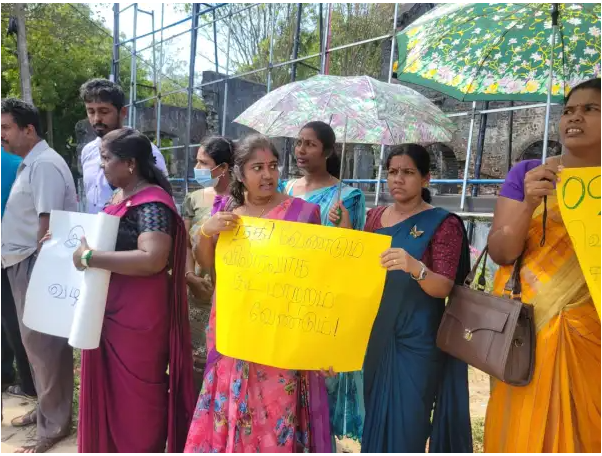
On February 25, 2026, the Northern Province Education Department issued a transfer list covering 193 teachers, citing "service exigencies" as justification. Affected teachers submitted appeals through their departmental heads to the Northern Province Public Service Commission. Despite this, education authorities simultaneously insisted that the teachers vacate their existing posts and report to new duty stations — before those appeals were even decided.
The complainants argued that these transfers were enforced in an arbitrary and unjust manner, in violation of natural justice and the dignity of the profession. Critically, the affected group included some of the most vulnerable members of the service: pregnant women, teachers suffering from cancer or kidney disease, mothers of children under five or children with special needs, and individuals caring for disabled family members. Forcing these teachers to relocate before their appeals were heard, it was argued, would cause serious and irreparable harm.
The Commission reviewed the case on March 30, 2026, examining compliance with Public Service Commission rules, Provincial Public Service regulations, and the National Teacher Transfer Policy. It noted that emergency-based transfers require clear justification and procedural safeguards. Crucially, annual teacher transfers for 2026 had already been conducted for 363 teachers — a fact that significantly undermined the claim that transferring an additional 193 teachers was a matter of urgency.
Finding a prima facie violation of fundamental rights, the Commission concluded that the respondents had failed to provide adequate justification for treating these transfers as service-exigency cases. It accordingly directed the Provincial Director of Education, the Secretary of the Northern Province Ministry of Education, and the Secretary of the Northern Province Public Service Commission to immediately suspend the implementation of the 193 transfers until the investigation is completed and a final determination issued. In practical terms, the affected teachers must be allowed to remain in their present posts for the time being. The order explicitly warns that non-compliance may constitute contempt under Section 21 of the HRCSL Act, punishable by the Supreme Court.
A Pattern, Not an Isolated Incident
This crisis did not emerge from nowhere. It began with allegations that the 2025/2026 transfers — specifically, the selection of replacement teachers who had not applied for transfers — were conducted under the guise of "service requirements" by a transfer board convened without the participation of the Sri Lanka Teachers' Union. Last year, the Jaffna High Court was compelled to intervene, ordering the Provincial Department of Education to withdraw a transfer list of 290 teachers following writ petitions filed by the Union and affected teachers.
The Department subsequently issued letters to 198 teachers directing them to serve as replacements — again labelled "service requirement" transfers, and again conducted without union involvement. While affected teachers found themselves unable to sign in at their permanent schools, the Union lodged complaints with the Human Rights Commission. The HRC has now called a halt.
The situation has long since ceased to be a routine administrative matter. Officials and teachers now find themselves on opposing sides of an increasingly bitter dispute. Pressing questions remain unanswered: who will hear the pending appeals, and on what basis will they be decided? More importantly, given that the process has twice been found seriously deficient — first by the courts, and now by the HRC — accountability cannot be avoided indefinitely. Someone must answer for this. The question is: who?
Three Faces of a Deeper Malaise
Beyond the transfer crisis, a disturbing pattern of cruelty and degradation persists within the provincial public service — one that demands both judicial and institutional attention.
The first case involves a teacher on the eve of retirement. Decades into her service, questions were suddenly and belatedly raised about the validity of her original appointment. Rather than resolving the matter with dignity, the system subjected her to months of professional humiliation: denied her teaching duties, confined to a staff room, and left in a state of institutional limbo despite repeated appeals. The heartbreaking end point of this prolonged ordeal came when she was found at 2:45 in the morning, standing outside the Governor's office with her belongings. No woman who has given her working life to the state should ever be reduced to such desperation. It is worth noting that the HRC regional office was well aware of the conduct of the officer principally responsible for her suffering.
The second case involves a doctor whose inquiry process had lapsed beyond the legally permissible time limit and was therefore required, by law, to be terminated. The Secretary of the relevant Ministry was furnished with clear legal reasons for this conclusion but chose to disregard them, apparently fearing the political displeasure of a particular union. It was only after the courts intervened that justice was finally served. In the interim, a constitutional crisis of conscience arose when the Attorney General declined to appear on behalf of the Governor, whose position was directly at odds with the legal instructions previously given. The episode posed a stark question: should the Attorney General do what is legally correct, or bow to convention? The final order of the Court provided its own answer.
The third case involves a woman officer in the agriculture department who was subjected to a campaign of fabricated allegations and systematic persecution lasting nearly four years, orchestrated by two senior officers. A thorough inquiry by the regional HRC office documented circumstances so disturbing that the Governor himself found them difficult to read. He directed that severe penalties be imposed and relief provided to the victim. Yet compliance with those orders was so poor that the HRC was recently compelled to issue three firm strictures, effectively repeating directives that had been ignored.
The Duty to Protect
This culture of retaliation reaches beyond these individual cases. On more than one occasion, the writer and several legal colleagues found it necessary to intervene to protect public officials — largely police officers — who were targeted for punishment simply because they had performed their duties lawfully during election periods. The act of upholding the Constitution had itself become a liability, requiring legal protection against executive retribution.
Taken together, these cases make one thing unmistakably clear: public servants require robust protection from executive action — or deliberate inaction — that enables human rights abuses. The Human Rights Commission is a vital, if last, resort in such situations. But the first line of responsibility lies with the Governor, as the chief executive of the Province. The Governor is the shepherd; the officials who serve under that authority are the flock. The duty of protection is not merely administrative. It is moral and constitutional.
As the celebrated Indian jurist Justice V.R. Krishna Iyer once observed, the state must not become an "unsympathetic leviathan" that crushes the very people it employs. Civil servants, he reminded us, are not chattels to be disposed of at will — the rule of law must temper the power of the state over its own servants. The jurisprudence of the United States Supreme Court echoes this: the state is not an abstraction; it acts through people. When it becomes an oppressor of its own employees, it betrays the social contract.
The Moral Compass
Law can provide a framework. It cannot legislate conscience. Ultimately, it is Dharma — the righteous duty of those in authority — and the individual moral courage of the Chief Executive, the Secretary, and the Departmental Head that must serve as the final compass. Technicalities and political convenience must yield to the higher demands of fairness.
We live in the age of Generation Z and the Aragalaya — a generation that has awakened to the demand for accountability and will not easily be silenced. This Province has known armed rebellion and the deep wounds of prolonged conflict. Old Park stands as a grim monument to that past, its underground structures a reminder of what becomes possible when power is exercised without the restraint of law or conscience.
We must not allow people to lose faith in due process and just administration. To do so is not merely a failure of governance. It is a step toward repeating the darkest missteps of our history.