
By M.R. Narayan Swamy
“Are you still angry with me?”
This was Anton Balasingham’s poser to Tamil Tigers chief Velupillai Prabhakaran as the two men spoke over the telephone in an attempt to make up after some two years of frosty ties.
The conversation took place months before the fourth and final Eelam War broke out in August 2006, which militarily destroyed the once awesome Liberation Tigers of Tamil Eelam (LTTE) and decimated its leadership.
Addressing the LTTE founder-leader as Veera Maarthandar, Balasingham asked Prabhakaran whether he still felt angry with him.
When Prabhakaran insisted that he was not at all upset with Balasingham, the latter sought to know why he had been sidelined then for almost two years after having served the Tigers so faithfully for so long.
The pain in Balasingham’s voice was evident.
As the two men spoke, Indian security services monitored the conversation in real time from one of their intelligence hubs in southern India. India's technical and human intelligence capabilities against the LTTE were far more extensive than even the Tiger leadership had feared.
Clearly at his diplomatic best, Prabhakaran replied that he stopped consulting Balasingham out of concerns over the latter’s deteriorating health.
That Balasingham was battling serious health issues was widely known. His wife, Adele, a former nurse from Australia, had in later years warned him against travelling to the LTTE's lair in Sri Lanka, fearing that even a mosquito bite could prove life-threatening because his immune system had become so severely weakened.
The lack of physical contact only widened the gulf between Prabhakaran and Balasingham, who had known each other since the early 1980s.
A former Tamil journalist, Balasingham, who considered himself a Marxist, moved closer to Prabhakaran when the latter was a largely unknown personality.
Once the LTTE carried out an ambush that killed 13 soldiers in Jaffna in July 1983, triggering a Tamil separatist campaign in earnest, Balasingham came to be seen as an ideologue of the Tamil Tigers.
Although the two men appeared to get along well despite their 16-year age gap, Balasingham, who never wielded a gun, always had his differences with the younger LTTE leader. This remained true even while he was based in India.
Balasingham expressed his views to those he trusted, even outside the LTTE circles. But Prabhakaran chose to ignore the pinpricks, probably out of consideration for Balasingham’s age and wider exposure to the world.
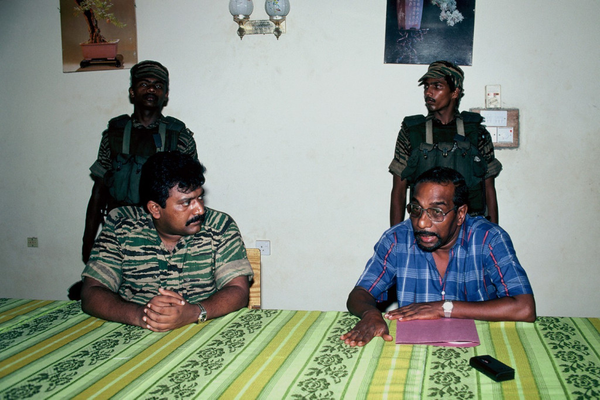
Balasingham was seated next to Prabhakaran at the press conference in Kilinochchi in April 2002 following the Norway-brokered ceasefire between the LTTE and Colombo. That is when he gloated that the LTTE chief was the “President and Prime Minister of Tamil Eelam”.
But their decades of friendship unravelled within months.
In December 2002, Prabhakaran was furious after Balasingham signed the “Oslo Declaration” that committed the LTTE to explore a political solution based on a federal structure within a united Sri Lanka.
This was anathema to Prabhakaran, who was determined to carve out a Tamil homeland in Sri Lanka's north and east and for whom peace talks were merely a stepping stone to an independent Tamil Eelam. The LTTE leader was so enraged that he tore up the Oslo Declaration when a copy reached him in Kilinochchi, then the LTTE's administrative hub.
From 2003, Prabhakaran began to ignore Balasingham, who became a kind of recluse even as the peace talks between Colombo and the Tigers continued, although haltingly.
Even after their renewed ties following the telephonic conversation, Balasingham remained critical of Prabhakaran’s limited worldview, warning a select few who met him in London that the LTTE would meet its nemesis if it ignited a war again with the Sri Lankan state.
His concerns mounted after Karuna, the Tamil Tigers' long-time eastern regional commander, revolted in April 2004, seriously weakening the once-monolithic LTTE.
Among others, Balasingham complained to Erik Solheim, the Norwegian peace facilitator, that some senior LTTE leaders were responsible for the rupture in his relationship with Prabhakaran because they were jealous of the warm and enduring personal bond the two men shared.
Balasingham admitted frankly that his desire was to see an end to the conflict in Sri Lanka before he died, with the Tamil side getting its due honour.
Although the telephonic conversation monitored by the Indians ended the chill between the two men, Balasingham and Prabhakaran did not become the close chums they were for long years.
On his part, Balasingham became more and more critical of Prabhakaran as his health began to worsen. He did not reveal his mind publicly. He knew the LTTE supremo did not like anyone contradicting him, that too publicly.
But he continued to tell Tamils who met him that Prabhakaran had stopped listening to his sage advice and refused to see reason that any future armed showdown with Sri Lanka would prove to be disastrous to the Tigers.
He also stunned the LTTE leadership and its sympathisers by issuing a virtual apology over the 1991 assassination of former Indian Prime Minister Rajiv Gandhi, calling the crime “a monumental historical tragedy”.
Balasingham died in London, his base for long years, in December 2006 due to cancer and other health complications. Amid the war, Prabhakaran conferred the title Thesathin Kural (Voice of the Nation) on Balasingham.
By then, the last of the LTTE-Sri Lanka war was underway. In less than three years, the LTTE and its military brass would become history. This is precisely what the politically astute Balasingham had feared could happen.