
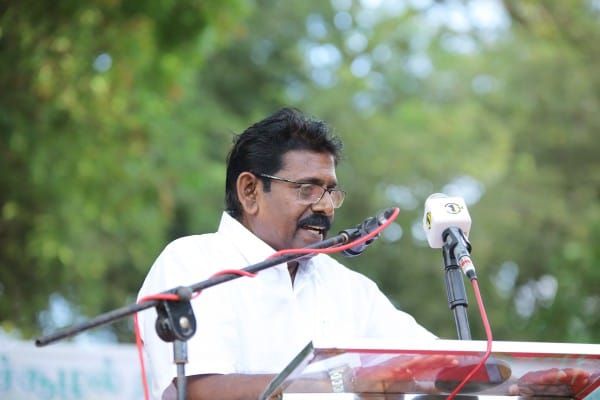
“Just as the weapons fell silent in Mullivaikkal, our art and literature too have lost their voice,” lamented P. Aingaranesan, leader of the Tamil National Green Movement and author of Vermugangal (Rooted Faces). His latest book is a collection of interviews with leading figures in art and literature conducted by Aingaranesan himself.
Speaking at the launch of the book in Mulliyawalai recently, Aingaranesan said art and literature once carried the heartbeat of the Tamil national struggle—explaining its justice, giving voice to its pain, and inspiring unity.
“While weapons spoke on the battlefield, it was art and literature that spoke among the people. They stirred emotions, raised voices, and kept alive the dream of a nation,” he said.
But with the end of the armed phase of the struggle in 2009, he noted, creativity also fell silent.
“Even though countless issues still demand to be spoken, our artists and writers have remained mute. This is deeply regrettable,” he added.
Struggle Transformed, Not Ended
Aingaranesan insisted that the Tamil struggle itself has not come to an end.
“Only the armed struggle was brought to an end. The causes that gave birth to it remain unchanged. Therefore, the struggle must continue—through democratic means.”
He criticized how political leaders have narrowed the national struggle into their own agenda, while many artists and intellectuals have withdrawn altogether.
“Those who once set aside their pens must re-enter the democratic struggle with renewed commitment,” he urged. “We must tell them of the justness of our cause, the victories achieved, and the sufferings endured. That responsibility belongs to our artists and writers,” he concluded.
The Double Lives of Tamil Poet-Prophets
While it is true that many Tamil writers and poets documented the horrors of war and the war crimes of the Sri Lankan state through literature and verse, a critic told Jaffna Monitor that some of the so-called Tamil poets—including Kasi Anandan—played a dangerous role in fanning the flames of conflict and radicalizing an entire generation.
According to the critic, Kasi Anandan’s poetry did not merely romanticize resistance; it pushed vulnerable Tamil youth toward certain death with incendiary lines such as:
“Has your loincloth been stripped away?
Cut off his hands.
Do not beg and tie it back again.
Fight on with pride.”
and also:
“Ten times the funeral bier will not come, O Tamil!
You are a tiger lying in hiding.
Death comes only once—
Stride into the battlefield with a smile.”
Yet, while urging other people’s children to embrace death, the critic argued, he himself kept a safe distance from the battlefield. Living comfortably in Tamil Nadu for many years, he escaped the carnage he glorified and raised both his children to become doctors.
“The tragic irony,” the critic observed, “is that thousands of innocent children of other parents—moved by such fiery verses—marched to their graves, while these poet-prophets secured safe futures for their own. This hypocrisy of our writers must also be acknowledged. History, he concluded, must maintain its balance sheet fairly.”