

Air Force Radar Plan Near Thirukoneswaram Temple Draws Opposition

Air Force Radar Plan Near Thirukoneswaram Temple Draws Opposition


Share this post

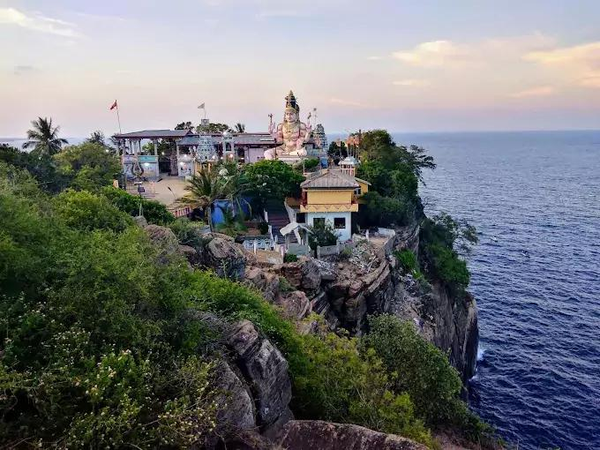
COLOMBO, Sri Lanka — A proposal by the Sri Lanka Air Force to install a radar system on land within the historic Fort Frederick precinct in Trincomalee has drawn opposition from trustees of the Thirukoneswaram Temple, who say the move threatens the sanctity of the site and extends a decades-long pattern of military encroachment.

The temple, which is associated in local tradition with King Ravana, is a Hindu shrine perched on a rocky promontory overlooking the Indian Ocean in eastern Sri Lanka. It is among the country’s most visited religious and cultural landmarks. It is also revered as one of the Pancha Ishwarams — the five ancient abodes of Lord Shiva on the island — and holds deep spiritual significance in Hindu religious life, attracting thousands of devotees from Sri Lanka and India.

A member of the temple's Board of Trustees, Mr. Jeyasankar, urged the public on Friday to resist the proposed installation, saying that successive security deployments in the area had steadily eroded the grounds surrounding the shrine. He has served the temple for more than four decades and is a founding member of its current trustee board.

"If land is now allocated for the Air Force as well, we will be left asking what remains of our land," Mr. Jeyasankar said.

The temple's holdings extend to approximately 247 acres, he said, citing a copper plate grant issued during British rule and preserved at a religious institution in India as evidence of long-established land rights.

Mr. Jeyasankar said the proposed radar site was the latest in a series of state security installations that have reduced temple-controlled land over the years. The Sri Lanka Army had earlier closed off a traditional small tank at the temple's entrance, he said. A police headquarters was subsequently established nearby, and a naval base was later built on Swami Rock, the cliff known locally as Nandi Malai.

He questioned why the Air Force had selected the temple precinct when other sites in the region, including the China Bay area, could accommodate radar infrastructure without affecting a place of worship.

"There is a need to understand the intention behind choosing this location," he said.

Beyond the religious concerns, Mr. Jeyasankar warned that further military construction could deter visitors to Trincomalee, where the temple — dramatic in its cliffside setting — anchors the city's tourism economy.

Officials have not publicly detailed the scope or rationale of the proposed installation. The Air Force has not publicly responded to the concerns raised. Further details about the project are expected to emerge in the coming days.


Share this post

Be the first to know

Join our community and get notified about upcoming stories

Subscribing...
You've been subscribed!
Something went wrong
From Remittances to Investment: Rethinking the Tamil Diaspora’s Role

From Remittances to Investment: Rethinking the Tamil Diaspora’s Role

The Tamil diaspora has long been an integral part of Jaffna’s social, economic, and cultural landscape. Spread across countries such as Canada, the United Kingdom, Australia, and parts of Europe, this global community has maintained strong and enduring ties with Northern Sri Lanka. These connections have been expressed through family relationships, financial support, cultural exchange, and political engagement. During periods of conflict and immediate post-war recovery, diaspora contributions p


Colonel Nalin Herath

Colonel Nalin Herath

Exclusive: Iran’s Ambassador Sets Out Tehran’s Position on the Strait of Hormuz

Exclusive: Iran’s Ambassador Sets Out Tehran’s Position on the Strait of Hormuz

By: Dr. Alireza Delkhosh, Ambassador of the Islamic Republic of Iran to Sri Lanka On 28 February 2026, the United States and the Zionist regime, through an unlawful act of aggression contrary to the fundamental principles of international law, acted against the territorial integrity and national sovereignty of the Islamic Republic of Iran. In response, and within the framework of the inherent right of self-defense pursuant to Article 51 of the Charter of the United Nations, the Government of th


Dr. Alireza Delkhosh

Dr. Alireza Delkhosh

The Business of Hope: How IMHO Helped Rebuild Lives in Sri Lanka

The Business of Hope: How IMHO Helped Rebuild Lives in Sri Lanka

Two decades ago, a small group of Tamil professionals in the United States asked a simple question: instead of meeting and eating, why not do something for our people? What grew from that conversation has transformed hospitals, restored sight, saved hearts, and quietly rewritten the story of a community that war nearly erased.  By: Aruliniyan Mahalingam I have no formal connection to the medical profession. Yet, in a way that feels almost inevitable, I have always found myself surrounded by do


Aruliniyan Mahalingam

Aruliniyan Mahalingam

Appointed, Then Abandoned: The Betrayal of Northern Health Volunteers

Appointed, Then Abandoned: The Betrayal of Northern Health Volunteers

By: Jeevan Thiagarajah A Travesty of Justice in the Northern Province In the annals of public service recruitment, few stories are as harrowing or as indicative of systemic failure as the plight of the Health Services Volunteers in the Northern Province. This is a saga marked by a cruel travesty of justice, where the hopes of the most vulnerable were raised and dashed by the very system designed to protect them. The most damning aspect of this tragedy is that letters of appointment to gove


Jeevan Thiyagaraja

Jeevan Thiyagaraja