

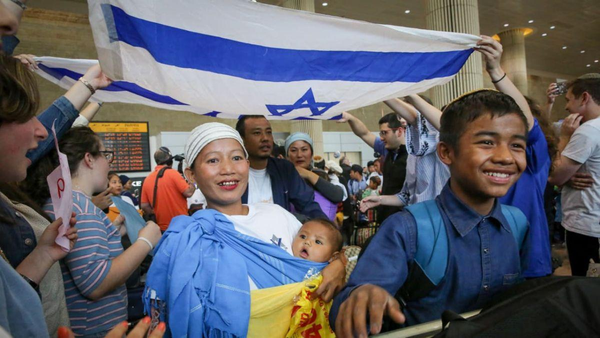
They came through the doors shortly after ten at night, a small procession of exhausted travellers shuffling beneath an arch of blue-and-white balloons. A red carpet had been unrolled across the polished floor of Terminal 1. In the distance, a loudspeaker played “Oseh Shalom,” the old peace song that has become a runway anthem for Israeli homecomings.
The men wore knitted kippot or hats. The married women wore head coverings, as is customary in Orthodox Judaism. Many were weeping.
There were more than two hundred and fifty of them, all Indian nationals, all claiming descent from a tribe that the Assyrian Empire had deported from the northern Kingdom of Israel more than twenty‑seven centuries ago. They had flown in from Manipur and Mizoram, two restive states in India’s far northeast. In the self‑understanding of the cheering crowd behind the security rope, they had flown in from the long exile described in the Book of Kings.
They were the first Bnei Menashe to land in Israel since the Israeli cabinet approved, in November, a programme to bring the remaining six thousand members of the community to the country by 2030. The plan carries the official title ‘Operation Wings of Dawn’.
For the arrivals themselves, the airport was an emotional ambush. Dagan Zolat, seventy‑one, who made his own journey two decades ago and lost his eldest son, Gary, to a Hamas rocket in Jabalia during the Gaza war, stood pressing his forehead against a man he had not seen in nine years. “This man is like a brother to me,” he said softly. “He used to carry my boy in his arms when we still lived in India.”
A short walk away, a seventeen‑year‑old named Amos Namte, who arrived in Israel as a four‑year‑old. His Hebrew was quick and unaccented. His parents, once farmers in the hills who rose before dawn to walk to family fields, now work in a factory in the industrial zone of Nof HaGalil. They will soon be joined, the Israeli government promises, by nearly everyone they left behind.
The scene at Ben Gurion was by any measure moving. It was also, beneath the balloons, a small chapter in one of the strangest stories of religious return in the modern world.
Who, exactly, are the Bnei Menashe, and why are they considered Jewish?
The People From the Caves
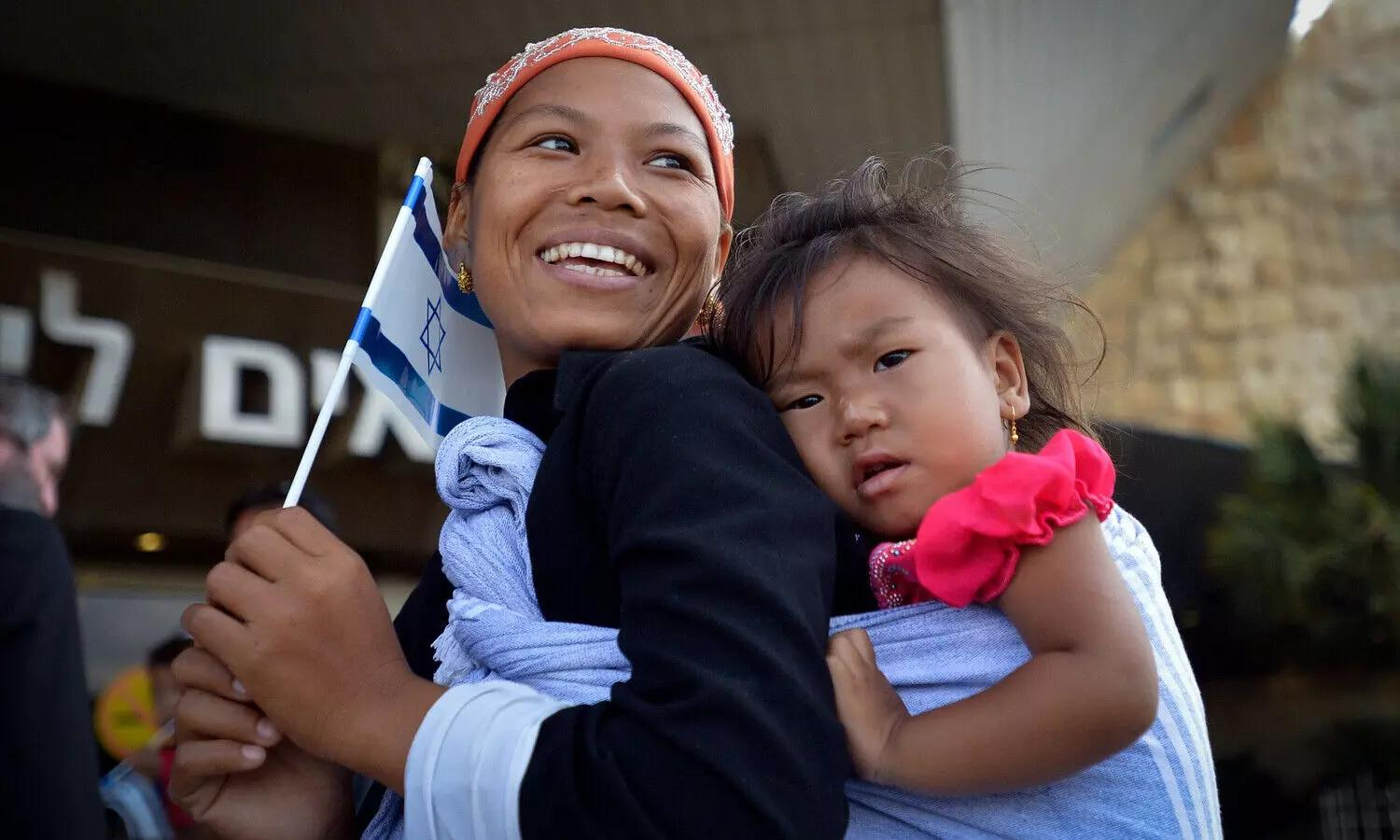
The community now called the Bnei Menashe—Hebrew for “Children of Manasseh”—is drawn almost entirely from the Kuki‑Chin‑Mizo cluster of Tibeto‑Burman‑speaking peoples who live along the jagged, forested border between India and Myanmar. They are sometimes known locally as the “Shinlung” or “Sinlung,” after a word in their own lore meaning “the great cave,” the place in southwestern China where their ancestors are said to have hidden from persecution before moving west into Burma and the hills of what is now the Indian state of Mizoram.
They are, in ordinary terms, hill people: cultivators of rice and maize on terraced slopes, organised into close kinship networks, historically animist, and then, under British and American missionaries in the nineteenth and twentieth centuries, overwhelmingly Christian. Today, Mizoram has one of the highest proportions of Baptists in Asia. Manipur, which has been convulsed for nearly three years by ethnic violence between its mostly Hindu Meitei majority and the mostly Christian Kuki minority, is considerably more mixed. It is out of this world, and not out of any historically recognised Jewish community, that the Bnei Menashe have emerged.
Estimates of their number vary, but the figure cited by most researchers and by the Israeli organisations that advocate for them is around ten thousand worldwide. Roughly half are now in Israel. The rest—somewhere between five and six thousand, depending on the source—remain scattered across Manipur, Mizoram, and the Myanmar borderlands.
Shavei Israel, the Jerusalem‑based organisation that has midwifed the movement for three decades, places the number of Bnei Menashe already in Israel at roughly four thousand, with about seven thousand still in India.
These numbers matter because the Bnei Menashe are easy to confuse with the much older, better documented Jewish communities of the Indian subcontinent—the Cochin Jews of Kerala, the Bene Israel of Maharashtra, the Baghdadi Jews of Bombay and Calcutta—whose historical presence in India is a matter of centuries, in the case of the Bene Israel, perhaps millennia, and entirely uncontested. The Bnei Menashe are something different. They are a community whose Jewish identity is, in recorded terms, new. Their synagogues are new. Their conversions are new. Everything old about them is oral.
The Memory of an Exile
The founding claim of the Bnei Menashe is simple, and, in its way, extraordinary. They say they are the descendants of Manasseh, the elder son of Joseph, whose name was given to one of the Twelve Tribes of Israel, and whose people, along with nine others, were carried off by the Assyrian king in the eighth century before the Common Era—the exile from which, famously, they never returned. They are, on this telling, a fragment of the Ten Lost Tribes. They have simply been lost in a place nobody thought to look.
The route they describe is long. Their oral tradition carries them out of ancient Samaria into the territories of the Assyrian Empire in what is now northern Iraq and western Iran; then eastward, over centuries, through Afghanistan, across the high plateaus of Tibet, and down into central and southern China; then in flight from some further persecution into caves—Sinlung—from which they eventually descended into Burma and the hills of northeast India. The migration narrative survives in scattered songs and place names, in the names parents gave their children, and in a recurring ancestral figure called “Manmasi,” whom Bnei Menashe writers identify, without hesitation, as Manasseh, son of Joseph.
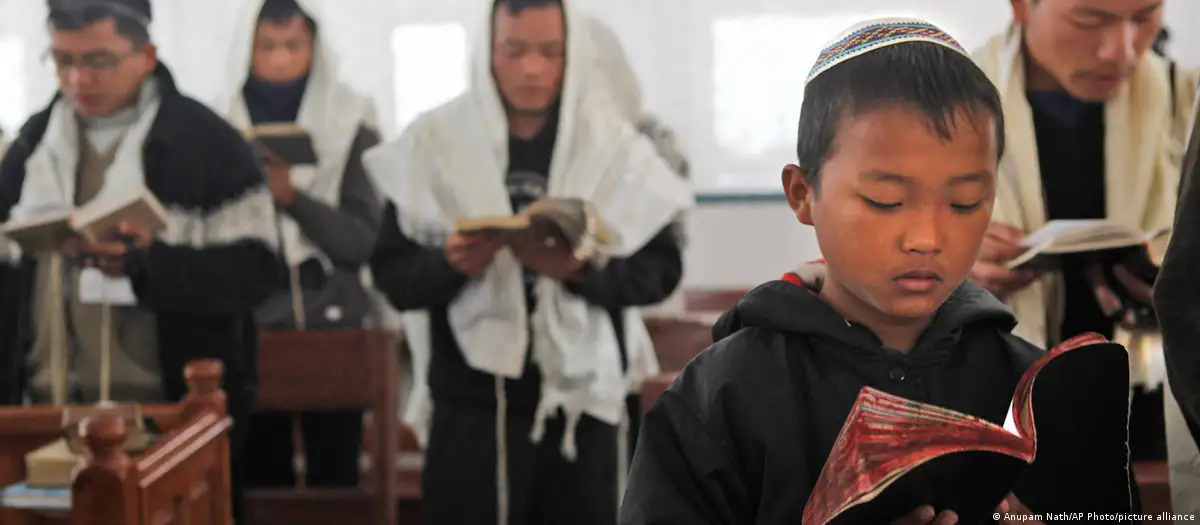
Its defenders point to textures of ritual that are at least suggestive. Bnei Menashe elders describe ancestral practices that included a weekly day of rest on Saturday; the draining of blood from slaughtered animals; avoidance of pork in certain groups; a form of levirate marriage, in which a widow is taken in by her deceased husband’s brother; mourning rites with parallels to biblical practice; and animal sacrifices offered to a single high god, with prayers that later chroniclers compared to the prayers of ancient Israel. The Hmar harvest song known as “Sikpui Hla,” which some versions of the tradition say was composed in the distant past, contains verses that its advocates read as a coded memory of the crossing of the Red Sea and the wandering in the wilderness, complete with a cloud by day, a fire by night, and a bread that fell from heaven.
Set against this oral edifice is a more sceptical scholarly consensus. Most historians and anthropologists who have looked closely at the material argue that the overlaps between hill‑tribe ritual and biblical narrative are best explained not by a lineal descent from ancient Israel but by a process of reinterpretation that took place largely after the arrival of Christian missionaries in the region.
The missionaries brought the Hebrew Bible, often translated into local Kuki‑Chin languages; the hill communities read those texts; and over time, as converts absorbed the stories of the Old Testament, older local traditions were reread through a biblical lens. Resemblances were noticed, sharpened, and, eventually, narrated back as proof of descent. A song about a crossing became a song about the Red Sea. An ancestor named Manmasi became Manasseh. A cave in the old country became Sinlung as a lost Israelite refuge.
There is no archival document linking any Kuki‑Chin‑Mizo community to the Assyrian deportations. There is also no archival document excluding it. What exists is an oral tradition of undeniable intensity and internal consistency, layered over a century and a half of missionary contact, layered in turn over three decades of deliberate rabbinical instruction. The Bnei Menashe themselves tend to experience the sceptics’ arguments as beside the point. For them, the question is not whether a historian would convict on the evidence. It is whether they remember themselves as Israel.
Missionaries, Dreams, and the Turn
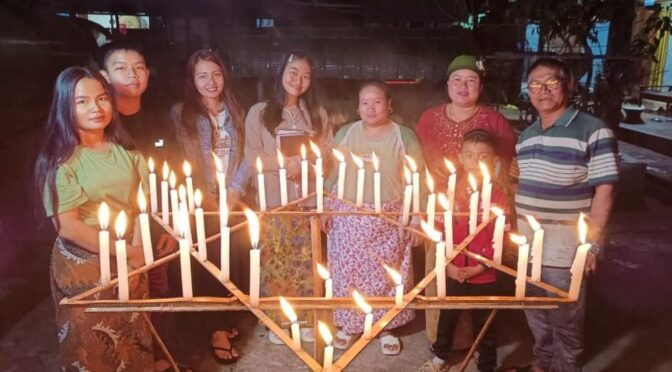
The modern movement dates to the middle of the twentieth century. Its triggering event, as the community tells it, was a dream. In the early 1950s, a tribal figure in Mizoram reported a vision in which he was told that the true homeland of his people was not Aizawl or Churachandpur, but a small country on the eastern shore of the Mediterranean that he had never seen. Word of the dream spread. Small groups began to study the Hebrew Bible with more than ordinary interest. Some quietly stopped attending Baptist or Presbyterian services. A few began to keep a form of Sabbath.
The real institutional build‑up came in the 1970s. Rabbi Chaim Yehezkel Lhungdim, a local figure who had travelled outside India to study Judaism, returned to the northeast carrying the tools of religious practice: a Torah scroll, a pair of tefillin, a set of tzitzit, and a library of halachic texts. He began teaching. At the same time, on the other side of the world, an Israeli rabbi named Eliyahu Avichail, founder of the organisation Amishav, had made it his life’s work to track down the remnants of the Ten Lost Tribes. Avichail visited the hills, recognised what he saw, and gave the community a Hebrew name that would eventually appear in Israeli cabinet papers: Bnei Menashe.
By the 1980s, small synagogues had appeared in Mizoram and Manipur. Hebrew classes were being taught. Children were being circumcised on the eighth day. Prayers were being directed toward Jerusalem. None of this amounted, in the strict rabbinic sense, to a formal conversion, and the community was not considered Jewish under halakha. But it had become, in its own eyes, something more than a waiting room.
It is worth pausing here, because this is one of the rare stories in modern religious history that runs against the usual current. The standard narrative of twentieth‑century conversion in the Global South runs from indigenous religion into Christianity, and occasionally from Christianity into Islam. The Bnei Menashe run the other way. They moved from animism to Protestant Christianity, then to Orthodox Judaism. It is a reverse arrow, and an uncomfortable one for some of the missionary denominations that still operate in the same hills.
Recognition, and Its Fine Print

The decisive intervention came in 2005. In a ruling that remains the legal and theological foundation of everything that has happened since, Sephardi Chief Rabbi Shlomo Amar formally recognised the Bnei Menashe as “descendants of Israel,” ‘zera Yisrael’, the seed of Israel. It was a generous statement. It was also, read carefully, a limited one.
What Rabbi Amar did not do was declare the Bnei Menashe Jews. Under Orthodox halakhic reasoning, Jewishness passes through the mother. Because it was impossible, after twenty‑seven centuries of movement and intermarriage, to establish an unbroken matrilineal line from any individual Bnei Menashe woman back to an ancient Israelite mother, the community could not simply be folded into the Jewish people by fiat. What the ruling did was open a door. It said, in effect, that there was enough seed of Israel in these people to warrant bringing them in, provided they underwent formal Orthodox conversion upon arrival, and provided the state of Israel agreed to help organise the process.
This is the arrangement that remains in force today. The Bnei Menashe are not covered automatically by Israel’s Law of Return in the ordinary way. They arrive under a special administrative track. Mikvaot, the ritual baths required for conversion, have been built in Manipur and Mizoram. Rabbinical courts sent from Israel have overseen the immersion of hundreds, and by some counts thousands, of candidates. Upon landing in Israel, the new arrivals enter absorption centres, continue their instruction, and complete the formal steps that make them, halachically, Jews.
Operation Wings of Dawn
For most of the last three decades, the movement of Bnei Menashe into Israel was a slow trickle—a few dozen here, a few hundred there, each group requiring years of administrative negotiation. Successive Israeli governments were cautious. Cabinet positions on large‑scale aliyah of newly recognised communities have always been politically delicate, not least because they touch on questions of cost, of conversion standards, and of demography.
That caution was set aside in November. The Israeli cabinet, under Prime Minister Benjamin Netanyahu, approved an operation to relocate every remaining Bnei Menashe in India to Israel by 2030—roughly five thousand eight hundred to six thousand people, depending on the count. The first wave, of twelve hundred arrivals, is budgeted at approximately ninety million shekels. The full programme will cost a multiple of that. Its name—Operation Wings of Dawn—deliberately echoes earlier rescue missions such as Operation Solomon, which airlifted fourteen thousand Ethiopian Jews out of Addis Ababa over thirty‑six hours in 1991.
The chosen landing zone is the Galilee. New arrivals will be settled first in the absorption centre at Nof HaGalil, a hilltop city overlooking Nazareth, which already hosts a substantial and established Bnei Menashe community.
What the DNA Said, and Did Not Say
In 2003 and 2004, two genetic studies—one conducted by researchers at the Technion–Israel Institute of Technology, another by a laboratory in Kolkata—set out to test the lost‑tribe claim directly. Their results have been frequently mischaracterised, by advocates and critics alike, and are worth stating carefully.
On the paternal side, the Y‑chromosome DNA of Bnei Menashe men showed no meaningful signal of Middle Eastern ancestry. The haplotypes clustered firmly with East and Southeast Asian populations, which is, on reflection, what one would expect of a Tibeto‑Burman‑speaking hill people. On the maternal side, the mitochondrial DNA results were more ambiguous. A subset of Bnei Menashe women carried mitochondrial lineages that bore limited resemblance to Middle Eastern maternal populations, though the signal was faint and the pathways by which it might have arrived—through some ancient intermarriage along a trading route, for instance—impossible to reconstruct from the data alone.
The honest reading of the genetic evidence is that it does not vindicate the lost‑tribe claim and does not, on its own, disprove it either. What it does is remove genetics as a foundation for the community’s Jewish identity. Whatever the Bnei Menashe are, they are not a people whose Jewishness can be settled in a laboratory. Their belonging, such as it is, will have to rest on practice, on rabbinic recognition, and on the willingness of the state of Israel to receive them.
It is also, for those who find the identity politics of the movement troubling, the weakest point in the architecture. A sceptic is entitled to observe that a community whose case for ancient descent has no archival and no genetic confirmation, and which is being relocated en masse into a geographically sensitive corner of a contested country, deserves a harder set of questions than it is generally asked. A defender is entitled to answer that Jewishness has never been, in the end, a matter of DNA; that converts of every background have been absorbed throughout Jewish history; and that the ritual life of the Bnei Menashe, whatever its origins, is real.
Between Aizawl and Ashdod
Life in Israel, for the Bnei Menashe who have already made the crossing, has not been easy, and honest accounts of the community tend to say so. The new arrivals come overwhelmingly from rural backgrounds and land in a country whose economy runs on Hebrew, on credentials, and on a degree of urban fluency that takes years to acquire. Many of the first generation have settled into low‑wage work: factories in Nof HaGalil’s industrial zone, agricultural labour, caregiving, the unglamorous underlayer of the Israeli economy.
Against this backdrop, the second generation has pushed forward with remarkable determination. Bnei Menashe teenagers are conspicuous in Israeli high schools for their academic focus.
Cultural integration is more complicated. Namte himself, standing beside the balloons at Ben Gurion, put it with almost diplomatic precision. He has grown up in Israel. He considers himself Israeli. And yet he still feels, he said, a gap between himself and those born to Israeli parents, a gap he described as being about “values.” His people, he said, have “‘Asian’ sort of values—we’re super polite, humble.” Israelis, he went on, gently, “love to talk, to express their opinions. We don’t like to talk as much. We’re a bit more shy on the whole.” He said he had learned, over time, to talk more. It was, he added with a half‑smile, still a challenge.
That gentle observation from a seventeen‑year‑old captures something that the more triumphal coverage of the movement tends to skip. The Bnei Menashe are not simply being slotted into Israeli society. They are negotiating, as every immigrant group eventually does, the terms on which they will be absorbed, and the parts of themselves they will preserve. A distinctive hybrid liturgy is emerging in Bnei Menashe synagogues in the Galilee, weaving Hebrew prayer with the musical modes of the hills. Families cook the foods of Churachandpur on the Sabbath. Weddings in Nof HaGalil feature Kuki textiles beneath the huppah. A generation of Hebrew‑speaking children carries the dialect of the old country as a second or third language at home, and some linguists have begun, half‑seriously, to speak of an emergent “Judeo‑Zo.”
The Politics Nobody Wants to Name
No honest account of Operation Wings of Dawn can avoid the politics in which it is embedded, and they are not always flattering. The Bnei Menashe have been brought to Israel, over the years, in a pattern of waves whose timing tracks more closely with the needs of Israeli demographic policy than with any particular crisis in India. Earlier cohorts were settled, at times, in contested areas of the West Bank, where housing was cheaper and where adding visibly religious, visibly loyal new residents served a purpose that the Israeli state did not always publicly articulate. More recent cohorts have been steered toward the Galilee, where the strategic calculation is different but no less real.
Critics, including some within the Israeli left and within the community itself, have argued for years that the Bnei Menashe are being instrumentalised—welcomed in part because they are politically convenient, and shaped on arrival into a constituency whose votes and whose children’s military service reliably reinforce the religious right. The critique is overstated when it implies that the Bnei Menashe themselves are naive about this. They are not. They know why they are wanted. Many of them reply that they would rather be wanted for complicated reasons than not wanted at all.
There is also the Indian side of the ledger, which receives too little attention. The relocation of an entire community out of Manipur and Mizoram is not a neutral event in Indian federalism. It alters the fragile ethnic calculus of two border states already convulsed by violence. It raises questions that New Delhi has been notably reluctant to ask in public—about the role of foreign religious organisations in the organised emigration of Indian citizens; about whether conversions to Judaism conducted under the supervision of rabbinical courts flown in from abroad sit easily within the spirit of Indian anti‑conversion legislation; and about what it means for the Kuki community, already under pressure in Manipur, to lose a visible and internationally connected subgroup of its own population.
For the Kuki left behind, the departure of the Bnei Menashe can feel like a subtraction at precisely the wrong moment. The violence in Manipur has, paradoxically, sharpened the community’s desire to leave and weakened the capacity of those who remain to protect themselves.
Faith and Evidence
To stand at Ben Gurion on Thursday night, watching exhausted arrivals embrace relatives they had not seen in a decade, was to encounter a kind of religious experience that does not yield easily to secular analysis. Whatever a geneticist or a historian might say, the men and women shuffling down that red carpet believed themselves to be completing a journey begun in 722 BCE. They had travelled, spiritually if not literally, out of Samaria and into the Galilee by way of the Assyrian plains, the Silk Road, the caves of Sinlung, the jungles of Manipur, and the fluorescent gates of Terminal 1. They had been met, at the end, by the Minister of Aliyah and Integration, Ofir Sofer, who called the moment “historic.” They had, it is fair to say, been met also by history itself, in several of its less reconcilable forms.