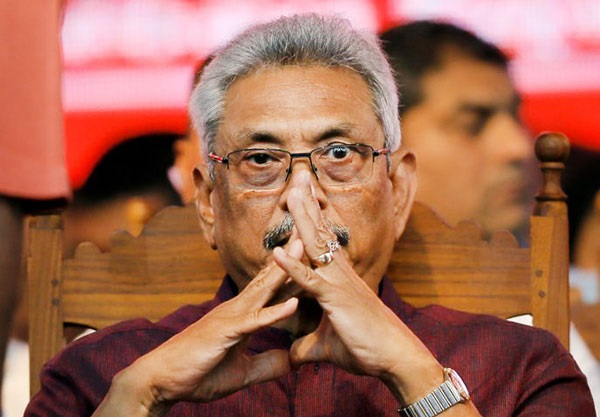
COLOMBO, Sri Lanka — Former President Gotabaya Rajapaksa, whose years as defence secretary coincided with the extensive use of the Prevention of Terrorism Act, has petitioned the Court of Appeal to prevent his arrest under the same law, which became a central pillar of the security apparatus he helped shape.
The petition, filed through Attorney-at-Law Sanath Wijewardena, seeks an order barring investigators from arresting Mr. Rajapaksa under the Prevention of Terrorism Act, or PTA, in connection with the ongoing investigation into the 2019 Easter Sunday bombings that killed more than 260 people.
The application names the Inspector General of Police, Priyantha Weerasuriya; the Director of the Criminal Investigation Department, Shani Abeysekara; and CID investigator Madhava Gunawardena among the respondents.
On June 3, a magistrate at the Colombo Fort Magistrate's Court imposed an overseas travel ban on Mr. Rajapaksa — the first time he had been formally drawn into the Easter Sunday investigation as a person of interest. That order followed a request by the Criminal Investigation Department based on evidence provided by Azad Maulana, a former insider who sought asylum abroad and whose testimony has yet to be tested in open court.
The case has widened in recent months. Major General (Retired) Suresh Sallay, the former director of the State Intelligence Service and one of Mr. Rajapaksa’s closest security aides, has been detained under the PTA since February. Authorities allege that he conspired in and aided the Easter Sunday attacks, accusations he has denied.
Public Security Minister Ananda Wijepala told Parliament this month that investigators believe the inquiry is moving beyond operational actors and toward those who occupied senior positions within the state apparatus at the time of the bombings.
Enacted in 1979 as a temporary measure but retained for decades, the PTA grants authorities extraordinary powers of arrest and detention. Human rights organizations, the United Nations, and the European Union have repeatedly criticized the legislation, arguing that it enables prolonged detention without adequate judicial oversight and creates conditions conducive to abuse.
During Mr. Rajapaksa’s tenure as defense secretary between 2005 and 2015, the PTA formed a central pillar of Sri Lanka’s counterinsurgency and postwar security framework. Thousands of Tamils were detained under its provisions during and after the civil war. Human rights groups argued that many detainees were never charged or convicted and that the law was frequently used against political opponents, activists, and individuals with little or no demonstrated connection to terrorism. Rights organizations also documented allegations of torture, enforced disappearances, and arbitrary detention during that period, allegations successive governments have largely rejected.
As president from 2019 to 2022, Mr. Rajapaksa continued to defend the law against mounting international pressure for its repeal or substantial reform, arguing that robust security powers were necessary to protect the country from terrorism.
Now, as investigators examine whether senior officials bear responsibility for failures surrounding the Easter Sunday attacks, the former president finds himself seeking judicial protection from the same statute.
The petition does not address the broader history of the law. Instead, it argues that any attempt to arrest Mr. Rajapaksa under the PTA would be unlawful and asks the Court of Appeal to intervene before such action can be taken.
The court has yet to fix a date for hearing the application.