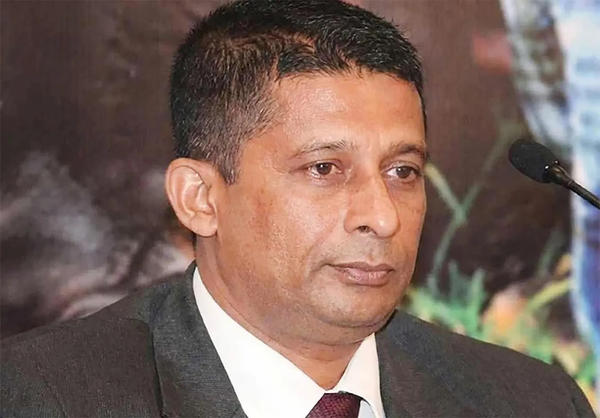
COLOMBO — Several physicians have raised concerns about the nutritional management of Suresh Sallay, Sri Lanka’s former intelligence chief, who has been on a hunger strike since June 7 and was later admitted to the National Hospital of Sri Lanka.
The physicians question the reported use of intravenous nutrition rather than feeding through his digestive tract, saying the approach may have exposed him to complications that might otherwise have been avoided.
The physicians, who spoke on condition of anonymity because they were not authorized to discuss the case publicly, said Mr. Sallay has developed blood clots in his arm during treatment and has shown signs of cognitive decline, including forgetfulness and repetitive speech.
Mr. Sallay, 58, a retired major general and former head of the State Intelligence Service, has been in state custody since his arrest in February in connection with the investigation into the 2019 Easter Sunday bombings.
After his health deteriorated while in the custody of the Criminal Investigation Department, he was transferred to the National Hospital in Colombo, where he remains under treatment. His wife is said to visit him daily.
Jaffna Monitor was unable to independently review Mr. Sallay’s medical records.
A Fundamental Principle of Clinical Nutrition
A patient who cannot or will not eat can be fed either enterally, through the digestive system, using a nasogastric tube in the short term or a surgically placed stomach tube known as a PEG for longer periods, or parenterally, by delivering nutrients directly into a vein. Sallay is receiving the latter.
Doctors commonly summarize the principle in a simple phrase: “If the gut works, use it.”
A PEG, or percutaneous endoscopic gastrostomy, is a tube inserted directly into the stomach through the abdominal wall. The procedure is routinely performed worldwide for patients who cannot maintain adequate nutrition by mouth but retain a functioning digestive system.
Several physicians interviewed by Jaffna Monitor said that, based on the information available to them, they would ordinarily expect a patient in Mr. Sallay’s circumstances to receive enteral feeding.
“Using the gastrointestinal tract is generally safer, more physiological, and associated with fewer complications,” one senior physician said. “That is what medical training and most nutrition guidelines recommend whenever it is possible.”
Risks of Intravenous Feeding
Parenteral nutrition can be lifesaving for patients whose digestive systems cannot be used because of intestinal obstruction, severe bowel disease, or major gastrointestinal surgery.
But doctors say it also carries significant risks.
The nutrient solutions administered intravenously are highly concentrated and often require long-term venous access. Medical literature has linked prolonged parenteral nutrition to bloodstream infections, liver dysfunction, electrolyte imbalances, metabolic complications, and catheter-related blood clots.
Several physicians alleged that Mr. Sallay developed thrombosis, or blood clotting, in the veins of the upper limb after intravenous nutrition was initiated.
“When veins are repeatedly used for prolonged nutritional support, inflammation and clot formation can occur,” one physician said. “While many factors can contribute to thrombosis, it is a recognized complication of long-term intravenous feeding.”
Doctors also noted that patients recovering from prolonged fasting are at risk of developing refeeding syndrome, a potentially life-threatening condition caused by rapid shifts in electrolytes and metabolism when nutrition is reintroduced after a period of severe nutritional deprivation. The condition requires careful monitoring and gradual nutritional support, regardless of whether feeding is provided orally, enterally, or intravenously.
Questions Over Consent and Decision-Making
The physicians interviewed by Jaffna Monitor acknowledged that hunger strikes can complicate treatment decisions because patients may refuse feeding interventions.
However, several doctors questioned whether all available options had been adequately explored.
One senior physician said that when a patient declines a PEG tube or another form of enteral feeding, doctors typically assess whether the patient has the capacity to make an informed decision. If concerns arise about a patient's ability to participate fully in medical decision-making, discussions often involve close family members as part of the broader treatment process.
“In many hospitals, discussions with next of kin become part of the process when major nutritional interventions are being considered,” the physician said.
Several doctors who have observed Mr. Sallay described him as appearing psychologically distressed and expressed concern about his mental state. In light of those concerns, some questioned whether his decision-making capacity had been formally evaluated and whether his wife, who is understood to visit him daily, had been closely consulted regarding significant treatment decisions.
Another physician expressed concern about his overall prognosis.
“I am worried about his long-term recovery,” the doctor said. “Even if he survives this episode, there is a possibility that he may not fully regain his previous level of functioning.”
Those assessments could not be independently verified by Jaffna Monitor.
Medical Ethics and Political Sensitivity
Some physicians interviewed for this article suggested that the political sensitivity of the case may have created an atmosphere of caution around clinical decision-making.
Several doctors nevertheless emphasized that medical care should be guided solely by clinical considerations.
“We took the Hippocratic oath,” one senior physician said. “We do not ask whether a patient is a criminal, a thief, a politician, or an intelligence officer. Every patient deserves treatment according to established medical principles.”
Another physician was more blunt. “Even if every allegation against him were true, his medical care should be determined by medicine, not by politics,”