COLOMBO / JAFFNA — On 6 July, the University of Moratuwa, one of the country's foremost engineering schools, sent its students home and moved teaching online for two weeks, after a cluster of more than fifty dengue infections spread through a campus where examinations were still underway. Several of those students, the university acknowledged, had sat their papers while feverish. It was the third campus disrupted in a matter of weeks. The University of the Visual and Performing Arts in Colombo had already suspended on-site activity for the same reason, and at the University of Colombo, where more than seventy students had fallen ill since May, several faculties shifted to online or hybrid teaching. The University Grants Commission announced it would issue new dengue guidelines for institutions across the island.
By 12 July, the National Dengue Control Unit had recorded more than 68,000 dengue cases for 2026 and 47 deaths, a case-fatality rate of roughly 0.07 percent. June alone produced about 21,500 infections, the worst month of the year, and the first eleven days of July added nearly 12,700 more — around 1,150 a day, compared with about 720 in June. At that rate, July will pass June to become the outbreak's worst month. Five of the dead were children under five, and officials noted that mortality was running higher among women. More than half of all cases, 52.5 percent, by the Health Ministry's count, came from the Western Province, with Colombo and Gampaha districts alone making up about a fifth of the national total. Health officials concede that 2026 is on course to rival or exceed the 2019 epidemic, when more than 105,000 cases were recorded nationwide, and clinicians warn that the strain dominant this year, DENV-2, carries a heightened risk of severe illness for those infected a second time.
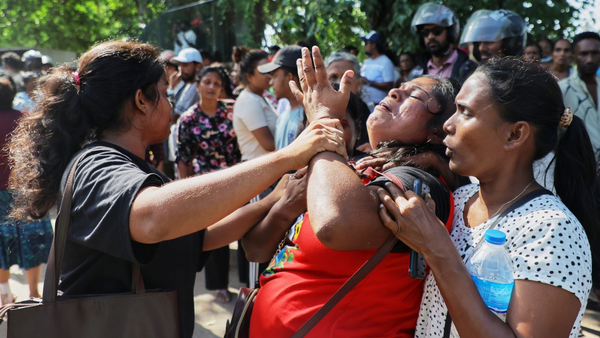
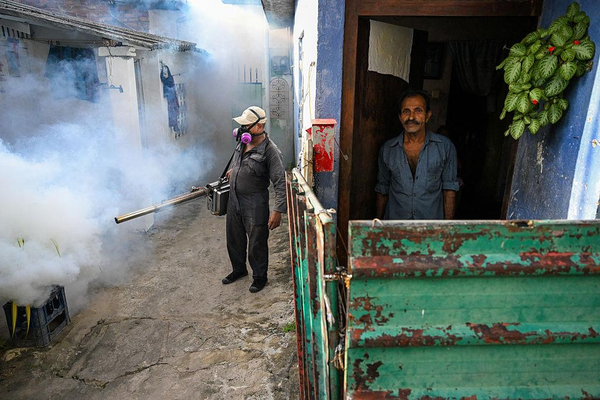
In the hospitals, the strain was plainly visible. At Peradeniya, patients lay in corridors. At Kandy General, a physician described occupancy at three times capacity, with two patients to a bed and others on the floor. At Ragama, the platelet count at which patients are admitted was quietly lowered, sending home people who would have been kept in a month earlier and leaving them to monitor their own blood counts. Daily admissions, which had hovered around 750, climbed to between 950 and 1,000. To map the danger, the authorities turned much of the island into a patchwork of "high-risk" zones: by late June the NDCU had flagged more than 300 Medical Officer of Health divisions and 538 Grama Niladhari divisions across fourteen districts, and the Health Ministry launched a "special" drive across twenty-three high-risk areas in the Western Province. Yet residents in many of these zones describe the same short-lived rhythm they have watched for years — a burst of fogging and clean-up when the cameras arrive, and silence once the attention moves on.
A quiet North, and how fast it turns
The North presents a different picture. As of early July the Northern Province had recorded fewer than 1,000 dengue cases — about 1.6 percent of the national total — with Jaffna accounting for more than 700 of them, outnumbering Vavuniya, Mannar, Kilinochchi and Mullaitivu combined. On paper that makes the North one of the least affected regions in the country this year. Health officials are not treating it as one. Jaffna sits among the districts marked for intensified surveillance, and the reason is recent memory. In November 2019 the district recorded 2,641 cases in a single month, five times the figure of the year before; tuition centres closed by the dozen, and Jaffna Teaching Hospital was so overrun that surgical wards were turned over to dengue patients. The municipal council had exhausted its stock of fogging chemicals and could not have it replaced in time, while hospital officials accused the municipality of acting too slowly. That collapse took only weeks to arrive, which is why a quiet July on the peninsula reassures no one who lived through it. A physician who spoke to the Monitor put it plainly: a low count today is no guarantee against a surge tomorrow.
A crisis foreseen
None of this was unforeseeable. Health officials have pointed, fairly, to the debris of Cyclone Ditwah — the storm that killed more than 600 people in late November and left waterlogged wreckage across all twenty-five districts, from discarded tyres to blocked drains to abandoned construction, ideal nurseries for Aedes aegypti as the southwest monsoon arrived. But the storm's aftermath was known in December. Entomological indices were climbing in January and February. Public health specialists say the months immediately after Cyclone Ditwah offered the best opportunity to remove mosquito breeding sites before the southwest monsoon accelerated transmission. Instead, the large-scale national response did not begin until 22 June, after cases had already surged.
The response has also been undercut from within. In late June, at the peak of the surge, Grama Niladhari trade unions — the village-level officers who identify breeding sites, run inspections, and carry health messages into households — withdrew from field duties and warned they might abandon dengue work entirely, over a grievance as basic as an unpaid fuel allowance for official travel. "We are only asking for the basic facilities required to carry out these duties," the unions' national organiser, Buddhika Rangana, told reporters. "We need fuel allowances to continue dengue activities." Entomologists have long questioned the government's heavy reliance on fogging. They say the method kills only adult mosquitoes, leaving larvae in stagnant water untouched. Over time, they warn, excessive use can also make mosquitoes less susceptible to insecticides.
How other cities hold the line
Unlike many infectious diseases, dengue prevention depends less on sophisticated medical technology than on sustained mosquito control. The mosquito that spreads the virus breeds in stagnant water found in everyday places — uncovered water containers, blocked drains, roof gutters, discarded tyres and construction sites. Health officials have long said that removing those breeding sites is the most effective way to prevent outbreaks before they begin.
The clearest recent example in South Asia is Delhi. When the Aam Aadmi Party took office in 2015, the capital recorded 15,867 cases of dengue and chikungunya combined. By 2018 the dengue count had fallen below 2,800, and in 2025 Delhi reported roughly 1,400 dengue cases and a handful of deaths. The method was neither costly nor sophisticated. Its centrepiece was a weekly civic ritual — "10 Hafte, 10 Baje, 10 Minute," or ten weeks, ten o'clock, ten minutes — in which residents were asked every Sunday morning to spend ten minutes emptying standing water from their own homes, then to telephone ten others to do the same. Around it the city layered thousands of domestic breeding checkers going door to door, tens of thousands of legal notices against premises where larvae were found, pre-monsoon fogging, fever clinics, and saturation publicity. No city has eliminated dengue, and Delhi still suffers bad years — but it converted an annual crisis into a managed, low-level threat. The insight is simple: a mobilised public, backed by enforcement, is the only inspection force large enough to find every bottle-cap of water in a city.
Singapore has pursued the same logic for half a century, and further. In the 1960s, nearly half its premises harboured mosquito larvae; through relentless source reduction, public education, and a legal regime that fines households and construction sites where breeding is found, it drove that share to around one percent. Its National Environment Agency treats dengue as an environmental and governance problem, running a dense, year-round surveillance grid of tens of thousands of "Gravitraps" that reveal where mosquito numbers are rising before the cases do, then concentrating control exactly where the data points. On that foundation it has built Project Wolbachia, releasing male mosquitoes carrying a bacterium that renders their offspring non-viable; the programme has cut Aedes aegypti populations by 80 to 90 percent and dengue risk by more than 70 percent in treated areas, reaching some 740,000 households by early 2026 with a target of covering half the country by year's end. In 2025 Singapore recorded 4,036 dengue cases — its lowest tally since 2018.
A toolbox left on the shelf
Sri Lanka is no stranger to these methods. It has run a National Dengue Control Unit for years, with detailed risk maps and trained public health inspectors. It even piloted Wolbachia: in partnership with the World Mosquito Program, Monash University, and the Australian government, specially bred mosquitoes were released from around 2020 across Colombo North and Nugegoda, covering some 240,000 residents, with results officials themselves called encouraging. Six years on, that pilot has not been scaled. The National Dengue Control Programme is only now seeking a plot of Colombo municipal land on which to build the country's first local Wolbachia breeding facility, the eggs having until now been imported from Australia, while expansion to the rest of the Western Province has got no further than a recommendation awaiting sign-off. A dengue vaccine already in use in more than forty countries remains, in the authorities' own word, under "discussion."
Sri Lanka's problem is not a lack of understanding about dengue. Public health officials have spent decades fighting the disease and know what works. The challenge lies in carrying out those measures consistently across the country. Public Health Inspectors, who are responsible for identifying mosquito breeding sites and ensuring they are removed, have long complained that their numbers are insufficient to cover every community effectively. The health sector has also been struggling with broader pressures. Thousands of doctors and nurses have left the country in recent years, while hospitals have faced shortages of medicines and other essential supplies following Sri Lanka's economic crisis. Public health experts say such constraints make it harder to sustain year-round dengue prevention, leaving authorities to intensify their efforts only after cases begin to rise.