
By M.R. Narayan Swamy
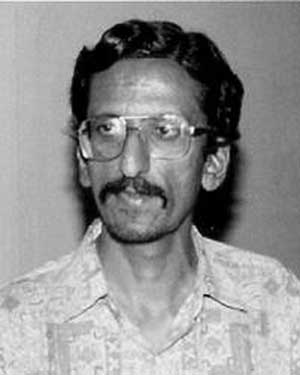
Every night before sleeping, he devoured pages from the Bhagavad Gita authored by Swami Chinmayananda. It was the last thing Ketheshwaran Loganathan read before he was shot dead by a Tamil Tiger on the morning of August 12, 2006.
August 2026 would mark the 20th anniversary of one of the most despicable killings during Sri Lanka’s long-drawn war.
I have met Kethesh, as he was widely known, many times – in Colombo, Chennai, and New Delhi. Most of our meetings took place when he was with the Eelam People’s Revolutionary Liberation Front (EPRLF).
In our discussions, Kethesh emerged as a fierce Tamil nationalist but one who believed that all communities in Sri Lanka – Sinhalese, Tamils, and Muslims – can and should live together, notwithstanding their differences.
Kethesh felt at home in the EPRLF because he believed that the group led by K. Pathmanabha stood for similar goals, although it was committed to the establishment of a Tamil Eelam homeland at one point.
His distaste for the Liberation Tigers of Tamil Eelam (LTTE) developed early on. This was cemented by the LTTE’s murderous onslaughts on other Tamil groups, including the EPRLF, a frenzy which left hundreds of young Tamils dead.
One day, seated in a hostel room at Delhi’s Jawaharlal Nehru University, Kethesh told me animatedly that the LTTE had dubious links with Western powers, in particular the Central Intelligence Agency (CIA).
He offered no evidence to back his claim. But looking back at the way the LTTE bought and shipped weapons and explosives from around the world with seeming ease for long years, I do wonder if Kethesh knew more than what he said.
Kethesh, to the best of my knowledge, never wielded a weapon. He probably disliked weapons. He certainly hated needless violence but admired Che Guevara and his brand of revolution.
No, he was no coward or an armchair intellectual. Had he been one, he would never have thrown in his lot with the EPRLF in the first place. His father was a highly successful banker. If Kethesh had wanted to, he could have lived a comfortable life, either in Sri Lanka or abroad.
Born in Jaffna, the Tamil heartland, Kethesh's pursuit of higher studies and scholarship took him to many places, including Colombo, Madras, the United States, the Netherlands, the United Kingdom, and Norway.
But his heart always beat for Jaffna, the Tamil community, and Sri Lanka. Yes, Sri Lanka too.
Which is why a section of Sinhalese-Buddhists – the Janatha Vimukthi Peramuna (JVP) of the earlier era included – hit below the belt when they taunted Kethesh as a covert Tiger sympathiser even after he joined the government’s peace secretariat.
It was this attitude – if you are a Tamil, you must be a Tiger – that gave implicit legitimacy to the armed struggle for an independent Tamil Eelam. No wonder the LTTE prospered for decades.
I was not surprised when he quit the EPRLF in 1994, four years after LTTE gunmen massacred Pathmanabha and fellow leaders in Chennai.
Like most others, Kethesh enjoyed a cosy and warm relationship with the soft-spoken Pathmanabha. The latter’s death deprived Kethesh of the crutch that kept him in the EPRLF despite many ups and downs.
Indeed, after Pathmanabha’s killing, it was Kethesh who, then in Delhi, contacted a wide spectrum of Indian leaders, Rajiv Gandhi included, to seek condolence messages for the ERPLF leader.
With his command of Tamil and English, he undertook his earlier role as the EPRLF spokesperson with a certain expertise. But he did not take up any post when the EPRLF formed an administration in Sri Lanka’s northeast after India had deployed its military in the region and waged war against the LTTE.
He was respected for his knowledge. When LTTE chief Velupillai Prabhakaran and others came to the Madras airport to see off their delegates to Thimpu in 1985, the Tiger boss turned to Lawrence Thilakar (one of the two LTTE representatives to Bhutan) and said: “When in doubt, take advice from Anne.” The ‘Anne’ was a reference to Kethesh, who incidentally opened the talks with the Sri Lankan government at Thimpu on behalf of the Tamil side despite the presence of the veteran Appapillai Amirthalingam.
From the EPRLF, Kethesh graduated to an independent political life, which initially took him abroad and then brought him back to Sri Lanka, where he plunged into writing.
Towards what turned out to be the last years of his life, he became a Director at the Centre for Policy Alternatives (CPA) in Colombo.
Reams have been written on why he left the CPA in 2006 and became a Deputy Secretary General in the Sri Lankan government’s Secretariat for Coordinating the Peace Process (SCOPP).
Apparently, Kethesh had wanted to sign up with the Bandaranaike Centre for International Studies. That is when President Mahinda Rajapaksa, probably eager to have a Tamil face in the Secretariat, wooed Kethesh.
Anyone who even remotely believes that Kethesh sold his soul to the Sri Lankan establishment by joining the Secretariat is foolishly off the mark.
If this allegation were to be true, then the LTTE must be dubbed the biggest agent of Colombo for accepting money, weapons, and more—in plenty—from President Ranasinghe Premadasa.
Kethesh may have thought that, by playing a role in the government Secretariat, he might be able to somehow influence the limping peace process, with which he was not happy.
At worst, he was naïve to believe so. For this, he paid with his life.
The LTTE gunman who fired several shots at Kethesh after calling him out of his residence in Dehiwala, Colombo, would have been told by his trainers that this bespectacled, skinny man was a traitor to Tamil Eelam. He had to go.
Was it a coincidence that Kethesh was assassinated exactly a year after a LTTE sniper took out Foreign Minister Lakshman Kadirgamar, another Tamil?
It is true that the LTTE did not take responsibility after Kethesh lost his life. But the Tigers also did not claim to have killed Rajiv Gandhi or Kadirgamar. It was their style.
However, pro-LTTE commentators showed where they stood on the murder. Days later, one Tiger propagandist described Kethesh as “a loose cannon”, “a bundle of contradictions,” and “an unabashed chameleon careerist”.
Those who counted themselves on the side of the LTTE dubbed him a “traitor”.
Away from politics and ethnicity, Kethesh led a simple life. He had few wants. He was a voracious reader, like his wife, Bhavani, who was two years older than him.
Only ten days before he was killed, he expressed a fear to Bhavani. With his many ailments, how would he manage if she died before him?
After all, he suffered from failing hearing, weak eyesight, and irritable bowel syndrome, which had never spared him since childhood. He often fell ill.
By gunning him down, the LTTE resolved the worry he had.
Those who ordered his cowardly killing did not realise that karma never spares anyone. Those who heap violence on others will die violently one day. This is true for everyone in the world, the LTTE included.