A few weeks before the arrest of former spy chief Suresh Sallay, an article arrived at Jaffna Monitor for review. It argued that a country needs sweeping laws such as the Prevention of Terrorism Act (PTA) to tackle terrorism. I did not publish it. It was, to put it plainly, bloody one-sided.
As a Tamil born and raised amidst the war, I know what the PTA is. I know what it has done to people.
In this issue of Jaffna Monitor, our Consulting Editor, M.R. Narayan Swamy, pens the agony of a pastor, Edward (Sam) Sivalingam, who was detained for nearly two decades under the draconian PTA despite having no connection whatsoever to the LTTE or to terrorism. His story is one example. Personally, I know hundreds.
The PTA is an evil law, and it has no place in a civilized country.
A few days before this issue went to press, Suresh Sallay — having spent more than one hundred days in detention under the PTA without being formally charged — began a fast unto death inside a Criminal Investigation Department detention cell, refusing food, water, and medication.
After meeting him, his 21-year-old son, Kushal Sallay, told reporters outside CID headquarters that his father had launched the protest after months in custody. He described the conditions of detention as inhumane and said the campaign was intended to draw attention to the sweeping powers of the PTA.
Note carefully who is making this demand. Sallay is not a Kilinochchi farmer or a Batticaloa trader. He is the former head of the State Intelligence Service and, before that, of military intelligence — a man who sat at the controlling end of this country’s security apparatus, the apparatus for which the PTA has been the principal legal weapon for four decades, and which deployed that weapon against countless Tamils and Muslims over long years.
His lawyers say he is being held under a detention order signed not by a court but by the President — as was the case in so many PTA detentions before his. His counsel has warned the Director of the Criminal Investigation Department in writing that officials could be held personally accountable should he die in custody.
Every element of that account — detention without charge stretching beyond one hundred days, an executive rather than judicial detention order, allegations of torture in police custody, a family pleading for access to lawyers, and a man so broken by confinement that he would rather die than endure further detention — will be instantly familiar to the Tamil readers of Jaffna Monitor.
Because this is the standard biography of a PTA detainee. The only extraordinary feature is the detainee’s former job title.
As a friend of mine put it: “The machine has eaten one of its own engineers.”
The late conversion of the PTA’s own men
Supporters of Sallay recently staged a satyagraha in Colombo Fort, drawing a number of prominent figures. Among those present were Udaya Gammanpila, Wimal Weerawansa, Galagoda Aththe Gnanasara, and several individuals who had long defended the PTA.
Before I forget: the author of the article I declined to publish — the one arguing that Sri Lanka needs sweeping laws such as the PTA — was also among the attendees.
I do not say this to ridicule anyone, or to brand them, hypocrites or opportunists. Quite the opposite. I am genuinely pleased that, at least now, they seem to have realized that the PTA is an evil piece of legislation that can be turned against anyone.
Rather than dismiss them, I respect the change of heart, even one that has arrived selectively. After all, as an old Tamil saying goes, only the hen that laid the egg knows the pain of laying it.
But some hens knew the pain perfectly well — and chose to forget it the moment the coop was theirs.
The JVP’s own cadres were swallowed by the state’s security machinery during the 1987–89 insurrection, many under emergency regulations and anti-terror laws. For years, the party campaigned against the PTA, denouncing it as a tool of repression. Today, it occupies the very offices from which detention orders are signed.
Sallay raised no audible objection to ministerial detention orders when they were imposed on Tamil youth in the Vanni or Muslim traders in Kattankudy. Indeed, many of his critics have portrayed him as one of the leading architects of the PTA's enforcement, particularly during his years in intelligence under the administration of Gotabaya Rajapaksa.
Nor was Udaya Gammanpila’s constitutional conscience much in evidence when the student leader Wasantha Mudalige spent months in detention in 2022 under a PTA order signed by the President, or when the poet Ahnaf Jazeem was jailed for more than a year over allegations linked to a collection of anti-war poetry.
For decades, every Tamil mother’s testimony was dismissed as LTTE propaganda, every Human Rights Watch report as foreign interference, and every United Nations finding as part of a conspiracy against Sri Lanka’s war heroes.
Sallay’s cries — and those of his family — cannot be dismissed on any of those grounds.
That is what makes this moment significant. It strips away the usual excuses and exposes, once again, the fundamental cruelty of the PTA.
What the record already proved
The statute itself, enacted in 1979 as a “temporary” measure and made permanent in 1982, authorises warrantless arrest on suspicion of loosely defined “unlawful activity” (Section 6); seventy-two hours of police custody before production to a magistrate (Section 7); detention on a minister’s order — originally up to eighteen months, twelve after the 2022 amendment — with no judicial determination (Section 9); transfer of remand prisoners to “any authority” in “any place” (Section 15A); the admissibility of confessions made to senior police officers, with the ordinary safeguards of the Evidence Ordinance disapplied (Sections 16 and 17); and supremacy over every conflicting law (Section 28).
The human consequences were documented in forensic detail. Official figures supplied to the UN Special Rapporteur on counterterrorism in 2017 showed that of eighty-one prisoners then in the judicial phase of PTA pretrial detention, seventy had been held for more than five years and twelve for more than ten. Human Rights Watch’s 2018 investigation, built on interviews with thirty-four former detainees and relatives, recorded torture or beatings in eleven of its seventeen detailed cases. The UN Human Rights Committee found in the Singarasa case that a Tamil man’s conviction — resting on a confession taken without an interpreter — violated fair-trial rights.
A woman detained in 2008 solely because the police could not locate her husband spent seven years inside before acquittal. A detainee said he confessed after officers threatened to rape his sister; he was acquitted in 2014, his hearing destroyed by torture. The journalist J.S. Tissainayagam received twenty years’ rigorous imprisonment for articles about the treatment of Tamil civilians. Jeyakumari Balendran was detained in 2014 for campaigning to learn the fate of her disappeared son.
After the 2019 Easter Sunday attacks — the very atrocity in connection with which Sallay is now held — the law turned on the Muslims. Human Rights Watch documented at least one hundred and twenty-five Muslims detained under the PTA in Kattankudy alone, most for between one and three years, the majority with little or no evidence ever produced. The lawyer Hejaaz Hizbullah lost nearly two years of his life to shifting allegations before being granted bail in 2022. The UN Working Group on Arbitrary Detention declared Ahnaf Jazeem’s detention arbitrary. The Human Rights Commission of Sri Lanka found in 2025 that the PTA detention of Mohamed Rusdi — a Muslim youth arrested over anti-Israel stickers — violated his fundamental rights.
Nor has the law’s appetite slackened under the present government. By Colombo’s own figures, reported to the UN human rights office, forty-nine PTA arrests were made in the first five months of 2025 — more than in all of 2024. As of late May 2025, eighteen people sat under detention orders, twenty-two on magistrates’ remand, and forty on High Court remand. And in the very week of Sallay’s hunger strike came the Jaffna CID’s arrest of the twenty-four-year-old rapper Sangeethsan Ganeskumar, remanded under the PTA over a TikTok video of a temple-festival performance.
A pledge in writing, a bill that makes it worse
The National People’s Power government cannot plead ignorance of any of this. Its manifesto promised, in writing, the abolition of oppressive laws including the PTA. In office, it has reversed itself, asserting that the fault lies in the Act’s “misuse” rather than in the Act — a claim refuted by the statute’s own text, since a law whose ordinary operation permits warrantless arrest, executive detention, and police confessions is functioning as written whenever it is abused.
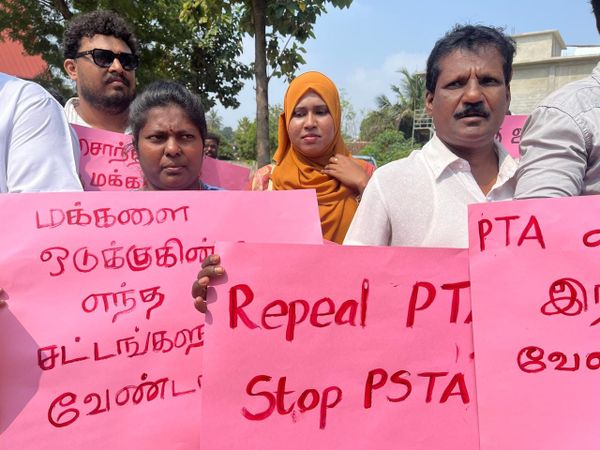
The government’s proposed replacement, the Protection of the State from Terrorism Bill, has been condemned by constitutional analysts and civil society coalitions on the documented ground that it would, in key respects, confer broader powers than the PTA — sweeping protest and dissent into terrorism’s definition while dropping the fundamental-rights exemption found in earlier drafts. In February, ITAK’s Shanakiyan Rasamanickam was reduced to tabling a private member’s repeal bill to force onto Parliament’s agenda what the governing party had promised the electorate. The European Union’s GSP+ monitors have pressed for repeal and been rebuffed. UN experts have demanded a moratorium since 2022, but have been ignored.
Forty-seven years of this law have now produced a closed circle of evidence: the statute’s text, the UN’s findings, the state’s own Human Rights Commission, thousands of Tamil and Muslim case files — and, finally, the sworn anguish of the man who once commanded the system. There is no vantage point left from which the PTA can be honestly defended.
The spymaster has discovered, forty-seven years late, what every Tamil mother could have told him.
He is late. But he is right.
Repeal it.