By M.R. Narayan Swamy
It really beats me how some Sri Lankan Tamil politicians continue to cling to a dead past even as they try to reinvent themselves in a world without the Tamil Tigers.
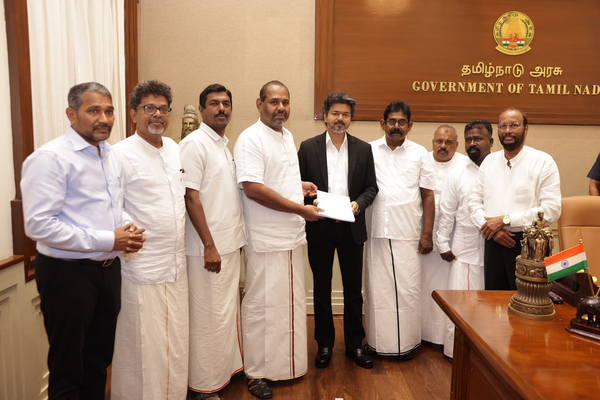
It would have made sense if a team of Tamil leaders who called on Tamil Nadu Chief Minister Joseph Vijay confined themselves to the problems faced by Tamil fishermen in Sri Lanka and the Tamil refugees living in India.
But old habits die hard. The delegation, led by Gajendrakumar Ponnambalam, also pressed the actor-politician to back an international probe into alleged wartime atrocities on Tamils and support a federal power-sharing system in Sri Lanka.
This is truly bizarre.
India is a quasi-federal state in which the central government holds dominant powers, increasingly so in recent years. Some Indian states, which do enjoy authority in various areas, complain that New Delhi is steadily chipping away at their limited autonomy.
This being so, how do you expect a politician in a quasi-federal India to call for a fully federal set-up in a neighbouring country?
Also, why should Tamils, even sections of them, call for federalism in Sri Lanka after the LTTE’s (now late) Anton Balasingham was loudly denounced for suggesting in Oslo a solution within a federal framework to end the ethnic conflict?
Is it because federalism was a dirty word when it was felt that an independent Tamil Eelam was around the corner, and that federalism is the new flag to flaunt since the homeland dream has crashed?
There is no doubt that thousands – the precise figure is disputed – of innocent, non-combatant Tamils died during the end of the war in 2008-09. No credible global investigation has taken place into the mayhem, though 17 years have passed. In all probability, no such inquiry will take place.
Now, what is the point in asking a chief minister in India – mind you, not the Indian government -- to jump into the fray? Will Vijay’s appeal make any difference? Or is this demand meant to placate the pro-LTTE diaspora, which is known to fund “Tamil nationalist” politicians in Sri Lanka?
As I said in an open letter to Vijay after he became the chief minister, the two subjects where he should try to be proactive relate to the Tamil refugees from Sri Lanka languishing for long years in Tamil Nadu and the grievances of the Tamil fishermen in the island’s north vis-à-vis their Tamil Nadu counterparts.
Unfortunately, on the fishing row, most Tamil Nadu politicians tend to focus only on the repeated arrests of Indian fishermen and the confiscation of their vessels instead of understanding the reasons for the enormous losses suffered by the fishing communities in northern Sri Lanka.
In any case, Vijay is not unaware that the Ponnambalam-led delegation had dismissed his political making with contempt when Tamil Nadu was ruled by the DMK and Vijay, new to politics, was struggling to woo voters.
Ponnambalam and others had on an earlier trip to Chennai called on then Chief Minister M.K. Stalin, the AIADMK brass, and Seeman, who could not win a single seat in the Tamil Nadu Assembly compared to Vijay’s 108.
Vijay (like any leader in Tamil Nadu) should certainly meet politicians from Sri Lanka, Tamils included, but must be wary of those who keep in their heart the Liberation Tigers of Tamil Eelam (LTTE), which was outlawed in India after it assassinated former prime minister Rajiv Gandhi.
Vijay must remember that the “Tamil nationalist” leaders in Sri Lanka have never condemned the LTTE’s murder spree, including the gory killings of Gandhi and Sri Lankan leaders, as well as any number of Tamils deemed rivals at best and “traitors” at worst.
Vijay should also note that Ilaiyaraaja, an accomplished senior in the Indian Tamil film industry, was forced to cancel a planned concert in Paris on July 4 because of appeals bordering on threats from pro-LTTE elements.
Ilaiyaraaja, now 83, is no ordinary soul. He is a respected musician, composer, orchestrator, multi-instrumentalist, lyricist, and playback singer with a rich career of 49 years during which he has composed over 5,000 songs, provided film scores for nearly 1,000 feature films in nine languages, and performed in over 20,000 concerts.
Such a man was vilified in posters put out by pro-LTTE Tamils in Paris and told to “get lost”. One bombastic pro-LTTE character gloated that they had written “polite” letters to Ilaiyaraaja but received no reply!
And what was Ilaiyaraaja’s “crime”?
The performance, arranged by some Sri Lankan Tamils, clashed with the Black Tigers event of July 5, when Tamils, according to LTTE sympathisers, are supposed to be in mourning and not attend musical or such joyful events.
A similar community event of Tamils belonging to Inuvil in Jaffna was also axed in Toronto, Canada, after telephonic threats from pro-LTTE persons.
Ilaiyaraaja is a Tamil from India and is not a member of the LTTE. Why should he be subjected to such a code?
Who knows, one day pro-LTTE voices from Sri Lanka may inject this culture into Tamil Nadu and tell Vijay not to have any celebrations (including movie shows) on July 5 or the day Tamil Tigers chief Velupillai Prabhakaran was killed or any other days deemed important in the LTTE calendar.
Those who forced the cancellation of Ilaiyaraaja’s concert in Paris were not “Tamil nationalist” politicians but activists allied to the LTTE. However, the political ecosystem of both categories is the same.
This reminds me of a laughable claim the LTTE made during the time the Indian military was at war with the Tamil Tigers in Sri Lanka.
A press release by the LTTE’s Paris representative, Lawrence Thilagar, claimed that it had “uncovered” a plot by the Indian intelligence to kill noted Indian Tamil playback singer T.M. Soundarrajan at a concert in the French capital and put the blame on the Tigers. The LTTE, it said, had saved him!
Clearly, in all these years, the Tiger stripes have not changed. In 1988, the Tigers “saved” one Indian film personality in Paris, and in 2026, they “ousted” another Indian film personality from the same city.
At the same time, in Chennai, "Tamil nationalist" politicians courted Vijay after having earlier treated him with disdain.
Tamil leaders from Sri Lanka should discuss with the Tamil Nadu leadership concrete proposals that, through investment or collaboration, could improve the economic conditions in their country's economically battered north and east.
And seek from Tamil Nadu support for the implementation of the 13th amendment of the Sri Lankan constitution and the much-delayed Provincial Council elections. Is the antipathy a result of the LTTE’s opposition to the 1987 India-Sri Lanka Accord that led to the Provincial Councils?
When will Sri Lankan "Tamil nationalist" politics come out of its time warp?