By M.R. Narayan Swamy
Indian-origin Tamils, descendants of indentured labourers brought to Sri Lanka in the 19th century, are steadily moving away from the tea plantations that once defined their existence.
After generations of living a hand-to-mouth existence, many are finding success in new fields emerging as a more empowered ethnic group. Yet, for the tens of thousands who still toil in the tea estates poverty and entrenched racism remain daily realities. Community leaders speak about significant changes in the socio-economic profile of the once exclusively plantation workers, treated for over a century almost like slaves despite the tea industry being one of the largest earners of foreign exchange in Sri Lanka.
In recent years, members of the community, whose forefathers hailed from south India, have branched out to become teachers, doctors, engineers, accountants, traders and industrialists, creating a new corps of Sri Lankans and breaking free from a vicious cycle of debts and penury.
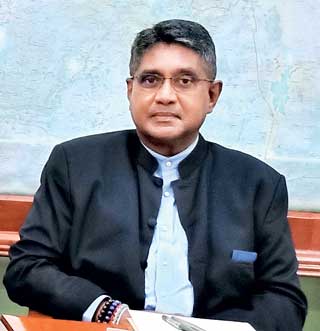
“We are no more just a labour segment in Sri Lanka,” Mano Ganesan, one of the most popular leaders of the Tamil plantation community, said in a telephonic interview, days after holding extensive talks with President Anura Dissanayake over issues confronting the ethnic group.
“New successful layers have emerged in different fields. Today, just about 100,000 Tamils work in the tea estates compared to one million earlier although much of the community still lives within the tea-producing region,” said the four-time MP who heads the Tamil Progressive Alliance (TPA). “Ninety per cent of the Tamils are out of it (tea industry).”
The British began shipping poverty-stricken indentured labourers from south India to Ceylon in the 1820s to work on initially coffee – and later tea and rubber – plantations as Sinhalese peasants were unwilling to take up the harsh, low-paid manual work in the country’s central highlands.
Also called “Malaiyaha (Hill) Tamils”, they worked for long decades under harsh and restrictive conditions widely seen as a form of bondage rather than free labour. Many died due to malnutrition, diseases and displacement.
The Sinhalese, Sri Lanka’s majority population, traditionally looked down upon the “Indian Tamils”. Even elite leaders of the indigenous Tamils populating the country’s north and east did not treat them as equals notwithstanding a linguistic affinity.
Paid a pittance despite doing backbreaking work in the money-spinning tea estates, the ‘Indian Tamils’ suffered from acute poverty, never-ending debts, terrible working conditions and ill health besides low level of education.
Ganesan said that schools serving the community came under the national grid only in 1977 – almost three decades after independence. Many ‘Indian Tamils’ lacked citizenship for decades, the disgrace not changing even after Sri Lanka became a free country.
Although they largely kept away from the blood-soaked Tamil separatist campaign that raged in Sri Lanka’s northeast for a quarter century, the ‘Indian Tamils’ were attacked by Sinhalese thugs for being Tamils. Many in Sri Lanka saw them as an underclass of the more successful indigenous Tamils.
No more, asserts Ganesan, 66, who like his parents was born and raised in Sri Lanka but whose ancestors were never indentured workers. He says many in his community have given up the drudgery of their parents and grandparents to be professionals, entrepreneurs and more.
In the process, most ‘Indian Tamils’ outside of the tea estates are now tri-lingual speaking English, Sinhalese and Tamil. Ganesan calls them the fourth ethnic group in Sri Lanka after the Sinhalese, indigenous Tamils and Muslims.
“There is a call within the community to identify themselves more as Sri Lankans to be recognized as a core part of the country,” he added. “It helps that there is gradual change in outlook towards India in the Sinhalese society.”
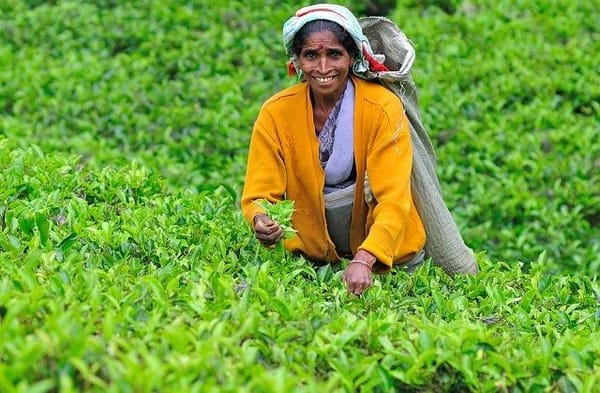
However, the estimated 100,000 Tamil workers, mostly women, who continue to slog in the tea estates, still encounter daunting problems.
Firstly, wages remain low, despite being increased only this year to SLR 1,750 a day from Rs 1,350. The hike has taken place in tea estates run by large as well as state-owned companies but not in privately held small tea estates.
At the same time, the workers have been told to pluck a minimum of 25 kg of tea leaves a day, up from 18 kg until recently. “Even if they fall short by one kilo, the wages are cut by half,” said Ganesan, also a trade unionist. “I conveyed this to the (Sri Lankan) president. How can people cope with such meagre income?”
He pointed out that while the ongoing Iran war had severely impacted foreign exchange earnings from tourism and garment industries besides reduction in remittances from the Gulf, the tea industry was keeping the national economy afloat. Tea exports alone generate $1.2 to 1.3 billion in foreign exchange annually.
But very little of this wealth percolates to those who make it happen, forcing more and more workers to quit the arduous part of the industry for good. Like the Sinhalese in earlier times, younger ‘Indian Tamils’ aware of better opportunities outside of the estates refuse to do this work.
Ganesan and his colleagues complain that decades of underinvestment in infrastructure, housing and early warning systems led to colossal deaths and destruction when the November 2025 cyclone ravaged Sri Lanka, disproportionately affecting the ‘Indian Tamil’ community.
Ganesan has urged the government to ensure that land rights are given to the community besides legal ownership of the houses where they live. Both are long-term demands reiterated regularly by Tamil leaders but ignored by successive Sinhalese-dominated governments.
While proud to be Sri Lankans, Ganesan says the community’s Indian identity cannot be ignored. So, he wants New Delhi to give the Overseas Citizen of India (OCI) status to all eligible Indian origin Tamils, on the lines of its rollout in Mauritius where the process was made easier.
“OCI status will be very useful,” said Ganesan, who presented a memorandum to Prime Minister Narendra Modi when he last visited Colombo. “While we are Sri Lankan citizens, we want the OCI status.”
This, he added, will make it easier for the community to travel to and from India. Most ‘Indian Tamils’ enjoy familial links with Tamil Nadu, in particular the districts of Tiruneveli, Tuticorin, Virudhunagar, Madurai, Salem, Tirichirapalli and Thanjavur.
“Poverty for the tea workers is not just about money,” he said. “It also relates to education, housing, health and food issues. The tea workers need dignity and respect. They deserve it.”
The economics apart, caste remains a sore factor.
The ‘Indian Tamils’ who migrated to caste-conscious Tamil regions of Sri Lanka’s north after violence by the Sinhalese are not generally considered as equals although many, over time, joined the Tamil Tigers. In the process, many of them died in the final battles between the Sri Lankan military and the Tigers in 2008-09.
Editor’s Note: This article was originally published by The Federal and is reproduced here by Jaffna Monitor with permission, with due acknowledgment to the original publication.