
For three decades, the state’s answer to the families of Jaffna’s disappeared has been that it does not know. A report released this week argues that it has always known — and has spent thirty years making sure that nothing could be done about it.
The report, published by the International Truth and Justice Project (ITJP), a London-based group that has documented Sri Lankan war crimes since 2013, lands as excavators returned to the Chemmani salt flats on Tuesday to resume a dig that has already yielded 412 sets of skeletal remains, of which 409 have been exhumed. Together with the 15 skeletons recovered in a brief, aborted excavation in 1999, the number of dead recovered from the site now stands at 427 — more than at any other mass grave uncovered on the island.
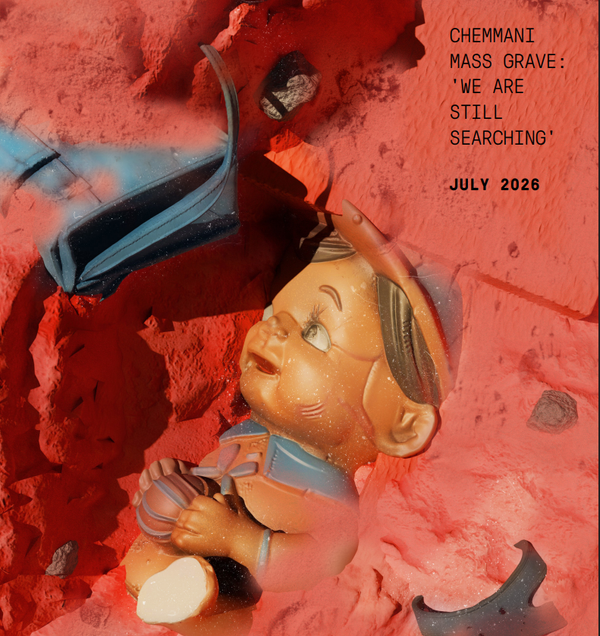
Titled “Chemmani Mass Grave: ‘We Are Still Searching’” — the 88-page document assembles perpetrator confessions, court records, habeas corpus filings, and the career histories of seven Sri Lanka Army officers into a single argument: that the failure at Chemmani has not been a failure of information, but of will.
“It has been thirty years since it was first discovered, but despite enormous publicity and two phases of excavation, one still in progress, no commander has yet been held criminally accountable,” the report states. What it calls most astonishing is that the Army continued to use the site as a dumping ground for bodies even after the first excavation. “Nothing speaks to the level of impunity more than this.”
A schoolgirl, and then a confession
Chemmani entered Sri Lanka’s public consciousness through a single crime. On 7 September 1996, Krishanthy Kumaraswamy, an 18-year-old student, was stopped at a checkpoint on her way home to Kaithady after sitting a chemistry A-Level paper. She was taken into a bunker, raped repeatedly, and strangled. Her mother, Rasamma, a school vice-principal; her 16-year-old brother Pranavan; and a neighbour, Siddambaram Kirubamoorthi, who went to the checkpoint to look for her, were all killed the same evening. All four were stripped and buried in shallow graves behind the checkpoint.
The 1998 convictions in that case were, at the time, treated as evidence that justice had returned to Jaffna. Instead they opened a much larger door. Offered a chance to address the court after sentencing, Lance Corporal Somaratne Rajapakse — the senior soldier at the checkpoint — testified that he and others had buried as many as 400 Tamil victims in the surrounding salt flats. “Almost every evening,” he said, “dead bodies were brought there, and the soldiers were asked to bury them.”
Rajapakse and four co-convicts subsequently recorded voluntary statements before the Human Rights Commission naming the officers above them. They described bodies delivered by tractor after curfew and buried by torchlight; instructions that corpses be stripped and their clothes burned in a separate pit to defeat identification; detainees “assaulted and killed” at Thavalkada Junction camp; a well behind the checkpoint capped with a metal plate and covered with earth.
The state’s response, the ITJP argues, set the template for everything that followed. Rajapakse was beaten unconscious in Welikada prison by a guard who wanted him to sign a letter recanting. An anonymous note signed “Some members of the Army” warned his wife that a return to Chemmani would cost the family their lives. Excavation was delayed until the monsoon threatened the evidence. A first dig in March 1999 collected soil samples from what local observers dismissed as an implausible location — without Rajapakse’s guidance.
The excavation that did proceed, in June and September 1999 under Additional Magistrate Manickavasagam Ilanchelian and with international observers present, produced 15 skeletons from eight burial sites — a young boy, a woman, and 13 men, most showing blows to the head and chest, several bound, several blindfolded. Two were identified: Rasaiah Satheeskumar, 28, and Mahenthiran Uthaskaran, 23, mechanics seized from their Ariyalai garage in August 1996. Their families had, weeks earlier, received “letters of regret” from the Ministry of Defence saying the men could not be traced.
Then the wider Chemmani area was left undisturbed for the next 25 years.
The officers who were promoted
Five suspects were arrested in 2000 on the strength of the convicts’ statements. Their case was moved from Jaffna to Colombo on the grounds that they feared for their lives; they were bailed within months. In 2010, the Criminal Investigation Department told the court it was still awaiting the Attorney General’s advice on a report filed in 2001. Sixteen years later, the ITJP says, that advice has still not come.
The report’s second annex tracks what happened to seven officers named by the convicted men. Amal Karunasekara, identified as running the intelligence unit at the Ariyalai camp, went on to command Sri Lanka’s first peacekeeping contingent in Haiti, became Director of Military Intelligence, and rose to Chief of Staff of the Army before retiring in 2018. Gamini Jayasundara, the brigadier, the confessions credit with instituting the aggressive “intelligence” regime in Jaffna from July 1996, commanded the 51st Division and later ran the National Cadet Corps. Duminda Keppetiwalana, commander of the Navatkuli camp, was named as the first respondent in nineteen habeas corpus applications arising from a single cordon operation on 19 July 1996 in which 24 people vanished; he served as a deputy chief military personnel officer for the United Nations in Haiti and retired a major general in 2019. Lalith Hewa retired a brigadier in 2024, honoured the previous year by a Colombo university for his contribution to the hospitality industry.
None has been tried. Two — V.D.S. Perera and Sachindra Wijesiriwardena — were still serving as recently as last year, the report says.
‘We don’t have the information for 1998’
On 19 June, Justice and National Integration Minister Harshana Nanayakkara visited Chemmani and told civil society organisations that identification would require “two public requests” from family members and an item associated with the victim — and that families must also name the perpetrator. Families were “not coming forward,” he said, and “people don’t remember; some of them are not even living.”
Asked about the 1998 statements and the forensic findings from the 1999 dig, the minister said the government no longer possessed them. “We don’t have the information for 1998.” He rejected an offer Rajapakse renewed in 2025 to name the senior officers involved in exchange for his freedom, saying only, “let’s see if it’s true or false separately.” On international assistance, he said: “The criminal law in our country is quite sufficient,” adding that “this investigation has not reached that level yet. It is still at the excavation stage.”
Six days later, he told parliament the government would seek foreign help with DNA identification “once excavations are completed.”
The ITJP calls these positions irreconcilable with the record and with international standards, under which forensic identification and criminal investigation run in parallel, not in sequence. It notes that the Human Rights Commission of Sri Lanka reached a similar conclusion in September 2025, describing “an overarching gap in capacity and will among law enforcement authorities,” and reporting that roughly 90 percent of remains exhumed had been unclothed, indicating a “reasonable likelihood” of extrajudicial killing. The commission also recorded “disturbing” allegations that law enforcement officials had intimidated people working on the exhumation, and noted that many at the site were unpaid volunteers.
What lies in the pits
The current excavation began by accident, when contractors building a crematorium at the Ariyalai Sinthubathi Hindu Cemetery struck bone on 13 February 2025. It has advanced in fits and starts ever since: 19 skeletons in nine days that May; 240 by September; a halt through the monsoon, when the pits filled with stagnant water; drainage attempts in February and March; funding delays that Tamil civil society observers have described not as administrative oversight but as a form of obstruction. The third phase ran for 12 days in late April, resumed in June and stopped again on 23 June.
Among more than 100 artifacts recovered are a small sandal, a schoolbag, a squeaky toy, a bead bangle, and a baby’s feeding bottle. On 9 June, of nine sets of remains uncovered, seven were children and an eighth an infant. No official breakdown of the dead by age or sex has been released, because the forensic examinations have not been done. No remains from 1999 were ever returned to the families who identified them.
Volker Türk, the UN High Commissioner for Human Rights, visited the site in June 2025 during a three-day Anaiya Vilakku — Imperishable Lamp — vigil and laid flowers at the memorial flame. “Like thousands of others, they want closure after 30 years of not knowing,” he said. The plinth holding the flame was smashed that October, rebuilt by residents, and smashed again in December.
The ITJP’s recommendations run to fifteen points: criminal investigation by the CID of every named perpetrator, encompassing command responsibility; suspension of serving officers credibly implicated; replacement of the Office on Missing Persons with an independent body holding subpoena and prosecutorial powers; an independent DNA laboratory; targeted sanctions. Families themselves, in the six demands they handed Türk last year, asked for UN monitoring of the excavations and referral to the International Criminal Court.
The report closes with the line that gives it its title, and with an older one. In 1999, Paramanathan Selvarajah, whose son disappeared in August 1996, told a reporter: “I would be shattered if the remains of my son were found buried at Chemmani, and I would be shattered if they were not. The only way I can be happy is if my son returns to me alive.”