
By M.R. Narayan Swamy
Realising that the war for Tamil Eelam would need a constant supply of weapons, Velupillai Prabhakaran set up in 1985 Kadal Pura, a modest sea wing in the Liberation Tigers of Tamil Eelam (LTTE). Over the years, it grew into the formidable Sea Tigers, which threatened to overwhelm Sri Lanka’s navy.
Once the fourth and final Eelam War resumed in August 2006, it became payback time. The Sri Lankan Navy rapidly sank in 2007 the LTTE’s awesome warehouse ships, left and right. The next year, it dealt knockout blows to the Sea Tigers. Due to the wholesale destruction, the Tigers had no choice but to keep retreating as there was not enough ammunition to fight. The LTTE’s final decimation came in 2009.
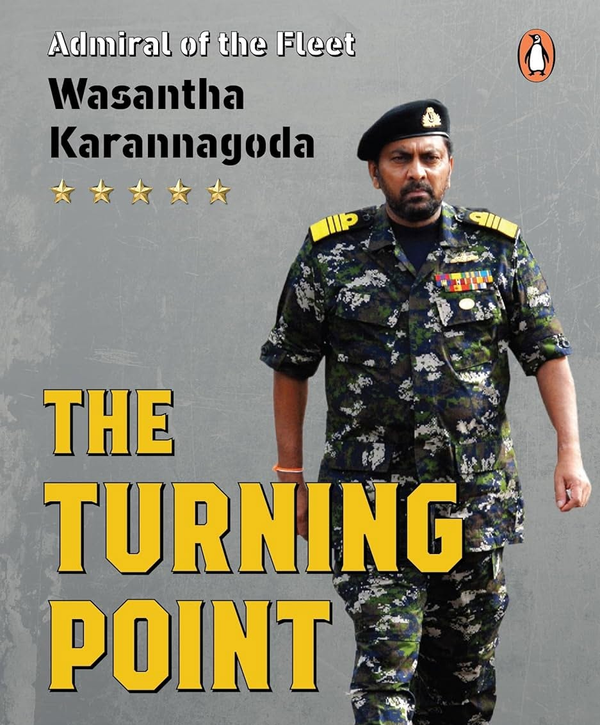
This is the crux of the story, which Admiral Wasantha Karannagoda, who was the naval chief during the crucial war years, has unveiled in his book, The Turning Point: The Naval Role in Sri Lanka’s War on LTTE Terrorism.
The book, published by Penguin India, came out last year. It immediately drew criticism over Karannagoda’s alleged wartime human rights abuses. Penguin India subsequently withdrew its contract with the author, and Amazon UK removed the book from sale after being told that selling it could amount to a criminal offence because Karannagoda had been sanctioned by the UK.
In March 2025, the UK government sanctioned retired Sri Lankan General Shavendra Silva, for enforced disappearances and killing civilians; Karannagoda, implicated in the abduction and torture of 11 Tamils by naval officers in 2008-09; former army chief General Jagath Jayasuriya, also for enforced disappearances and torture; and Vinayagamoorthy Muralitharan alias Karuna, a former senior LTTE commander for recruiting child soldiers and summary executions. The US also sanctioned Karannagoda and Silva.
I can understand the legal complexities involving the sale of Karannagoda’s book in the UK as a result of the sanctions. But I could not fathom why Penguin India axed its contract with Karannagoda, whose book I read only this week, as a result of my interest sparked by his arrest and bail in an alleged case of corruption involving one of the sons of former President Mahinda Rajapaksa.
Indeed, I had a tough time getting hold of The Turning Point. None of the leading bookstores in Delhi appeared to have the book. I requested Penguin India to provide me with a copy upon payment, but there was no response. Finally, I obtained a copy from a Hyderabad bookseller who specialises in used books.
Karannagoda’s fast-paced 341-page book is as much about the Sri Lankan Navy’s role in crushing the LTTE as it is about the Tamil Tigers in their dying years.
Karannagoda tells us about the crucial role played by the Sea Tigers as the insurgency escalated and expanded. He reveals the petty jealousies that at times derailed the military offensive against the Tigers. He admits that a section of senior officers in uniform pocketed money in the name of weapons purchases.
Karannagoda comes up with how the navy began to match the Sea Tigers and eventually overtook its fighting capabilities; how he overhauled the navy, replacing inefficient crew and equipment; and how help from other countries, in particular the US, helped to turn the tide against the LTTE.
“We (the LTTE) lost the war because of the Sri Lanka Navy,” the author quotes Shanmugam Kumaran Tharmalingam alias Kumaran Pathmanathan, the chief arms procurer for the Tigers, as saying after his capture. “When the first three (warehouse) ships were destroyed by the Navy in early 2007, the Sea Tiger leader Soosai told me (KP) over the phone, ‘Anne, we are slowly dying’. The destruction of the remaining four (warehouse) ships in September and October 2007 was the end of the LTTE.” These warehouse ships stored mammoth quantities of arms, ammunition, and explosives, and were often berthed in the sea, away from normal shipping lines, as far away as Australian territory, from where supplies were ferried to the war theatre in Sri Lanka.
Not everything Karannagoda has written is factually correct. Much of this relates to the early years and evolution of Tamil militancy, as well as certain aspects of India. But once you overlook these deficiencies, this is a very important addition to the growing literature on how the LTTE, for long one of the world's most powerful insurgent groups, was militarily crushed.
If Karannagoda did indulge in human rights abuses, particularly against innocent civilians, he must face the law, notwithstanding the role he played in decimating the Tigers. But what has that got to do with this book? The former naval chief’s royalty earnings may have been hit by the decisions taken by Amazon and Penguin India, but I am sure the man is not starving.
Indeed, if the logic against The Turning Point is taken to its logical conclusion, then Hitler’s Mein Kampf (My Struggle) should not be sold or read; after all, there was no greater war criminal than the German. We were able to read Gota’s War: The Crushing of Tamil Tiger Terrorism in Sri Lanka only because he was not designated a war criminal by any Western country. One may like or dislike Prabhakaran and his methods, but there should be no ban on his books, his speeches, and interviews.
The moral of the story is that Sri Lankan generals who wish to write their memoirs, particularly related to the war on the LTTE, should get them published within Sri Lanka.