

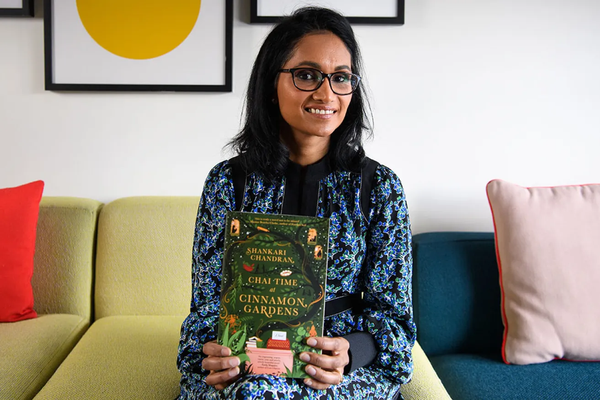
By: Shankari Chandran
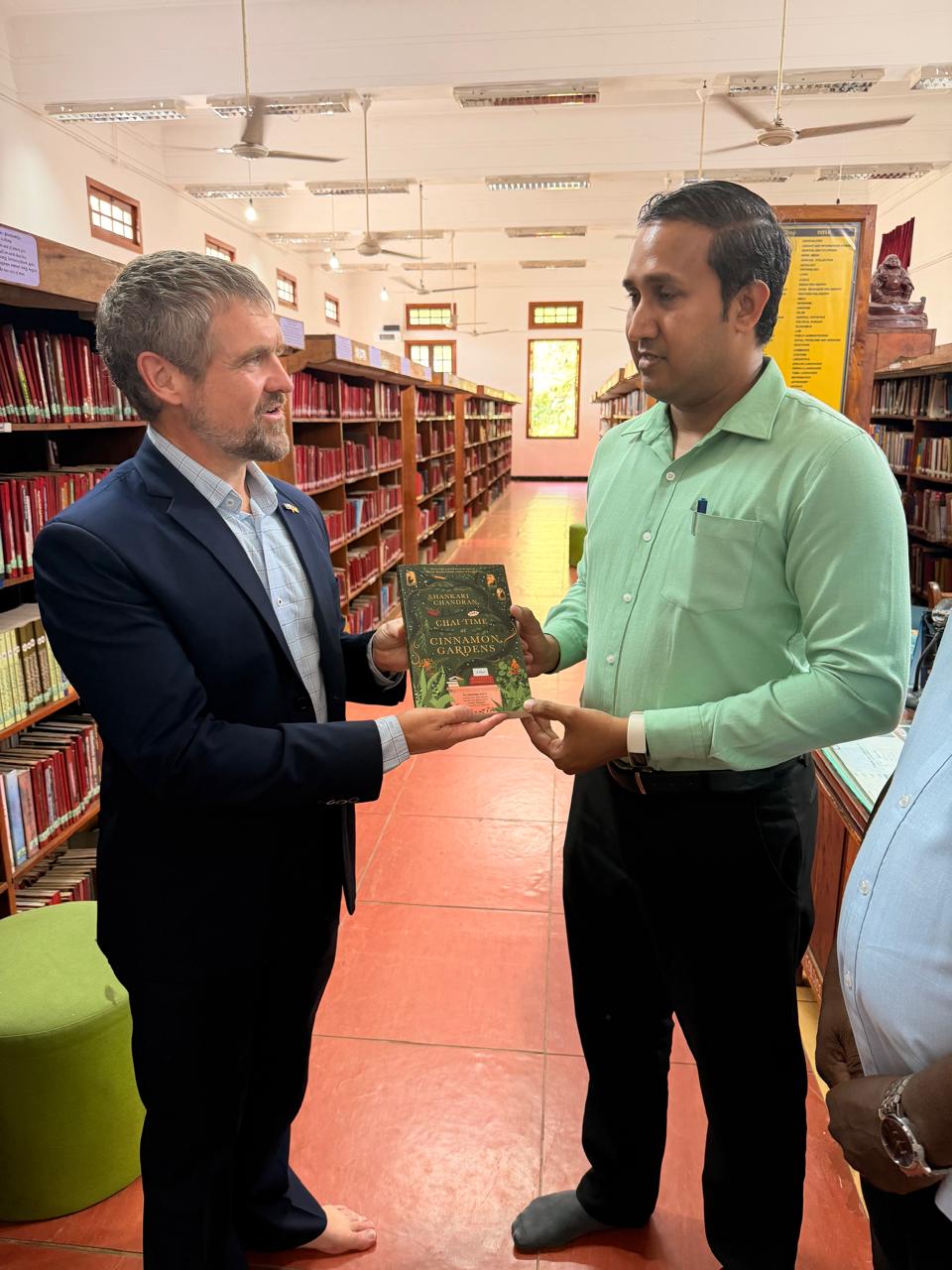
Editor's Note: As Australian High Commissioner Matthew Duckworth presents the complete collection of Shankari Chandran's novels to the Jaffna Public Library today, Jaffna Monitor republishes this essay by the Miles Franklin Award-winning Sri Lankan Tamil author, who reflects on the burning of the library, its enduring place in Tamil memory, and the lasting power of stories against erasure.
My footsteps slow when I pass a library. Any library. I am pulled inwards, to its endless stories and the possibilities they hold.
The public library of a country houses that nation’s stories, even the contested ones. It is a monument to the storytelling we call history. The political history of Sri Lanka is especially contested. Which race arrived on the island first, which warring faction committed the most atrocities, how many people died and how many remain missing. These are the narratives we still fight over. New ones have emerged — how corrupt was the previous regime, how many billions did they steal, how much do we owe China and how many children will go hungry as a result of it.
Libraries hold stories, but for me, one library also began a story. My novel, Chai Time at Cinnamon Gardens, was inspired by the burning of the Jaffna Public Library. It uses this act of cultural erasure to explore racism in my ancestral homeland, Sri Lanka, and my chosen homeland, Australia.
The Jaffna Public Library sits in Jaffna (Yalpanam), the ancestral capital of the Tamil people of Sri Lanka. It was constructed between 1953 and 1959, and its domed ceilings and gleaming white stucco walls stood proudly over the city, more like a palace than a library. It stored one of the largest archives of Tamil culture in the world — at its height, the collection contained 100,000 books, ancient manuscripts and historical records about Tamil civilisation in Sri Lanka.
It is — or was — a place of almost mythical cultural significance to the Tamil people.
In 1981, the Jaffna Public Library was burned to the ground by mobs and police. Two thousand years of Tamil culture, history and language were destroyed. Some texts were the only copies in existence and have been lost forever.
The Jaffna Public Library told a story about the place of the Tamil people in Sri Lanka. The political authorities of that time wanted to suppress this narrative; burning the archive was a quick and conclusive way to do it. For many Tamils, this biblioclasm was the culmination of decades of laws that disempowered the Tamil people. And it foreshadowed the civil war that was to come, two years later.
That war led to the forced migration of Tamil people to many parts of the world, and for my family, to Australia. It also led to the internal displacement of hundreds of thousands of Tamil people.
I was born and raised in the Tamil diaspora. For decades, my parents were afraid to return to Sri Lanka because of my father’s political activism. We moved to London and then Australia (where I was raised) in 1977, a few years after the end of the White Australia Policy.
I call Australia my chosen home because I have left many times and I always long to return. I am deeply happy and connected to both people and place here. From the strength and safety of Australia, I use fiction to interrogate the injustices that drove my family from one home and challenged them to create another.
Fiction allows me to assert myself in the present, and to understand how that present has been shaped by the past. At a recent literary panel, someone asked me if I felt my fiction was constrained by my ethnicity and our history. This was my answer: I stride into the future with stories, and it is vital to me that I take my history with me. I am uplifted, not burdened, by it. (At the same panel, a reader told me that my latest novel’s assertion of racism in Australia was deeply offensive. I smiled politely and said I find racism deeply offensive and destructive. I wanted to add — but didn’t — ‘Your local library will have a copy of White Fragility’.)
When the Jaffna Public Library was burned, I became bereft of a history, an archive of the past that helped anchor my place in the present. It is a moment in time that I have memorialised in all my writing.
As a writer and storyteller, all my work returns to the burning of books and stories. I cannot let go of the burning of books, the burning of the bodies and the burning of truth that followed.
Through fictional stories about Sri Lanka, I have tried to record our path to war and the terrible mistakes made by both sides. Through fiction, I’ve tried to understand how so many were killed and why there will not be justice for the living or the dead.
On my last trip to Sri Lanka in January 2019, I returned with three generations of our family. My parents took their children and grandchildren to our ancestral villages; to all the places they had loved and left behind. We saw how much had been erased by war; how much of our history had been erased by the post-war ‘rebuilding’ of the north.
We took our children to the new Jaffna Public Library, built on the ruins of the old one. It is still a stately building, its architecture an homage to the original design, but its archive will never be the same. We assembled the Chandran grandchildren in front of the library and took a photograph of them with their grandparents, recounting some of the stories that had been destroyed. We whispered the words, because although we were in the Tamil heartland, history had taught us to be afraid. We choked on the words because we felt the grief rise up through our bodies and threaten to overwhelm us. Finally, we pressed and we kissed the words into our children because the stories of their ancestors will help them write their own.
Standing outside the new Jaffna Public Library, on the hard, red earth of our ancestral homeland, I felt completely at home, while completely dispossessed of home.
Since that visit, the Library has added my novels to its collection. It is a small contribution to the librarians' ongoing work of rebuilding the cultural record of the Sri Lankan Tamil community, and one of the greatest honours of my life. I am deeply grateful for it. And I feel the yearning I always feel to begin a new story.