By Jeevan Thiagarajah
Seventeen years after Sri Lanka's civil war ended, the country has run one of the world's more closely studied reintegration experiments — and left another almost entirely undone. On one side, 12,196 former LTTE combatants passed through a state-run rehabilitation programme that concluded in 2021. On the other, hundreds of thousands of state security personnel — soldiers, sailors, airmen, and police who fought the same war — returned home to no equivalent programme at all. Both groups carry the same underlying burden: unresolved trauma, eroding health, economic precarity. Neither is tracked over time. That gap, not any shortage of goodwill or expertise, is the real policy failure.
The Case for Both Sides
But why the state owes each group ongoing monitoring is not the same question, and the answer shouldn't be flattened into "both suffered." State personnel who served twenty-plus-year careers receive a pension — compensation for service, not treatment for what that service did to them. Financial assurance and welfare are different goods, and Sri Lanka has supplied only the first. There is a fiscal logic here, too: untracked veteran decline surfaces later as suicide, family breakdown, and disability claims the state pays for anyway, just without the chance to intervene early.
Former LTTE combatants have neither a pension nor an institutional safety net of any kind, so their exposure to the same health-and-livelihood spiral is structurally worse. Their claim on the state rests on something else: responsibility for the conditions of a peace it declared complete. The Bureau of Rehabilitation formally closed its programme in 2021, transferring risk from a managed institutional setting onto individuals with nothing left to catch them. There is also a security argument unique to this group — an untracked, stigmatised population concentrated in the districts that supplied the most recruits is a recognised risk factor for the instability the war grew out of in the first place. Monitoring here is risk management, not generosity.
Neither argument needs to borrow the other's language. Both, independently, arrive at the same missing piece: nobody tracks either population after the point of exit.
What the Families Carry
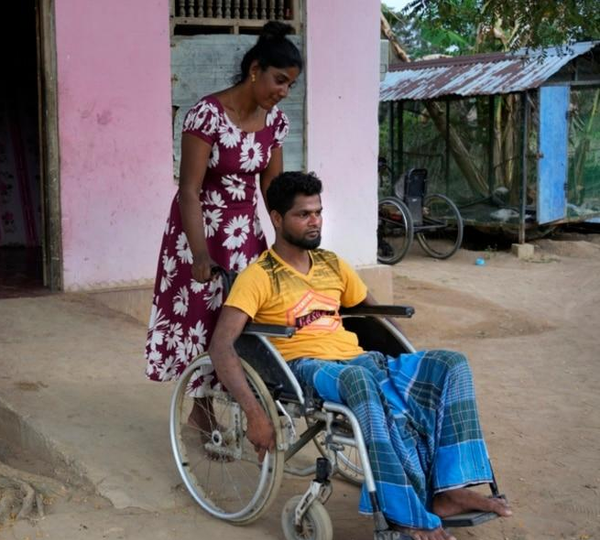
Nor should tracking stop at the combatant. Every soldier and every former cadre returned, or failed to return, to a household, and the war's costs did not stop at the individual. A 2018 proposal from the Centre for Humanitarian Affairs, built around the Ranaviru Authority's divisional network, already names roughly 30,900 kith-and-kin families alongside 13,000 disabled veterans as a population needing support — spouses who managed decades of deployment and absence, children raised around a parent's untreated trauma, families now providing full-time care for a disabled veteran. None of this is monitored yet, either; the proposal names the population without yet building the instrument for it. On the rehabilitation side, there is no equivalent proposal at all. Families of former combatants absorbed stigma, economic exclusion, and in some documented cases, the consequences of a livelihood grant spent on a motorbike instead of working capital — with no household-level support structure, only an individual one aimed at the ex-combatant. A caregiver managing a disabled veteran, or a widow raising children on a failed grant, is not a footnote to the primary case. They are a second case, any serious platform has to be built to see.
What the Evidence Actually Shows
Sri Lanka's own record makes the cost of not tracking hard to ignore. Major General (Retired) Dharshana Hettiarachchi, who oversaw the LTTE rehabilitation programme, points to seventeen years without a single rehabilitee returning to militancy as its clearest vindication. That claim deserves scrutiny rather than repetition: there has been no systematic tracking of rehabilitees since 2015. A zero-recidivism figure over a population nobody has checked on for a decade is not a verified outcome — it is an absence of bad news reaching the centre, which is not the same thing. Dr. Dayani Panagoda, former Director of Policy at the Secretariat for Coordinating the Peace Process, estimates the reintegration effort was roughly 70 percent effective, and locates the missing 30 percent precisely in what happened after graduation: women released early facing community stigma, some with no support structure to catch them; livelihood grants spent on the wrong things, generating friction with host communities instead of easing it.
The scale of unaddressed trauma in the north is not in dispute. A 2025 mixed-methods study of 336 war-affected residents across five northern districts — published in SSM-Mental Health by Thamotharampillai and colleagues — found depression in 57 percent of respondents, anxiety in 61 percent, PTSD in 47 percent, and functional disability in 36 percent, concentrated in Kilinochchi, Mullaithivu and Jaffna, the same districts that supplied the largest numbers of LTTE recruits. That overlap is a reasonable proxy for the scale of the problem in affected communities, though it is not direct outcome data on the 12,196 rehabilitated individuals specifically — which is exactly what real tracking, rather than a proxy study, would tell us. Community-level indicators were stark regardless: 86 percent of communities reported illicit drug use as a problem, 84 percent alcohol abuse, and the "linking" social capital connecting ordinary people to the institutions meant to serve them scored poorly everywhere.
On the security-forces side, the fragments that exist are more concrete but far from complete. The Centre for Humanitarian Affairs proposal envisions training 1,000 community "befrienders" to serve roughly 104,000 people — the disabled veterans and their immediate families — at a ratio of about 175 beneficiaries per befriender, anchored by 250 drop-in centres and a crisis hotline. It is a sound model, but it is costed, conceptually, for 104,000 people, not for the full population this argument describes, which runs into the hundreds of thousands once all serving and retired personnel are included. Scaling a befriender ratio designed for one population to one several times larger is a different undertaking, and nobody should call that "modest incremental cost" without the arithmetic to back it up. The honest path is to pilot on the disabled-veteran-and-family cohort first, and cost each expansion phase on its own terms.
How the Platform Would Work
None of this requires new institutions. The Bureau of Rehabilitation, the Ranaviru Authority, the Ministry of Health's base-hospital network already exist and already touch these populations. What is missing is the connective infrastructure between them: a shared data spine, a standard assessment instrument used identically on both tracks and extended to families, annual head-to-toe checks — physical and psychological — for as long as an individual needs them, and a socioeconomic vulnerability check run on the same cycle, so that a failed livelihood grant or a household sliding into debt gets caught before it becomes the next crisis. The British Army's Trauma Risk Management model offers a proven, low-cost template: peer-delivered, unit-embedded risk identification that lets most people recover within the normal four-to-six-week window, and flags the minority who don't for a proper clinical follow-up, without routing every case through a psychiatrist first.
In practice this could run as a mobile-first platform, not a paper file. A member or dependent logs an annual head-to-toe check on their phone — vitals, chronic conditions, standard PHQ-9 and GAD-7 wellbeing screens, a functional assessment covering everything from a child's developmental milestones to an elderly dependent's mobility. A traumatic incident, logged instead by a peer TRiM practitioner in the field, triggers the same system reactively. Either way, the data lands with a backend triage engine, not a filing cabinet, which sorts every case into one of three plain statuses: green, cleared until the next annual check; amber, recovering but held in closer, community-level monitoring for a few months; or red, routed straight into clinical care. Anything that looks like an acute emergency — a dangerous blood-pressure reading, signs of severe psychological distress — goes red immediately, bypassing the ordinary process entirely: an automatic alert goes to the individual and to the nearest Ministry of Health base hospital, and the case is pushed straight into the hospital's clinical queue. Everything else enters the normal four-to-six-week TRiM recovery window, after which a peer practitioner checks back in and scores the standard risk factors — amber if recovery is on track, red if it has stalled. Crucially, the peer practitioner doing that check-in never needs to open the person's full medical file to log it; access is split by role, so a neighbour trained as a TRiM practitioner can flag a case without becoming privy to someone's entire clinical history. That distinction is what makes the surveillance fear and the neglect fear answerable at the same time — the system sees enough to act, and no more than that, and the people doing the seeing are drawn from the same community being watched. A basic feature phone and an SMS gateway are enough to reach someone in a low-connectivity district; a low-bandwidth backend built to sync with the Ministry of Health's existing hospital records system means a base-hospital doctor already has the file by the time a flagged patient walks in the door. None of the pieces here are exotic — the innovation is simply that, for the first time, someone would be watching continuously, on both sides of this war, instead of only at the moment someone happens to ask.
Stabilising Livelihoods, Not Just Watching Them
Monitoring only answers half the problem. A platform that flags a household sliding into debt is worthless if nothing structured happens next, and the rehabilitee side of this story already shows what "nothing structured" looks like: Dr. Panagoda's account of livelihood grants spent on motorbikes rather than working capital is not really a story about individual bad judgment. It is a story about a one-time cash transfer handed over with no scaffolding around it, and no one checking back. A smarter version of the same money would move away from individual, one-off grants toward small cooperative structures — former combatants and family members pooled into shared agricultural, fisheries or craft ventures in the districts where those livelihoods already exist, paired with a mentor drawn from the same befriender network proposed for health monitoring, and with disbursement staged against a simple business plan reviewed on the same annual cycle as the health check, rather than paid out once and forgotten. Vocational certification should work the same way: an NVQ issued in 2013 needs periodic refreshing against real local labour demand, not permanent status as a credential frozen in time.
The security-forces side already has one idea worth borrowing wholesale: a proposed disaster-relief volunteer registry that turns economically stable, physically fit retirees into a standing civic resource instead of a closed file. There is no reason that registry should stop at veterans. A former combatant flagged by the platform as stable and capable is exactly the kind of person a district-level civic or disaster-response corps should be recruiting — a livelihood measure that also hands someone a paid, dignified public role, rather than a grant that simply runs out. And when the vulnerability check itself catches a household in genuine distress — debt, a lost primary earner, a failed harvest — the response built into the platform should be an automatic route into a small stabilisation fund or bridging micro-loan, not a note that sits in a file until next year's review.
The Politics of One System
There is a political risk worth naming honestly. Publicly tracking former LTTE combatants and state soldiers under one visible programme will, to some audiences, read as moral equivalence between the two, and that reaction alone could stall the idea regardless of its merits. The answer is not to abandon a shared architecture — building one data spine instead of two remains the efficient choice — but to keep the two tracks visibly and administratively distinct: separate governance, separate communications, each accountable to the population it serves, sharing nothing with the public except a well-engineered back office.
Governance itself need not be elaborate: a joint steering arrangement across the Bureau of Rehabilitation, the Ranaviru Authority, the Ministry of Health, with independent oversight from a body such as the Centre for Humanitarian Affairs to offset a trust deficit both populations report toward the state, publishing aggregate, non-identifying findings every year. That transparency matters on its own terms: the same 2025 study found communities in the north reporting fear of state surveillance and communities in the east reporting outright neglect. A platform that is honest about what it measures, who sees it, and what triggers a referral — and that structurally limits who can see a full file, rather than promising restraint after the fact — is more likely to be trusted, and therefore actually used, than one that repeats the state's closed, security-first posture.
Sri Lanka does not lack psychiatrists, hospitals, or administrative structure. It lacks the connective tissue that would let a single person's health and economic situation be tracked from the day they leave a rehabilitation centre or a barracks to the day, years or decades later, when they might need help again — and it lacks any mechanism at all for tracking the households that waited for them. Building that infrastructure, grounded in two distinct arguments and extended to families on both sides, is a modest ask against the scale of what this country's war actually cost.