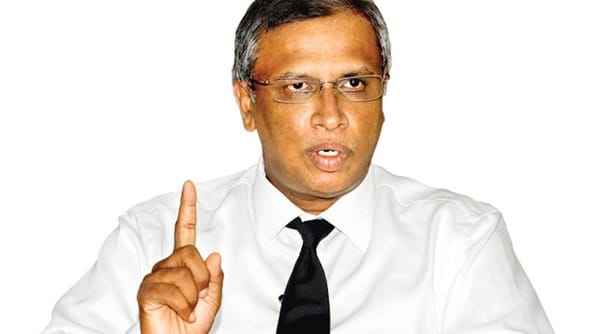
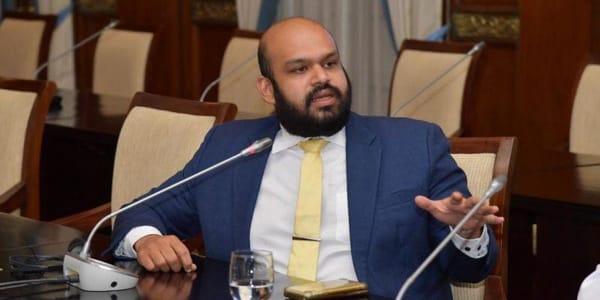
After Jaffna Monitor published its editorial on Sunday questioning Batticaloa District MP Shanakiyan Rasamanickam’s decision to invoke Sri Lanka’s Online Safety Act against dozens of Tamil critics, media figures, and political actors, the lawmaker telephoned this office to present his version of events.
Speaking at length, Mr. Shanakiyan defended his decision to seek relief through the courts and described what he said was a prolonged, coordinated campaign of personal defamation directed not only at him but also at members of his family.
The exchange was cordial. Mr. Shanakiyan did not request or demand publication of his response, nor did he issue any legal threats in relation to the editorial.
Jaffna Monitor is publishing his response in detail in the interest of fairness and the public record.
Three Points of Dispute
Mr. Shanakiyan said the editorial contained three factual errors.
The first concerned the postponement of the initial court hearing. The editorial had stated that the hearing was deferred because he was out of the country and did not appear, causing inconvenience to nearly 50 respondents who had travelled from the North and East to Colombo.
Mr. Shanakiyan rejected that account. He said he had authorized legal representation to appear on his behalf and that the adjournment arose only after lawyers for some of the respondents attempted to raise a jurisdictional objection orally.
According to him, the presiding judge directed that such objections should be made by written submission. The case was then fixed for March 25.
“I had no malicious intention,” he told Jaffna Monitor. “I had no intention of causing hardship or inconveniencing anyone.”
The second dispute concerned why the complaint had been filed in Colombo rather than in the North or East.
Mr. Shanakiyan said that the principal respondent in his case was IBC Tamil, which he identified as the main source of the allegedly defamatory material. Because IBC Tamil's registered office is in Colombo 12, he said, the complaint had to be filed there.
"If you ask me why I did not file in Jaffna or Batticaloa, it is simple," he said. "Those courts do not have jurisdiction. The main complaint is against IBC."
Jaffna Monitor has not obtained independent legal advice on the jurisdictional question. While the inclusion of IBC Tamil as the principal respondent provides a basis for filing the complaint in Colombo, it remains unclear on what legal basis all other respondents — particularly those whose alleged conduct may not be directly linked to IBC or to a single chain of dissemination — were brought within the same proceeding, rather than being addressed in their respective jurisdictions. The publication, therefore, presents Mr. Shanakiyan’s account of the jurisdictional requirement as stated.
Shanakiyan also offered an explanation for why summonses had been issued in Sinhala. According to Mr. Shanakiyan, court proceedings in Colombo are conducted in Sinhala, while proceedings in the Northern and Eastern Provinces are generally conducted in Tamil. If the case had been filed in a Tamil-speaking jurisdiction, he said, summonses to Sinhala-speaking respondents would likewise have been issued in Tamil.
“That is the rule of the country,” he said.
Under Sri Lankan law, Sinhala and Tamil are both official languages, and litigants are entitled to use either language in court proceedings. In practice, however, courts generally operate in the dominant administrative language of their jurisdiction — Sinhala in Colombo and Tamil in much of the North and East — with interpretation or translation provided where necessary.
The third dispute related to the editorial’s characterization of his earlier parliamentary speech opposing the Online Safety Act.
Mr. Shanakiyan said the editorial had misrepresented his position by suggesting that he had opposed the Act in its entirety and was now contradicting himself by using it.
He said his objection in Parliament had been directed specifically at the Online Safety Commission contemplated under the law, not at judicial oversight.
“We were objecting to the Online Safety Commission,” he said. “We always asked to give power to the judiciary, not to the commission.”
He said that under the Act, the commission — appointed by the Minister of Public Security — would consist of five members empowered to determine what online content is prohibited and what may be published.
“We are fundamentally against that,” he said. “But giving power to the judiciary is acceptable.”
“In the Online Safety Act, there are two parts,” he said. “One is the commission, appointed by the public security minister. Those five people are empowered to decide what information can be posted and what is problematic. We are fundamentally against it. But strengthening the judiciary or giving power to the judiciary is okay. We opposed the Online Safety Commission, not the Online Safety Act as a whole.”
“This Is About Personal Defamation”
Mr. Shanakiyan said the case was not an attempt to suppress political criticism but a response to what he described as systematic personal defamation.
He said false claims had circulated widely on social media alleging, among other things, that he had received 400 million rupees from former President Ranil Wickremesinghe.
“Even my friends call me and joke, ‘Machan, give me a portion from the 400 million you got from Ranil,’” he said. “But when such things are repeated again and again, people begin to believe them.”
He said the effect was political as well as personal.
“You need to understand that many voters are not like the readers of Jaffna Monitor,” he said. “A large number decide based on what they hear and see, especially on social media. Because of the mudslinging, even some of my own supporters begin to doubt me.”
He said that filing civil defamation cases individually against dozens of people would be prohibitively expensive and time-consuming.
“One civil defamation case costs around 500,000 rupees,” he said. “If I file against 50 people individually, it would cost roughly 25 million rupees just to begin.”
“You Have Seen Only a Fraction of the Material”
Mr. Shanakiyan also challenged the suggestion that the case rested solely on a handful of screenshots or isolated social media posts.
“You may have seen only a few pages of screenshots,” he said. “My complaint runs to 6,000 pages. I have given CDs and different materials to the court. I do not know what all you have seen.”
He insisted that the court would not have issued conditional orders based on a single shared post.
“A judge will not give a conditional order based simply on somebody sharing a post,” he said. “There is much more to it.”
He said the material submitted to the court included content circulated in WhatsApp groups, voice messages, and other communications that, he argued, revealed a larger pattern of conduct.
“There are even WhatsApp voice messages about my family and me that I do not want to share,” he said. “All the evidence is before the court.”
He added that he had spent nearly two weeks in court explaining the material.
“It is not as though a court in Sri Lanka gives a conditional order just like that,” he said.
Family, Grief, and the Limits of Politics
At several points in the conversation, Mr. Shanakiyan’s tone shifted noticeably, becoming emotional as he spoke about the effect of the attacks on his family.
He said false narratives had been circulated about his mother. “My mother is Tamil, and there is a debate about her ethnicity every day,” Mr. Shanakiyan told Jaffna Monitor, adding that there had been a systematic campaign falsely portraying her as Sinhalese and himself as of mixed Sinhala-Tamil background.
These claims, which Jaffna Monitor has independently seen, include material that is vile and deeply personal.
He said the attacks had also extended to his 76-year-old aunt, the daughter of the late Tamil political figure Rasamanickam, whom he described as unmarried and a former law college classmate of the late minister M. H. M. Ashraff. According to him, social media posts had circulated alleging an improper relationship between them — claims that Jaffna Monitor has independently reviewed and found deeply inappropriate.
“These are systematic attacks targeting the women in my family,” he said. “Just because I chose politics, should my mother or my aunt have to endure such vile personal attacks?”
He also referred to a photograph taken when he served as best man at a friend’s wedding, which, he said, had later been misrepresented online as proof that he had married a Sinhala woman said falsely to be the daughter of former minister Sarath Amunugama.
“My friends called me and asked me to do something because it was embarrassing even for the groom,” he said.
He said that he had purchased land privately, only to face what he described as propaganda claiming that he had stolen state land.
“I have been patient for 13 years,” he said. “But everything has a limit.”
“I just lost my father in November,” he said. “My mother is still grieving. Why should she go through all this trauma just because her son took a political path?”
“There should be a limit to everything,” he said. “That is why I took this action.”
Wider Campaign
He said the problem, in his view, was not a single post or isolated criticism, but a broader ecosystem of misinformation repeated across media platforms, WhatsApp groups, and internal political networks.
A source close to Mr. Shanakiyan said the targeting extended beyond him to those associated with him, describing what he called a deliberate strategy of applying pressure through personal attacks.
“Individuals in his inner circle — including members of their families — have been subjected to vile and deeply personal attacks,” the source said, adding that in some cases this had led to serious strain within families, even resulting in separations.
According to the source, such campaigns were intended to discourage support for Mr. Shanakiyan by targeting family members, particularly women, with false and degrading claims.
“The idea is to break people down personally so they distance themselves from him,” the source said, adding that the broader aim was to isolate him politically.
Another source close to Mr. Shanakiyan, speaking separately to Jaffna Monitor, said the lawmaker had long been under pressure from supporters to respond more forcefully to such attacks.
The source said Mr. Shanakiyan’s allies often point to the political trajectory of M. A. Sumanthiran, who, in their view, absorbed years of misinformation and mudslinging without adequately confronting it.
“They tell him, ‘Look at what happened to Sumanthiran — a deeply committed politician who never made money from politics, who sacrificed a successful legal career and, in the process, lost significant income — yet still suffered electoral setbacks, in part because of sustained and systematic mudslinging,’” the source said. “Shanakiyan is not prepared to take that path.”
The source also alleged that rival factions within ITAK, particularly networks aligned with Mr. Shanakiyan’s internal party rivals, had built what was described as a sustained social media machinery aimed at discrediting both Mr. Shanakiyan and Mr. Sumanthiran through posts, private messages, letters, and WhatsApp lobbying.
Not Only Public Critics
Mr. Shanakiyan also pushed back against the suggestion that the case was aimed broadly at his rivals’ supporters within ITAK.
He said it was incorrect to assume that every person named in the complaint had acted publicly or that all relevant conduct occurred on open platforms.
“Not everyone I filed the case against publicly worked against me on a public platform,” he said. “A few of them called my supporters and spoke ugly about me in ways that are not on the public record.”
On Kireshkumar
Addressing criticism over the inclusion of Kireshkumar, the brother of the late LTTE political commissar Kausalyan, Mr. Shanakiyan offered a more personal and political explanation.
He said Kireshkumar had been a paid employee of his at some point and later sought his support in forming a local council. Mr. Shanakiyan said he refused because he considered him corrupt.
He said Kireshkumar then aligned with the TMVP and formed the council.
Mr. Shanakiyan described the development as politically and morally ironic, given longstanding allegations that the TMVP was involved in Kausalyan’s killing.
He added that Kireshkumar does not operate his own social media accounts, and that whoever operates them should bear responsibility for the material published there.
“I Gave Some of Them an Option”
Mr. Shanakiyan said that, before proceeding against some respondents, he had indicated a possible way out.
“I gave a few of the ones I complained against options,” he said. “Come to court and accept that you shared false information about me. Agree to that on record. I will pay your lawyer’s fees. Do not repeat it.”
He said some of those now portraying themselves as mere sharers of posts were, in his account, involved in a much larger campaign of private and public mudslinging.
“The larger picture is that the majority of them were mudslinging against me in personal WhatsApp groups,” he said. “You do not have access to all of that.”
A Debate That Continues
Mr. Shanakiyan’s response does not resolve the broader question raised in Jaffna Monitor’s original editorial: whether a law long criticised by civil liberties advocates for its sweeping implications should be used in intensely contested political disputes, particularly within Tamil political society.
The Online Safety Act has drawn sustained criticism from both international and local human rights organisations since its enactment. Amnesty International described the law as “a major blow to human rights in Sri Lanka,” citing broadly defined offences and the powers granted to a government-appointed Online Safety Commission. The Office of the United Nations High Commissioner for Human Rights has warned that the law could have a chilling effect on freedom of expression. The International Commission of Jurists has called for the Act to be repealed or substantially revised to bring it into line with Sri Lanka’s international human rights obligations.
These concerns form part of a broader debate over how the law may be applied in practice — particularly in politically sensitive contexts — even as Mr. Shanakiyan’s case relies on its judicial provisions.
Jaffna Monitor publishes this account so that readers may assess the matter with the benefit of both the original editorial and the Member of Parliament’s detailed response. The publication remains open to carrying further responses, provided they meet its editorial standards, including a commitment to reasoned argument and the avoidance of personal attacks.